 kingpdc




product search
search
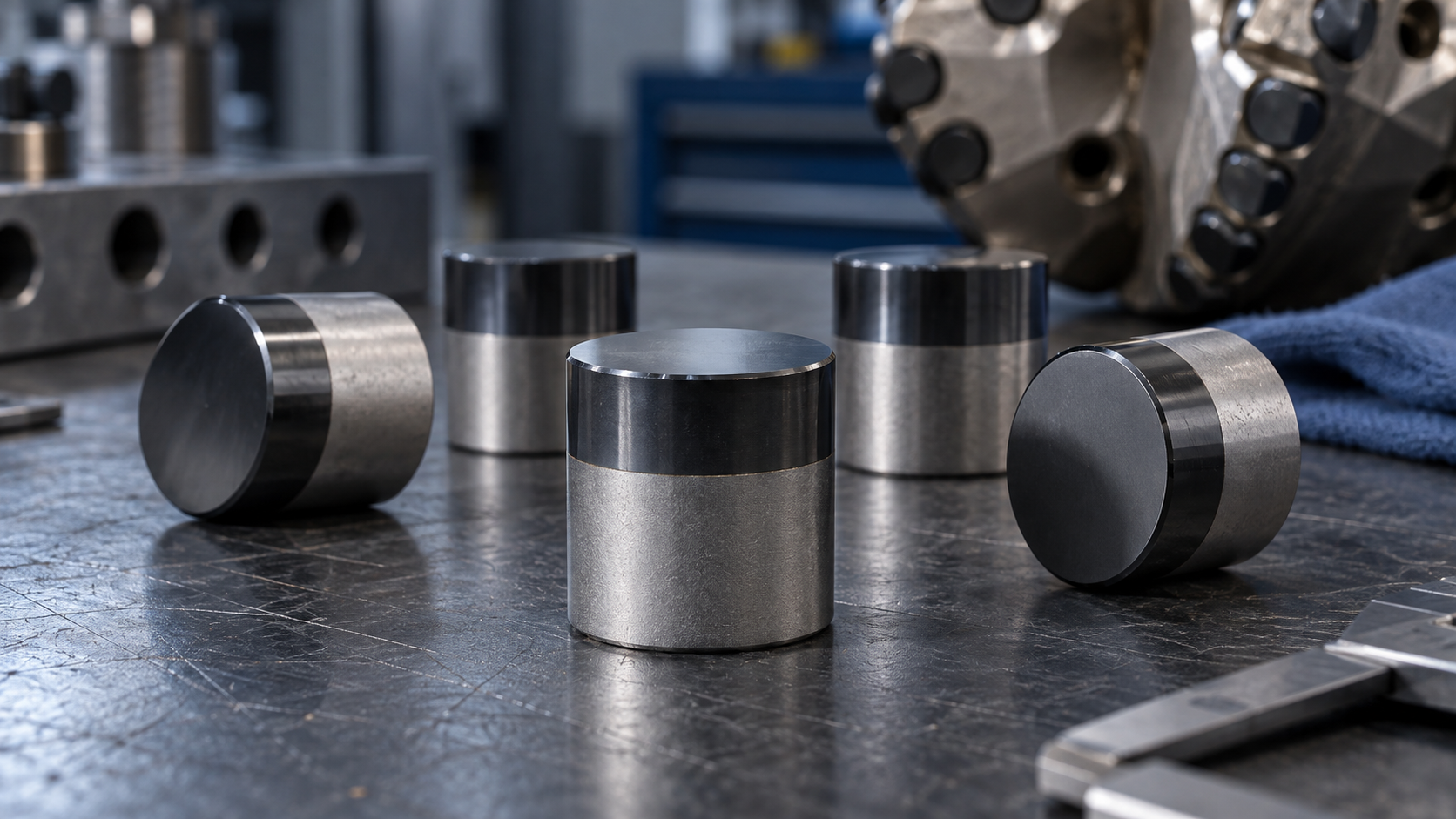
Treating the hardness of the PCD layer as a direct measure of an entire PDC cutter is a common mistake in material selection. The diamond working layer, cemented carbide substrate, and bonding interface share the same load path. Cutting-edge geometry, temperature, and drilling conditions also shape the final result.
PCD is a polycrystalline diamond material formed by bonding many diamond grains together. PDC normally refers to the composite created by joining a polycrystalline diamond working layer to a cemented carbide substrate. PCD describes the material itself, while PDC describes a finished composite component. A PDC cutter mounted on a drill bit must also be considered in relation to its working face, matrix, interface, and position on the bit.
The diamond layer mainly contributes hardness, wear resistance, cutting-edge retention, and thermal conductivity. The carbide substrate provides structural support, impact resistance, and a foundation for brazing or press fitting. The interface transfers tangential, normal, lateral, and thermal loads. A parameter measured on one layer cannot replace an evaluation of the complete composite.
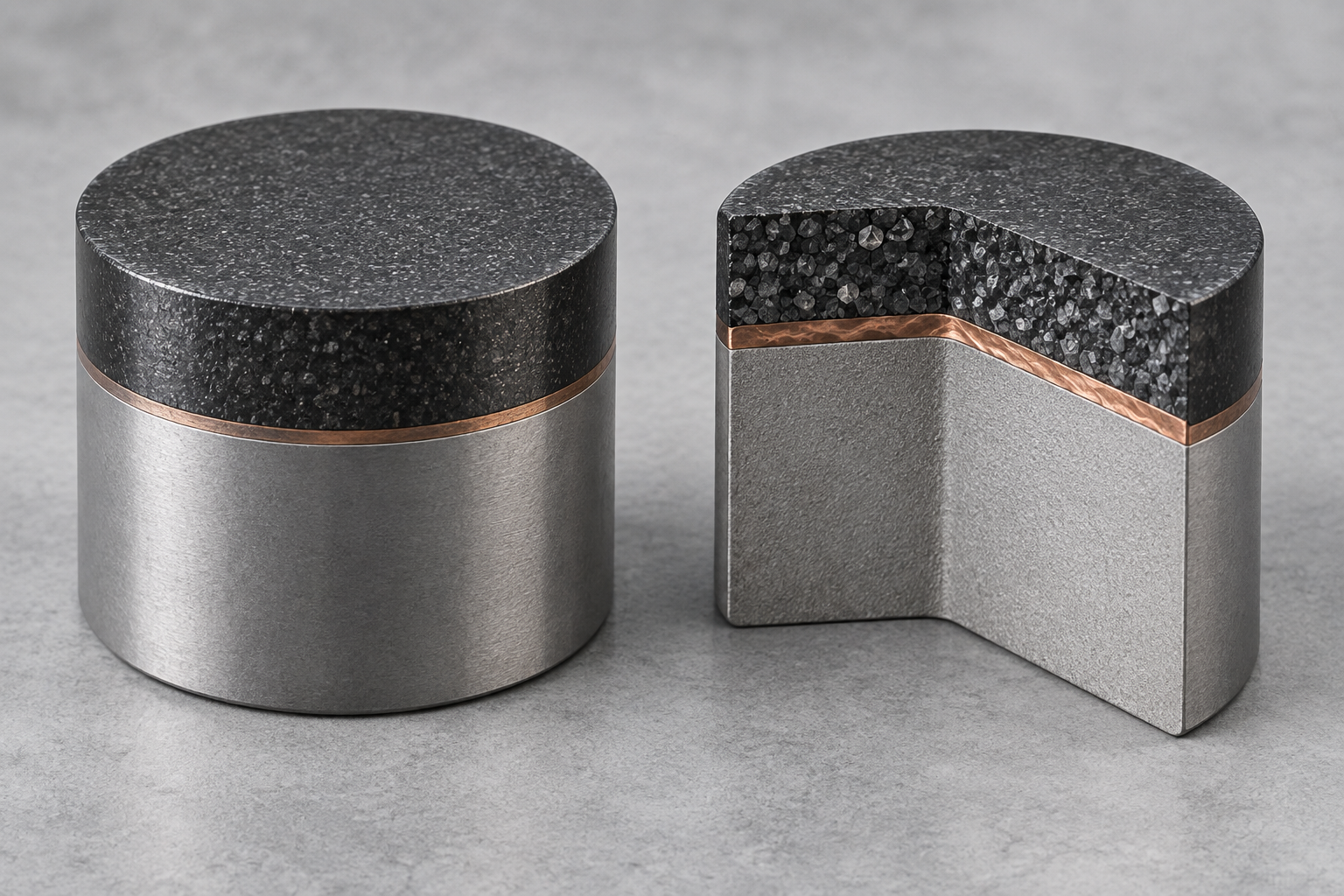
The polycrystalline diamond layer is made from micron-sized or finer diamond grains. Diamond-to-diamond bonding creates a continuous skeleton through the layer. The grains do not share one crystallographic orientation, which reduces the tendency for a crack to travel through the material along a single cleavage plane.
Random grain orientation does not mean that the material cannot crack, nor does it mean that every polycrystalline diamond body is perfectly isotropic. Pores, metal phase, and residual stress all affect performance. The thickness of the diamond layer, substrate stiffness, interface geometry, and cutting edge also change the load state of a PDC cutter.
For that reason, polycrystalline diamond properties should not be reduced to a single number that is simply “higher is better.” Hardness, wear resistance, fracture toughness, and impact resistance describe different trade-offs. A highly wear-resistant grade may chip under severe impact, while a tougher grade may dull sooner in an abrasive formation. Impact performance is also affected by edge geometry, residual stress, support stiffness, defects, and loading rate.
Diamond grain size affects particle packing, cobalt penetration paths, grain bonding, edge sharpness, and crack propagation. A fine-grain formulation can produce a dense, fine cutting edge. In some systems, a coarse-grain formulation can offer better fracture toughness or impact resistance. Bimodal and multimodal distributions can further adjust packing density, diamond continuity, and the channels occupied by the metal phase.
The same average grain size does not mean that two powders will produce the same material. Particle-size distribution, particle shape, metal content, and sintering quality may still differ. A grade should be assessed together with the diamond formulation, substrate formulation, interface, synthesis process, and post-processing. The grain-size label describes only one part of the material.
In a common cobalt-bonded tungsten carbide route, cobalt acts as a solvent-catalyst during diamond sintering, and some cobalt remains in the spaces between diamond grains. Residual cobalt can help with crack blunting and load transfer, but it can also limit high-temperature stability. At elevated temperature, cobalt may promote the conversion of diamond toward a graphite structure, reducing hardness and wear resistance.
Cobalt removal can reduce the metal phase in the working area and improve thermal stability there. However, the extent and depth of cobalt removal also affect porosity, strength, heat transfer, crack paths, and impact resistance. Cobalt-containing PCD, cobalt-depleted PDC, and TSP should not be compared by name alone. Remaining metal content and supporting structure matter just as much.
Thermal conductivity describes how readily heat moves through a material. Thermal stability describes how well the material retains its structure and performance at a stated temperature, atmosphere, duration, and load. These are not the same property. The thermal behavior of a PDC cutter is also affected by residual metal, cemented carbide, interface, braze alloy, frictional heating, cooling, and chip removal.
Around 700°C and above is sometimes used to describe a range in which conventional cobalt-containing PDC may face a clear risk of thermal degradation. It is not a universal operating limit for every material. In a specific single-cutter granite test, the wear rate rose sharply after the average wear-flat temperature exceeded about 350°C. That result belongs to a particular specimen and test method; it should not be separated from those conditions.
The same caution applies to thermal conductivity. Sintered PCD, high-purity CVD polycrystalline diamond, and a complete PDC cutter are different test objects. Their material routes, metal phases, and structural levels differ, so their values should not be placed side by side without checking the test definition.
The working layer of a PDC cutter is not a free-standing diamond plate carrying every load by itself. The substrate absorbs part of the impact and provides the base for connecting the cutter to the tool body. The interface transfers mechanical and thermal loads from the working layer into the substrate. Diamond-layer thickness, substrate stiffness, interface shape, chamfer, and residual stress work together to define this load path.
A non-planar interface does not automatically deliver higher performance. Its geometry must be judged together with the material formulation, layer thickness, and applied load. If substrate support is insufficient, the working layer may crack, break away, or detach as a whole. Increasing the hardness of the diamond layer alone cannot explain the reliability of the composite.
The PCD diamond layer, complete PDC, cobalt-depleted PDC, high-purity CVD polycrystalline diamond, binderless polycrystalline diamond, single-crystal diamond, and WC-Co are different material objects. Their structures, bonding phases, specimen forms, and test boundaries differ. They cannot share one universal “polycrystalline diamond performance value.”
Public Vickers-hardness examples for conventional metal-bonded sintered PCD are often reported at roughly 50–90 GPa. Special binderless or ultrahigh-pressure polycrystalline diamond materials may exceed 100 GPa. The reported value depends on the indenter, load, surface preparation, grain size, metal content, and measurement location. It should not be rewritten as a guaranteed value for a specific FIDE grade.
Hardness, fracture toughness, wear, impact, and thermal-stability tests answer different questions. When data from different products or sources are compared, the material state, test method, temperature, direction, specimen, formulation, geometry, load, speed, cooling, and failure criterion are all necessary boundaries.
Highly abrasive formations with controlled impact and stable shearing are more likely to show the value of PCD wear resistance and edge retention. Interbedded formations, gravel, faults, severe vibration, or dominant impact loads require attention to chamfer, back rake, exposure, depth of cut, substrate toughness, interface design, and bit dynamics as well.
When temperature is high or cooling is limited, a thermally stable material route cannot be judged separately from friction, mud packing, chip removal, cooling, substrate, interface, and braze alloy. Soft, sticky formations may be governed mainly by bit balling, cuttings flow, and stick-slip. In those conditions, increasing hardness may not address the first problem. The same cutter can also experience different combinations of speed and load at different positions on a bit.
For FIDE diamond-drill PDC cutters, publicly available material data can help explain selection logic and performance trade-offs. Claims about a specific grade, batch, or product guarantee should still be based on the corresponding product information and test conditions.
Optical microscopy, scanning electron microscopy, energy-dispersive spectroscopy, Raman spectroscopy, X-ray diffraction, X-ray or CT inspection, ultrasonic C-scan, and hardness, fracture-toughness, wear, impact, and thermal-stability tests answer questions at different levels. Even when two reports use the same method name, their results may not be directly comparable if the material state or test conditions differ.
A meaningful performance statement should identify the material, specimen, method, temperature, load, speed, cooling, and failure criterion at the same time. General industry data cannot replace verification for a specific FIDE product.
The practical value of polycrystalline diamond properties lies in understanding the relationship between structure, formulation, metal phase, interface, thermal conditions, and drilling loads. The diamond layer, cemented carbide substrate, and bonding interface jointly determine how a PDC cutter performs. Grain size, cobalt removal, and geometry then shift the balance between wear resistance, toughness, thermal stability, and load capacity.
For a reliable comparison, define the material object first, keep the test boundaries beside every number, and finish by checking the target drilling application. This approach produces a more useful selection decision than choosing a cutter from one isolated hardness or temperature figure.

Pdc Drill Bit Structure, Classification, Parameter Optimization And Performance,Its Role In Efficient Drilling.
View details
Master PDC Drill Bit Specifications: Body Type, Blade Count, Cutter Size & Hydraulic Design For Optimal ROP.
View details
Learn how PDC cutters enhance diamond tip drill bits, boosting drilling efficiency, durability, and cutting performance.
View details
Learn how PDC cutters enhance diamond tip drill bits, boosting drilling efficiency, durability, and cutting performance.
View details