 kingpdc




product search
search
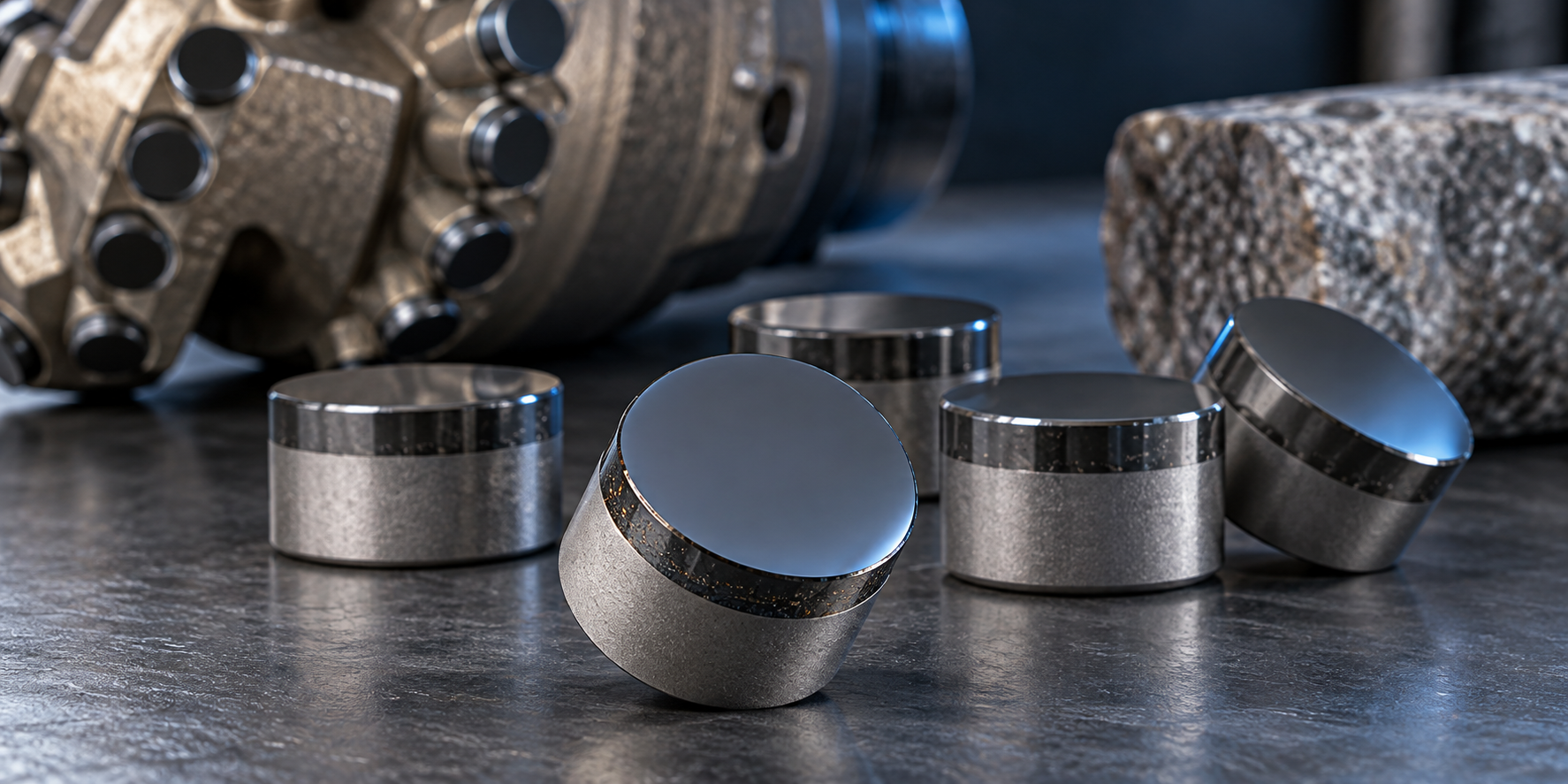
When readers ask what is polycrystalline diamond, the first question is whether they mean the material itself or a composite component made from it. PCD is not a single crystal diamond. It is a polycrystalline diamond material made by bonding many diamond grains together. It often forms the working layer of a PDC cutter, but PCD and the complete cutter are not the same object.
PCD stands for Polycrystalline Diamond and refers mainly to the material. PDC usually stands for Polycrystalline Diamond Compact and refers to a composite in which a polycrystalline diamond layer is joined to a supporting substrate. In a typical PDC cutter, the upper section is the diamond working layer, the lower section is a cemented carbide substrate, and a bonding interface connects them.
The diamond layer provides the main cutting and wear-resistant function. The carbide substrate supports the layer, carries part of the impact, and provides the basis for installation. The bonding interface transfers the applied load. In other words, PCD describes the polycrystalline diamond material, while PDC describes the complete composite structure made from the diamond layer and substrate. PCD table, diamond table, and diamond layer normally refer to the working polycrystalline diamond layer; carbide substrate refers to the cemented carbide body below it.
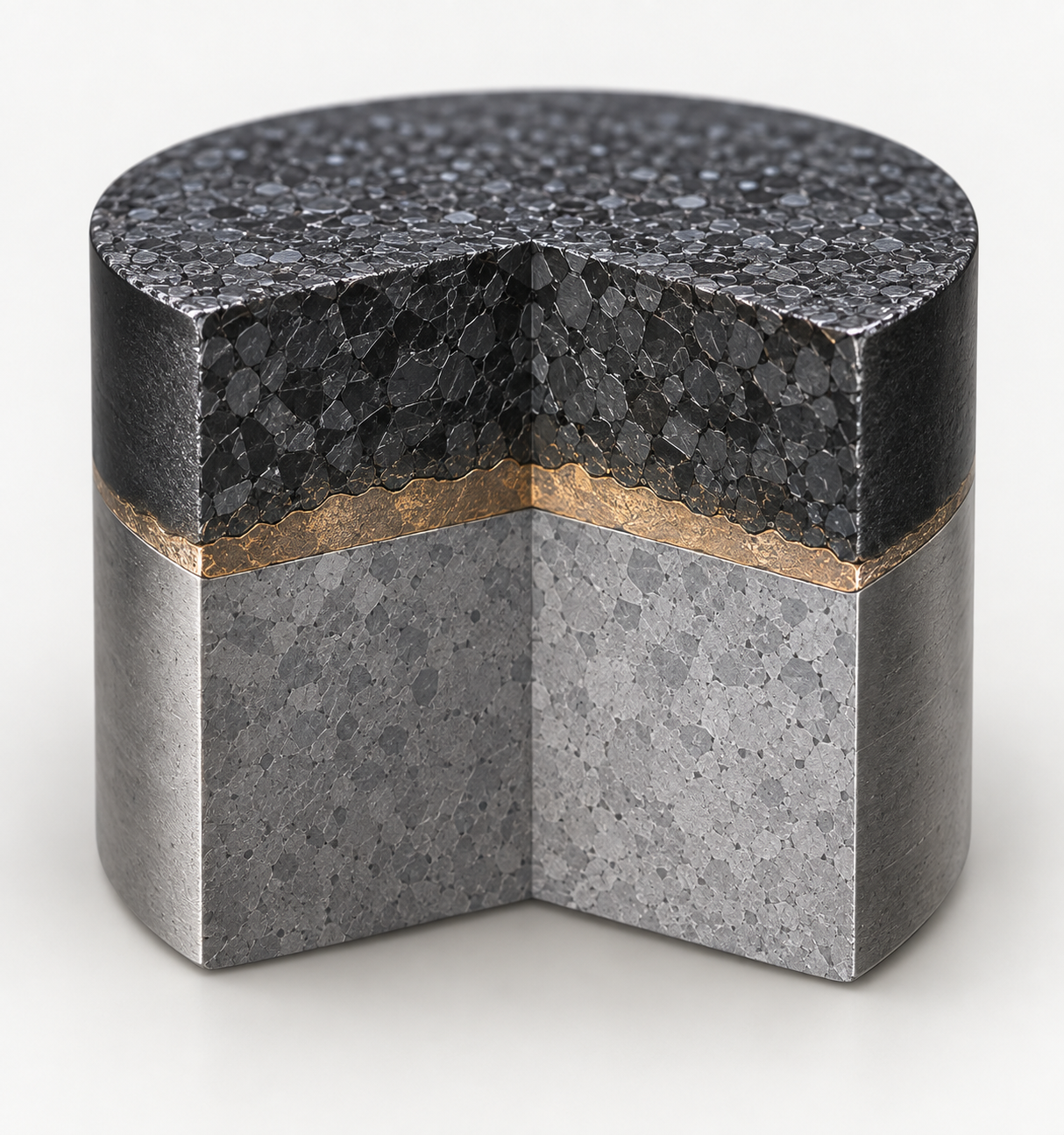
The PCD working layer is made from micron-sized or finer synthetic diamond grains. The grains form a continuous diamond-to-diamond bonding network, and they are usually not aligned along one crystallographic direction. This random orientation reduces the tendency for a crack to travel through the material along one cleavage plane. It does not mean that PCD cannot crack, or that every polycrystalline material is perfectly isotropic.
Small gaps remain between the grains and may contain cobalt or another metallic second phase. The continuity of the direct diamond bonding, metal-phase content, pores, and residual stress all influence the material’s behavior. Hardness, wear resistance, fracture toughness, impact resistance, and thermal stability are different properties. High hardness does not automatically mean that a material will not chip, and high wear resistance does not guarantee reliable performance under every impact condition.
The polycrystalline diamond layer in drilling PDC is commonly formed through HPHT, or high-pressure high-temperature sintering. In a typical route, selected diamond powder is placed on a cemented carbide substrate. Under high pressure and high temperature, cobalt or another solvent-catalyst promotes the dissolution, transport, and reprecipitation of carbon. Adjacent grains then form diamond-to-diamond bonds while the diamond layer and substrate become a composite structure.
The pressure, temperature, and holding time are not the same for every PDC product. Equipment, the synthesis cell, powder formulation, product size, and process curve all affect the applicable process window. A process number therefore needs to be read together with the specific material and product route rather than treated as a universal PDC parameter.
Cobalt helps form the polycrystalline structure during sintering. After sintering, cobalt remaining between the grains can contribute to crack blunting and load transfer, but it also limits high-temperature stability. At elevated temperature, cobalt may promote the conversion of diamond toward a graphite structure, reducing hardness and wear resistance. Cobalt-depleted or other thermally stable routes can change the thermal behavior of the working area, while the depth and extent of cobalt removal also affect pores, strength, heat transfer, crack paths, and impact resistance.
Public Vickers-hardness examples for conventional cobalt-containing sintered PCD can be found in the range of about 50–90 GPa. The result depends on the indenter, load, surface preparation, grain size, metal content, and measurement location. This range describes particular samples and methods; it should not be rewritten as one guaranteed parameter for a FIDE grade.
Polycrystalline diamond can be formed through a high-pressure high-temperature sintering route or through chemical vapor deposition. HPHT-sintered PCD contains diamond grains, direct diamond bonding, and residual material in the spaces between grains. CVD polycrystalline diamond grows layer by layer from carbon species in a gas phase on a substrate and can be made as a thin film, thick film, or another form. The diamond layer in drilling PDC is normally HPHT-sintered PCD.
The two routes involve different structures and test objects. When a hardness, thermal-conductivity, or thermal-stability value is quoted, first identify whether it describes HPHT-sintered PCD, CVD polycrystalline diamond, a PCD layer, or a complete PDC cutter. Data from different material objects should not be treated as directly interchangeable.
A PDC cutter is not a diamond layer working without support. The diamond layer contacts the rock and provides cutting and wear resistance. The cemented carbide substrate provides support and the installation base, while the bonding interface transfers the applied load. In a PDC bit, multiple cutters are arranged around the bit and remove rock through scraping and shearing as the bit rotates.
The material grade of one cutter cannot independently determine the rate of penetration or service life of the complete bit. Bit structure and field conditions also affect the final result. The useful way to understand polycrystalline diamond is therefore to identify both the material layer and the composite structure in which that layer works.
Master PDC Drill Bit Specifications: Body Type, Blade Count, Cutter Size & Hydraulic Design For Optimal ROP.
View details
PDC Cutter improves drilling performance and reliability, enabling operators to achieve faster, more precise, and cost-effective operations.
View details
Discover How PDC Cutter Leaching Removes Cobalt To Stop Thermal Failure. Boosts Wear Resistance For Longer Bit Runs & Higher ROP.
View details
Pdc Drill Bit Structure, Classification, Parameter Optimization And Performance,Its Role In Efficient Drilling.
View details