 kingpdc





product search
search
Two products can both be described as polycrystalline diamond and still show very different thermal conductivity values. Before comparing a high number with a PDC cutter specification, identify the material behind it: is it HPHT-sintered PCD used in a drilling cutter, or CVD polycrystalline diamond made as a film or plate? For polycrystalline diamond thermal conductivity, the material route matters as much as the number.
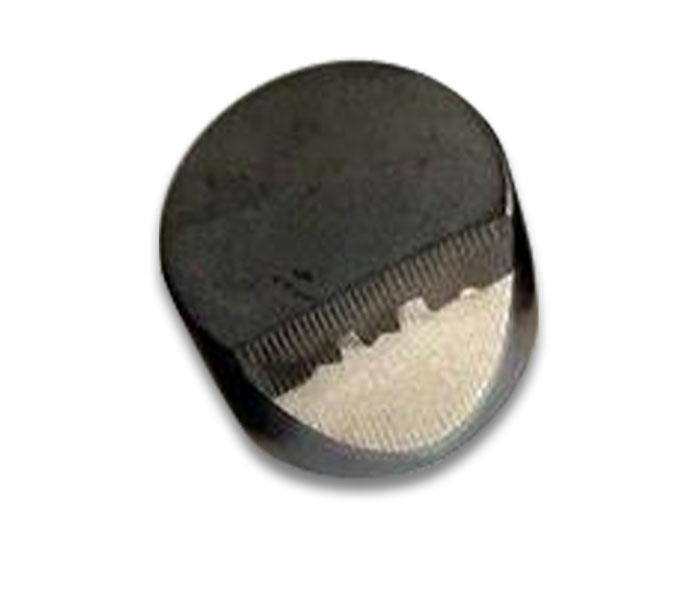
The working table of a drilling PDC cutter is generally HPHT-sintered PCD. Heat flow through it is affected by how the diamond grains connect, as well as by residual cobalt and porosity. CVD polycrystalline diamond, by contrast, may be produced as a thin film, a thicker layer, a heat spreader, or another plate-like form. Its structure and intended use differ from those of cobalt-containing sintered PCD, so their reported values are not interchangeable.
Published examples for sintered PCD used in drilling and cutting tools span roughly 120 to 560 W/(m·K). Individual studies or grades report figures such as 120, 300, 459, 543, and 560 W/(m·K). They come from different samples and applications; averaging them would not produce a fixed specification for a commercial cutter.
High-quality CVD polycrystalline diamond can exceed 1,000 W/(m·K). Some high-purity thermal-management grades have reported values around 1,900–2,200 W/(m·K), while mechanical-grade CVD data are around 600–1,100 W/(m·K) at 300 K. These figures describe particular CVD materials, not a default value for cobalt-containing drilling PCD. Putting both material families in one table does not make them directly comparable. A high CVD result cannot stand in for a measurement of the PCD grade being considered.
Thermal conductivity describes how readily a material transfers heat under a temperature gradient and is commonly reported in W/(m·K). In sintered PCD, grain-to-grain connections, residual cobalt, and pores all affect that path. Grain boundaries, pores, non-diamond carbon, and impurities scatter phonons. A continuous diamond network generally favors heat transfer, while larger cobalt pools conduct less effectively than a high-quality diamond network.
The measurement direction matters too. CVD diamond may differ between its nucleation and growth sides. In sintered PCD, in-plane and through-thickness heat flow can be affected by the layered structure, interfaces, and residual stress. Temperature also changes the result; above room temperature, thermal conductivity generally decreases. A value without its test temperature and direction is therefore difficult to interpret.
The flash method typically measures thermal diffusivity directly, not thermal conductivity. For a homogeneous material, the conversion is:
Thermal conductivity = thermal diffusivity × density × specific heat capacity
Two samples with the same thermal diffusivity can yield different conductivity values if their density or specific heat capacity differs. Uncertainty in those inputs also carries through to the calculated result. A surface-temperature reading from a thermal camera is not a thermal-conductivity measurement either.
The test specimen matters. The flash method described in ISO 18755 is intended for thermal-diffusivity measurements of homogeneous monolithic ceramics. A complete PDC is a layered composite, so a single-layer model cannot be applied to it without accounting for that structure. Testing may use an isolated PCD specimen, a layered inversion approach, or a composite model that specifies direction. A report should make clear whether it covers single-layer PCD, cobalt-depleted PCD, CVD diamond, or a complete PDC, and state the test temperature, heat-flow direction, and method.
Higher conductivity can help move heat away from the working edge, but it does not determine cutting-zone temperature by itself. Heat generation, contact area, cutting speed, and cooling conditions also affect how much heat is produced and removed. In a complete PDC cutter, heat travels through the PCD table, interface, carbide substrate, braze joint, bit body, and surrounding fluid; the interfaces can add thermal resistance.
Thermal conductivity and thermal stability are different properties. Conductivity describes heat transfer; stability has to be considered with the temperature, atmosphere, duration, and load involved. For a drilling cutter, conductivity is one useful piece of information about heat flow—not a stand-alone prediction of downhole operating temperature.

PDC bits are the core drilling tools in the fields of oil drilling, geological exploration...
View details
PDC Cutters—short for Polycrystalline Diamond Compact cutters—are at the heart of modern drilling efficiency. Built for strength and precision, these cutters feature a synthetic diamond layer fused onto a carbide base, allowing them to sl...
View detailsMonocrystalline Diamond Vs Polycrystalline: Compare Structure, Wear, Fracture Behavior, And Tool Applications.
View details
Check 6 5 8 Reg Pdc Bit Torque By Confirming The Connection And Approved Makeup Procedure Before Installation.
View details