 kingpdc





product search
search
The phrase ceramic bond polycrystalline diamond does not, by itself, identify one fixed formulation, product structure, or performance grade. “Ceramic-bonded” describes a bonding phase or material route. To interpret the term, first determine whether it refers to the PCD working layer, a complete PDC cutter, or a thermally stabilized composite.
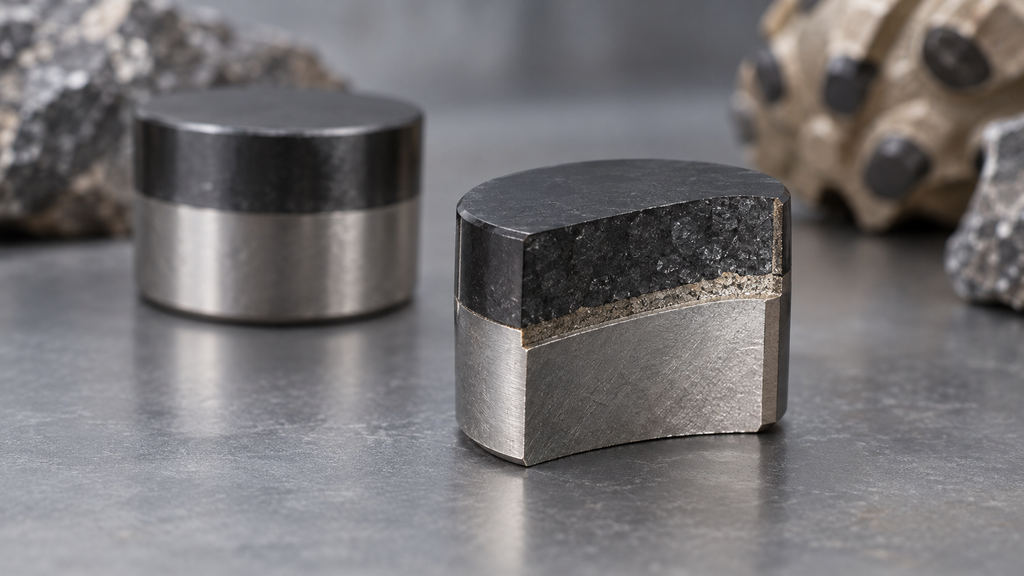
Polycrystalline diamond (PCD) consists of many diamond grains joined into a continuous diamond-to-diamond network. A drilling PDC cutter usually includes more than this diamond material: it has a PCD working table, a WC-Co cemented-carbide substrate, and an interface joining the two. PCD describes the working material; PDC describes the composite component. A property reported for a PCD table should not automatically be treated as a property of the complete cutter.
The word “bond” can refer to different parts of that structure. It may describe how diamond grains are joined, which bonding phase is present in the material, or how the diamond layer is joined to its substrate. The phrase alone does not resolve those distinctions or establish the component’s application limits.
In a cobalt-bonded high-pressure, high-temperature (HPHT) route, cobalt can infiltrate the diamond powder layer from the cemented-carbide substrate. It acts as a solvent-catalyst, promoting carbon dissolution, transport, and reprecipitation as the diamond grains bond. Some cobalt remains in the spaces between grains after sintering.
That residual metal is not simply a defect: it can contribute to load transfer and, to some extent, crack blunting. The trade-off is thermal. Cobalt and diamond expand differently as temperature changes, which can create internal stress. At elevated temperatures, cobalt may also catalyze the conversion of diamond toward graphite. These mechanisms help explain why a conventional cobalt-bearing PCD structure can face thermal-stability limits.
A temperature figure is meaningful only alongside its test conditions. Atmosphere, heating duration, specimen structure, and the criterion used to define failure can all affect the result. A value measured on a free-standing PCD specimen is not automatically comparable with one measured on a PDC cutter that retains its substrate.
One way to improve thermal stability is to remove much of the residual catalytic metal after the PCD has formed. The regions from which metal is removed become pores. This reduces metal-related thermal expansion and catalytic effects, but the resulting porosity also changes heat transfer, strength, and crack paths. Decobaltization is therefore a structural trade-off, not simply the removal of an unwanted ingredient. Its depth and distribution matter, as does whether the carbide substrate remains in place.
A different route uses a non-metallic or ceramic bonding phase selected for thermal-expansion compatibility and chemical stability. SiC-bonded thermally stable polycrystalline diamond (TSP) is one example. In certain diamond-silicon systems, silicon participates in an HPHT reaction and forms silicon carbide, producing a diamond-SiC composite. That structure is not the same as a metal-leached PCD layer containing pores, so the two routes should not be grouped together merely because both aim to improve thermal stability.
A 2011 U.S. Department of Energy project brief describes a class of SiC-bonded TSP materials as stable up to about 1,200°C, while reporting fracture-toughness values of about 6–8 MPa·m1/2. Those figures describe a specific material class, not a universal specification for ceramic-bonded PCD. A 2018 HPHT study examined a different diamond-SiC composition, including SiC-whisker-reinforced specimens, and reported results for those particular samples. Composition, atmosphere, specimen geometry, and test methods differ; the figures should not be ranked as though they came from one standardized test.
Even within SiC-bonded materials, diamond grain structure, SiC distribution, porosity, manufacturing route, and later processing can vary. A ceramic phase may support a thermally stable composite, but the overall response still depends on the microstructure. Brittleness and crack behavior need to be judged from the relevant test evidence. The words “ceramic” or “SiC” do not imply that heat resistance, strength, toughness, thermal conductivity, and wear resistance will all improve together.
It is also important to distinguish a free-standing TSP element from a PDC cutter that retains its carbide substrate. Fully decobaltized TSP is commonly used as a separate diamond sheet or shaped element, while a selectively decobaltized PDC can retain its substrate. Similar treatment of the diamond layer does not make the support, interface, loading, or installation structure identical.
When reading a material description or research result, identify the specimen first: is it a PCD sheet, a TSP element, or a PDC cutter with a WC-Co substrate? Then identify the thermal-stability route: metal removal or a non-metallic/ceramic bonding phase. For a leached material, the treated region or depth also matters. Finally, check the atmosphere, temperature program, and specimen structure. These details determine whether two reported results can be compared meaningfully.
Thermal stability is not the only property that affects a finished component. Porosity, heat transfer, strength, toughness, the bonding interface, and machining characteristics can all matter. If a source gives a single temperature without describing the sample and test method, treat it as a result from that particular case—not as proof that one material family is universally superior.
Thermal stabilization is intended to address particular heat conditions, but drilling and cutting also involve impact, changes in formation, cutter geometry, and substrate support. A TSP or ceramic-bonded route may offer an advantage under some thermal conditions; that does not make it better in every application. In strongly interbedded formations with high impact loads, for example, the thermal-stability label alone is not enough to establish an advantage over a tougher conventional PDC.
Before treating two products as equivalent, establish what the bonding phase is, whether the data describe a material layer or a complete cutter, whether a substrate is present, and which test conditions produced the reported performance. Similar names do not guarantee the same formulation or behavior.
Understand 4 1 2 Reg Pdc Bit Make Up Torque And Why Connection, Cutter Layout, Wob And Rpm Affect Torque.
View details
Learn How To Verify 6 5/8 Reg Pdc Bit Torque For Makeup And Distinguish It From Torque Measured While Drilling.
View details
PDC (Polycrystalline Diamond Compact) cutters are integral components in drilling operations across a variety of industries, including oil and gas, mining, and construction. These advanced cutting tools are specifically engineered for hig...
View details
PDC Stands For Polycrystalline Diamond Compact. Discover How These Bits Use Diamond Shearing To Increase Drilling ROP.
View details