 kingpdc





product search
search
When making a bulk inquiry, clearly state in the first line whether you require complete PDC bits with shaped cutters installed, or individual shaped cutting inserts for bit manufacturing or repair. The drawings and acceptance criteria for the two differ. Even if two teeth have the same shank diameter, their ridge heights and orientations may differ; fitting into the same tooth socket does not guarantee that they will engage the rock in the same manner once installed.
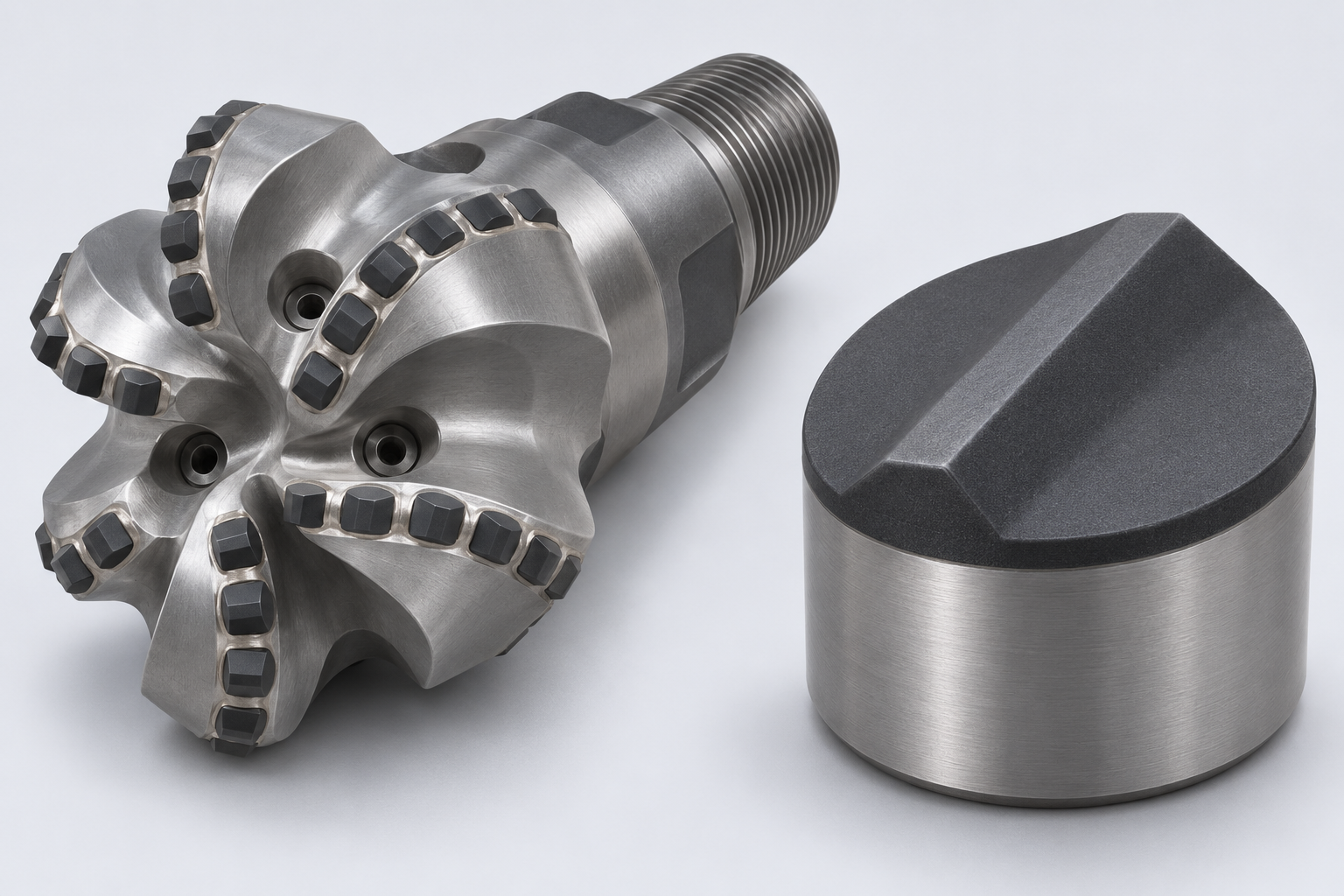
When purchasing a complete drill bit, seek a supplier that can verify the bit configuration based on well-section operating conditions, and require them to provide a tooth layout diagram or a per-tooth configuration table. When purchasing only cutting teeth, seek a PDC composite manufacturer that can supply according to the tooth profile drawing, and require them to confirm dimensions, tolerances, and the working face contour based on the part drawing. The English inquiry can be written as “complete PDC bits fitted with shaped cutters” and “shaped PDC cutters for PDC bits,” respectively, and the purchase quantity should be specified in terms of how many drill bits or how many teeth.
You can start by submitting your requirements through our King PDC bulk quotation page. The page distinguishes between full‑diamond bits and cutting teeth, listing the model numbers and dimensions of composite inserts such as edge‑trimming types and bullet‑nose types. Cutting teeth can be quoted based on catalog model numbers or drawings; complete drill bits are verified according to application and configuration. Specific tooth arrangements, delivery schedules, and pricing are subject to written confirmation.
Taking the serrated edge as an example, the raised serrations may come into contact with the rock before the surrounding working surface. Changing the orientation of the edge alters the point where it first contacts the rock; adjusting the exposed height of the tooth may modify its cutting role relative to adjacent teeth. Shale cutting tests revealed that the tested triangular teeth cause cuttings to split laterally along the edges, whereas the convex edge of the tested chisel-shaped teeth contacts the rock first, exhibiting a distinct rock-breaking mechanism. These results correspond to the specific tooth profiles and mounting conditions in the tests and cannot be used to rank the performance of all custom gear trains. https://link.springer.com/article/10.1007/s40948-024-00843-0
This also explains why replacement parts require cross-referencing two types of drawings: the part drawing to confirm fit, and the assembly drawing to verify the correct cut after installation. For example, the base diameter and overall height of the candidate gear both meet the specifications, but the protruding ridge is rotated by an angle relative to the mounting datum. The individual part passes dimensional inspection, but its working orientation changes after assembly. When encountering such a deviation, first verify whether the design permits it, then determine whether a substitution is acceptable.
What specifications should be included in a batch Request For Quotation (RFQ)?
| Procurement Object | Information Provided to Supplier | Content Required for Supplier’s Confirmation |
| Complete PDC bit equipped with shaped cutters | Bit outer diameter (OD), connection thread, target formation and well section, expected Weight on Bit (WOB) and RPM range. If data on currently used bits is available, attach configuration and wear records. | Mark which blades and cutter positions use shaped cutters, and which retain conventional flat cutters. Confirm the installation direction, back rake angle, and exposure height of key cutter positions. Simply stating “equipped with shaped cutters” is insufficient to verify that two quotes have the identical configuration. |
| Shaped PDC cutters for manufacturing or repair | Cutter profile drawing and version, substrate diameter, total height, diamond table dimensions and their measurement locations. Depending on the cutter shape, supplement the ridge height, ridge angle, tip radius or chamfer, and specify key tolerances. | Confirm profile dimensions and measurement datums. If used for existing bits, attach cutter pocket dimensions, installation datums, and target exposure height, and ask the supplier to confirm any assembly differences item by item. |
When the original drawing for a replacement part is unavailable, you may first provide the old sample part, photos with dimensions, and gear position information, and request the supplier to produce drawings for confirmation. Ground teeth can help identify the profile, but they cannot be used directly as an acceptance template for the original dimensions. Prior to mass production, the drawing revision shall be signed off, and arrangements shall be made for first-article inspection records, batch identification, and change approval procedures.
If the procurement objective is to increase mechanical rate of penetration (ROP), torque and wear after tripping out should also be monitored during test drilling. A full‑size drill‑bit test drilled Longmaxi Formation shale at 50 rpm; under higher weight‑on‑bit conditions, the experimental bit drilled faster than the reference bit and exhibited approximately 9.8% higher torque. This figure applies only to this particular test, but it illustrates why drilling rate alone should not determine whether to increase the bit weight: if torque rises as drilling rate increases, the drill string’s torque margin must be reassessed, and checks should be made to see whether any non-standard tooth positions are experiencing localized chipping or damage. https://link.springer.com/article/10.1007/s40948-024-00843-0#Sec12
When comparing prices, use the same set of drawings or gear‑tooth tables. Ask suppliers to quote unit prices separately for samples and for the planned production batch, and clearly specify the minimum order quantity, the point at which lead time begins to be calculated, whether dedicated tooling incurs an additional charge, as well as the currency and terms of delivery. When buying whole drill bits, compare them by the piece; when buying cutting teeth, compare each tooth individually, ensuring they share the same tooth profile and specifications. If the low-cost option reduces the number of non-standard teeth or changes the mounting tooth position, first evaluate it based on the different configurations; confirm that the configuration used for trial drilling is the same as the one for mass production and delivery before comparing unit prices.
Polycrystalline diamond, commonly referred to as PCD in the industry, is an ultra‑hard material formed by sintering a large number of fine diamond grains under high temperature and high pressure. It retains diamond’s near‑ultimate hardness and wea...
View details
Learn what shapes pdc bit cost and compare quotes by design, cutter specification, quantity, quality, and delivery.
View details
Use Pdc Bit Dull Grading To Document Cutter Wear, Compare Bit Zones, And Connect Damage Patterns With Drilling Data.
View details
Single Crystal Diamond Vs Polycrystalline Diamond Explained With Hardness And Cutting Use Differences.
View details