 kingpdc





product search
search
PDC cutter is a fixed cutter bit on the direct cutting of rock components. It consists of a polycrystalline diamond layer and a tungsten carbide cemented carbide substrate. The cutting edge of the diamond layer cuts into the rock, and the substrate supports the cutting edge at the rear. PDC is the abbreviation of polycrystalline diamond compact, Chinese often called polycrystalline diamond compact. The PDC cutter on the English drawing refers to a single cutting tooth, and the PDC bit refers to the entire drill bit equipped with these cutting teeth.
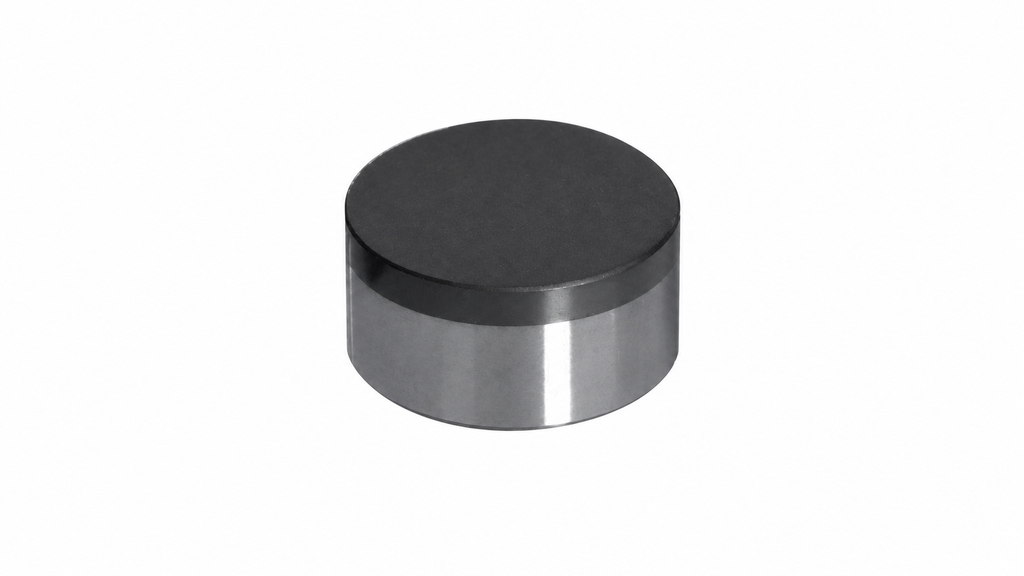
Take 1 common cylindrical flat teeth. One end of the cylinder is a polycrystalline diamond layer (diamond table), its outer end face is the cutting surface, and the working edge is located on the outer edge of the cutting surface. The rear cylinder is a cemented carbide matrix (substrate). When manufacturing, diamond particles are sintered into a polycrystalline layer under high temperature and high pressure, and combined with the substrate. The thickness of the diamond layer marked on the product profile is the end layer.
The load exerted by the rock on the cutting edge is transmitted to the blade of the drill bit through the diamond layer and the substrate. The support of the substrate will affect the performance of the diamond layer under stress. Taking Figure 6 of the 1 drill patent as an example, under certain cutting conditions, the matrix behind the edge will grind into a depression, weakening the support of the diamond layer and increasing the risk of cracking or spalling. When looking at the profile of the cutting tooth, it is also worth paying attention to how many matrix supports are behind the cutting edge.
Taking the plane tooth installed by brazing as an example, the base body is installed into the tooth socket of the blade, the diamond cutting surface faces the direction of the coming rock, and the working cutting edge is exposed outside the blade. There are two connections here. The diamond layer and the base body are sintered and bonded when the tooth is made, and the base body and the tooth socket are fixed by brazing when the drill bit is assembled. The former one connects the two materials into 1 cutting teeth, and the latter one fixes the cutting teeth on the blade.
The weight on bit presses the cutting edge into the rock face, and the drill bit rotates to sweep the rock laterally with the cutting teeth fixed to the blade. The 1 thin layer of rock in front of the cutting edge is separated under the action of shear and slides along the cutting surface, leaving a cut mark behind the tooth. According to the patent Figure 6, the cutting edge into the rock can be found from the outer edge of the cutting face, and then the direction of the debris leaving can be seen along the cutting face.
Use Pdc Bit Dull Grading To Document Cutter Wear, Compare Bit Zones, And Connect Damage Patterns With Drilling Data.
View details
Looking at two PDC bits with the same outer diameter, the size and number of cutting teeth may be similar, but the wear after coming out of the well may be concentrated in completely different positions. The cause may not lie in the tooth itself. ...
View details
Explore How Polycrystalline Diamond (Pcd) Is Used In Oil And Gas Drilling, Geological Exploration, Stone Cutting, And Precision Machining.
View details
Learn the different shapes of PDC cutters in diamond tip drill bits and how they impact drilling efficiency, strength.
View details