 kingpdc





product search
search
A precision machining tip and a cylindrical cutter mounted on a drill-bit blade may both use polycrystalline diamond, yet their cutting edges, supporting structures, and loads differ. Understanding applications of polycrystalline diamond pcd starts with the distinction between a material and a cutting element: PCD consists of many bonded diamond grains, while a PDC typically combines a PCD working layer with a cemented carbide substrate. The same material name does not mean the same tool design.
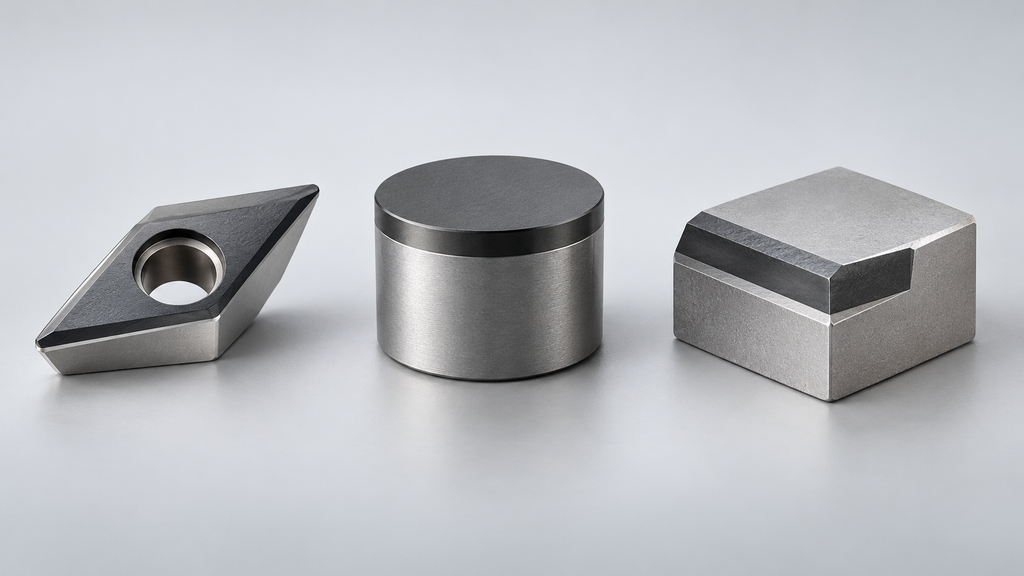
PCD machining tools are commonly used for non-ferrous metals and non-metallic materials, including certain abrasive composites. Where a workpiece continuously wears the cutting edge, polycrystalline diamond can help maintain that edge. Fine-grained PCD is often suited to fine cutting edges and improved surface finish, although wear resistance and resistance to chipping still have to be balanced.
Single-crystal diamond also has a place in ultra-precision machining that calls for a continuous cutting edge without grain boundaries. The focus here is the edge and the surface it produces. A cylindrical drilling PDC cutter has additional support and rock-cutting duties. Machining inserts and drilling cutters differ in geometry, working-layer design, substrate, and loading conditions.
The workpiece sets another boundary. Diamond is susceptible to chemical wear during high-temperature continuous cutting of iron, steel, and certain materials containing iron, nickel, or cobalt. This machining limitation should not be carried over directly as a rule excluding particular rock formations.
In rotary tools for oil and gas wells, water wells, geothermal wells, and geological exploration, PCD commonly cuts rock as the working layer of a PDC cutter. As the bit rotates, the cutter removes rock by scraping and shearing. The cemented carbide substrate supports the working layer and provides an interface for attachment to the tool body. The bond between the two transfers loads, but it can also be affected by thermal stress and delamination.
Quartz and other hard minerals can increase abrasive wear, while interbeds and fractures may increase impact loading. Highly abrasive conditions with controlled impact are more likely to benefit from PCD’s edge-retention capability. When impact dominates, greater hardness or a thicker working layer does not necessarily extend service life; cutter shape and support also affect suitability.
Water-well and geothermal cutters illustrate this distinction. In the relevant product designs, flat-face cutters are suitable for soft rock and general formations, while micro-arc cutters intended for hard granite and quartzite offer corresponding resistance to chipping. This relationship is specific to the product and operating conditions, rather than a universal ranking of all micro-arc and flat-face cutters.
Geothermal drilling can combine elevated temperatures with abrasive hard rock. Leaching cobalt from the working region can improve thermal stability, but impact resistance and support must still be considered. Cooling and cleaning remove heat and cuttings. When they are inadequate, recutting and heat accumulation affect performance. Thermally stable materials and effective cooling address different parts of the problem.
Square or stepped PDC cutting elements can be used for granite and marble. Square elements can be used on chain-arm saws, while stepped elements suit stone-cutting equipment with bolt fastening, making replacement easier after wear. PDC elements can also be used in road maintenance and pavement milling.
Polycrystalline diamond still provides cutting and wear resistance in these applications, but element shape, fastening, and loads may differ from those of drilling cutters. Specifications for stone-cutting or road equipment should not be used directly in place of drilling PDC specifications.
For drilling tools, a candidate cutter must also match its primary-cutting, backup, or gauge position. A change of position calls for a fresh assessment of mounting angle, exposure, and loads. Validation should bring the workpiece or formation, speed, loading, cooling, and mounting as close as possible to the target conditions to establish whether the complete cutting-element design is suitable.

Stop Thermal Degradation In The PDC Diamond Compact. Use Deep Leaching And The W-I-T Pyramid To Extend Bit Life.
View details
Master Polycrystalline Diamond PCD Tools. Learn Top Tooling Secrets And The T-C-V Framework To Stop Edge Failure.
View details
Pdc Drill Bit Structure, Classification, Parameter Optimization And Performance,Its Role In Efficient Drilling.
View details
Learn how PDC cutters enhance diamond tip drill bits, boosting drilling efficiency, durability, and cutting performance.
View details