 kingpdc


product search
search
To achieve sub-nanometer surface roughness (Ra) without sacrificing material removal rate (MRR), synthetic polycrystalline diamond and polycrystalline micropowder are the only reliable solutions in the industry. Ordinary single crystal diamond particles are massive, easily in the deep material left serious sub-surface damage (Subsurface damage); and polycrystalline powder unique rough spherical (nodular) structure can achieve soft multi-point cutting. This fundamentally eliminates micro-scratches on high-value substrates such as silicon carbide (SiC) wafers, sapphire optical lenses, and precision carbide molds. This technical guide will directly dismantle the precise particle size distribution (PSD), purity index and structural characteristics that must be killed in the chemical mechanical polishing (CMP) and grinding process, and help you completely eliminate the rejection rate of the production line.
The reason why man-made polycrystalline diamond has a unique cutting mechanism is entirely due to its explosive synthesis process. Under the action of instantaneous high temperature and high pressure (HPHT) shock wave, the carbon precursor is melted into spherical and polycrystalline composite aggregates. The surface of every 1 such agglomerates is densely covered with thousands of tiny cutting edges.
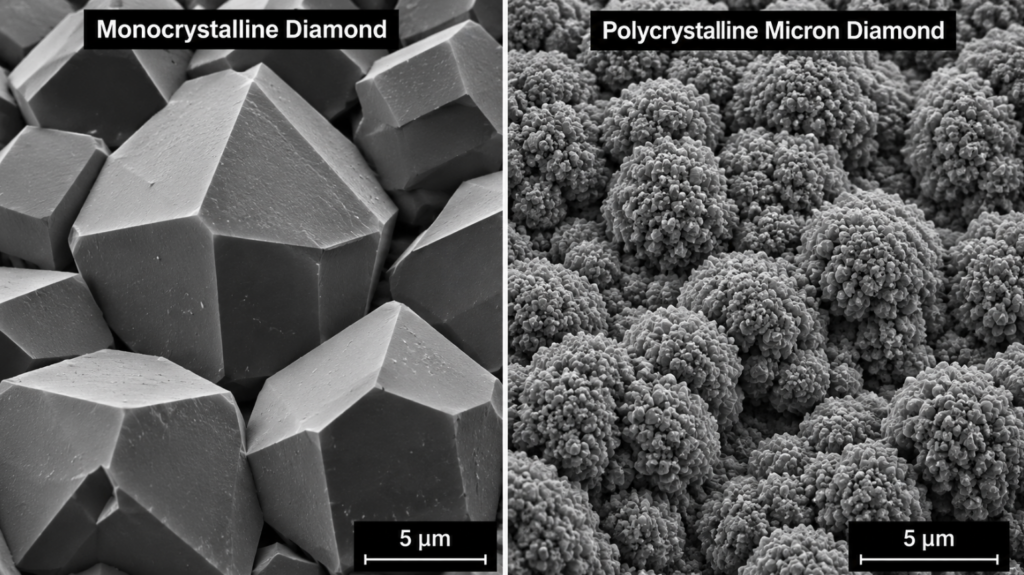
This polycrystalline surface structure will produce a “self-sharpening effect” of great practical value when subjected to high-pressure grinding “. When severe friction (shear force) occurs between the polycrystalline particles and the superhard substrate such as sapphire, the fine grains on the surface thereof will simply break and peel off from the main particles. This micro-cleavage (Micro-cleavage) process allows the diamond to always expose a new, sharp cutting edge to the workpiece. On the other hand, single crystal diamond will only slide on the surface of the substrate after being blunt, which not only leads to MRR cliff-type decline, but also accumulates extremely serious frictional heat. Therefore, locking the polycrystalline structure can ensure that the diamond grinding fluid maintains an absolutely stable cutting force throughout the life cycle.
Many B2B purchasing teams have suffered a big loss: the yield of the production line suddenly collapsed because they were staring at D50 (median diameter) to evaluate polycrystalline micropowder. To put it bluntly, the D50 has no reference value for your scrap rate. What really scratches optical lenses and semiconductor wafers is the very small number of oversized particles mixed in the powder-commonly referred to as “free large particles (Rogue particles)” on site “.
Only the limit control of D99 and D100 can be regarded as real industrial powder. The 1 high-quality 1μm polycrystalline micropowder must not be satisfied with an average size of 1μm, and its absolute maximum particle size (D100) must be pressed below 1.5μm. Actual combat has proved that purchasing micropowders that have undergone advanced wet centrifugal classification can completely eliminate these free large particles and directly cut the scrap rate of the substrate by 85% in the harsh CMP process.
Production line engineers and procurement can directly apply the P-SLIDE matrix to comprehensively investigate and select suppliers of artificial polycrystalline micropowder. Please directly use these 5 death control standards to benchmark your process requirements:
In 2025, a head new energy vehicle power module foundry conducted a 1 field controlled production test, directly using data to prove the economic return of tightening the tolerance of polycrystalline micropowder. At that time, the engineering team directly replaced the factory’s standard 2 μm single crystal grinding fluid with 1/2μm high-grade polycrystalline diamond grinding fluid in the final polishing stage of 6-inch silicon carbide (SiC) wafers.
The results were immediate: the multi-point cutting characteristics of polycrystalline powder pulled the material removal rate (MRR) from 1.2 μm/h to 2.8 μm/h. At the same time, due to the strict control of D99, the free large particles were completely eliminated, the wafer surface roughness (Ra) was reduced from 0.8 nm to 0.15 nm at the atomic level, and the secondary chemical etching process was even directly cut off at the back end. The plant not only reduced the total polishing cycle by 42%, but also reduced the wafer scrap rate to nearly zero.
Please strictly according to the substrate material and final finish requirements, control the precise particle size distribution limit index selection, to ensure that the grinding dynamics are in the best state.
| Nominal Particle Size | D50 Target | D50 Tolerance Range | D99 Upper Limit | Recommended Processing Stage | Recommended Application Fields |
|---|---|---|---|---|---|
| 0–0.25 μm | 0.125 μm | 0.105–0.145 μm | ≤0.33 μm | Ultra-fine final polishing | Optical crystals, semiconductor wafers, precision ceramics, sapphire finishing |
| 0–0.5 μm | 0.21 μm | 0.18–0.24 μm | ≤0.53 μm | Mirror-finishing polish | Silicon carbide, sapphire, optical glass, high-grade metallographic samples |
| 0.25–0.5 μm | 0.35 μm | 0.31–0.39 μm | ≤0.70 μm | Fine corrective polishing | Hard coatings, carbide dies, precision optical components |
| 0.25–0.75 μm | 0.50 μm | 0.45–0.55 μm | ≤0.90 μm | Fine polishing | Technical ceramics, tungsten carbide, electronic substrates |
| 0.5–1 μm | 0.71 μm | 0.65–0.77 μm | ≤1.30 μm | Final polishing | PCD tools, carbide cutting tools, sapphire, ceramic seals |
| 0.75–1.25 μm | 1.00 μm | 0.95–1.05 μm | ≤1.70 μm | Precision finishing | Carbide molds, optical glass, advanced ceramics, hardened alloys |
| 1–1.5 μm | 1.19 μm | 1.13–1.25 μm | ≤2.00 μm | Fine lapping | Tungsten carbide, PCD inserts, ceramic components, precision molds |
| 1–2 μm | 1.42 μm | 1.35–1.49 μm | ≤2.30 μm | Fine lapping and pre-polishing | Mechanical seals, carbide tools, sapphire substrates, hardened steel |
| 1.5–2.5 μm | 2.00 μm | 1.90–2.10 μm | ≤3.00 μm | Intermediate polishing | Carbide dies, ceramic bearings, precision metal components |
| 1.5–3 μm | 2.39 μm | 2.27–2.51 μm | ≤3.50 μm | Pre-polishing | PCD tooling, technical ceramics, carbide punches and dies |
| 2–4 μm | 2.83–3.10 μm | Supplier-controlled | ≤5.00 μm* | Fine grinding and lapping | Tungsten carbide, silicon carbide, ceramic seals, hardened tool steel |
| 2.5–4 μm | 3.37 μm | 3.20–3.54 μm | ≤4.90 μm | Precision lapping | Carbide cutting tools, wear-resistant coatings, precision ceramics |
| 3–5 μm | 4.02 μm | 3.82–4.22 μm | ≤5.80 μm | General lapping | Carbide molds, PCD tools, glass, ceramics, hardened alloys |
| 4–6 μm | 4.87 μm | 4.63–5.11 μm | ≤6.80 μm | Stock-removal lapping | Carbide inserts, ceramic parts, optical glass pre-processing |
| 6–10 μm | 8.10 μm | 7.70–8.50 μm | ≤10.90 μm | Coarse lapping | Carbide blanks, stone, ceramics, hard-alloy components |
| 10–20 μm | 15.00 μm | 14.20–15.80 μm | ≤21.50 μm | Rough grinding | Rapid stock removal, tool reconditioning, hard-material surface preparation |
What is the difference between single crystal and synthetic polycrystalline diamond?
Single crystal diamond is composed of a single, continuous crystal lattice, with obvious cleavage surface, and the shape is massive and sharp. Artificial polycrystalline diamond is millions of tiny grains in the absence of cleavage surface fusion together to form a rough class of spherical particles, the structure of the subsurface damage produced by cutting minimal.
Why Polishing Sapphire Must Use Polycrystalline Micropowder Diamond?
Sapphire is extremely hard and prone to subsurface microcracks. The nodular surface of polycrystalline powder can disperse the grinding pressure to multiple contact points, which directly avoids the common deep scratches of single crystal particles and can throw a perfect and seamless mirror surface.
How does explosive synthesis produce polycrystalline diamond?
Explosive synthesis is the detonation of explosives in a closed control chamber, and the instantaneous high temperature and high pressure shock wave directly converts the carbon source (usually carbon black or graphite) into diamond grains. These grains are stacked and fused to each other during the extreme cooling phase, eventually condensing into a unique polycrystalline structure.
Diamond powder specifications in the d50 and d99?
D50 represents the median diameter size, that is, 50% of the particles in the powder are smaller than this value. D99 means that 99% of the particles are smaller than this size. In precision polishing, the dead control D99 indicator is extremely critical, which is the last physical line of defense to prevent oversized “free particles” from scratching the workpiece.
Can artificial polycrystalline diamond be used directly to prepare grinding fluid?
Yes. Polycrystalline diamond is the abrasive of choice for high-end chemical mechanical polishing (CMP) polishing fluids. However, before leaving the factory, its surface usually needs to undergo special chemical modification treatment to ensure that it can maintain a stable and uniform suspension state whether in water-based or oil-based carrier liquid to prevent clumping.
Is polycrystalline diamond really self-sharpen?
Yes. Affected by the micro-composite structure, when the polycrystalline particles are abraded by friction, the tiny grains of the outer layer will collapse from the main particles. This continuous micro-fragmentation process can constantly reveal new sharp cutting edges, thereby maintaining high cutting efficiency and doubling the life of the abrasive.
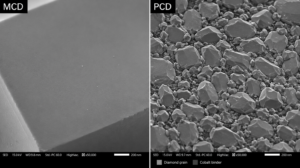
Evaluate Monocrystalline Vs Polycrystalline Diamond Applications For Extreme Precision And High-Impact PCD Tooling.
View details
Choose Top-Tier PDC Polycrystalline Diamond Drill Bits To Boost ROP And Cut Hidden Drilling Costs.
View details
Polycrystalline diamond, commonly referred to as PCD in the industry, is an ultra‑hard material formed by sintering a large number of fine diamond grains under high temperature and high pressure. It retains diamond’s near‑ultimate hardness and wea...
View details
Learn the different shapes of PDC cutters in diamond tip drill bits and how they impact drilling efficiency, strength.
View details