 kingpdc




product search
search
Polycrystalline Diamond (PCD) delivers a baseline Vickers hardness of 5,000–8,000 HV (50–80 GPa), thermal conductivity ranging from 400 to 800 W/m·K, and fracture toughness between 7.0 and 11.0 MPa·m^1/2. These static metrics determine theoretical tool life and mold durability. Relying solely on these spec sheet numbers guarantees premature material failure in severe machining environments. The micro-structural interplay between diamond grain size, cobalt binder distribution, and operating temperature dictates the actual performance threshold. We will dismantle the physics behind these specific mechanical parameters and establish a quantitative framework for precise PCD grade selection.
Grain size strictly dictates polycrystalline diamond hardness. Fine-grain PCD structures (0.5 μm to 2 μm) pack a higher density of diamond-to-diamond bonding per square millimeter, pushing the hardness up to 80 GPa. Sub-micron grades maximize abrasion resistance, making them mandatory for continuous cutting applications involving highly abrasive materials like high-silicon aluminum or Carbon Fiber Reinforced Polymers (CFRP).
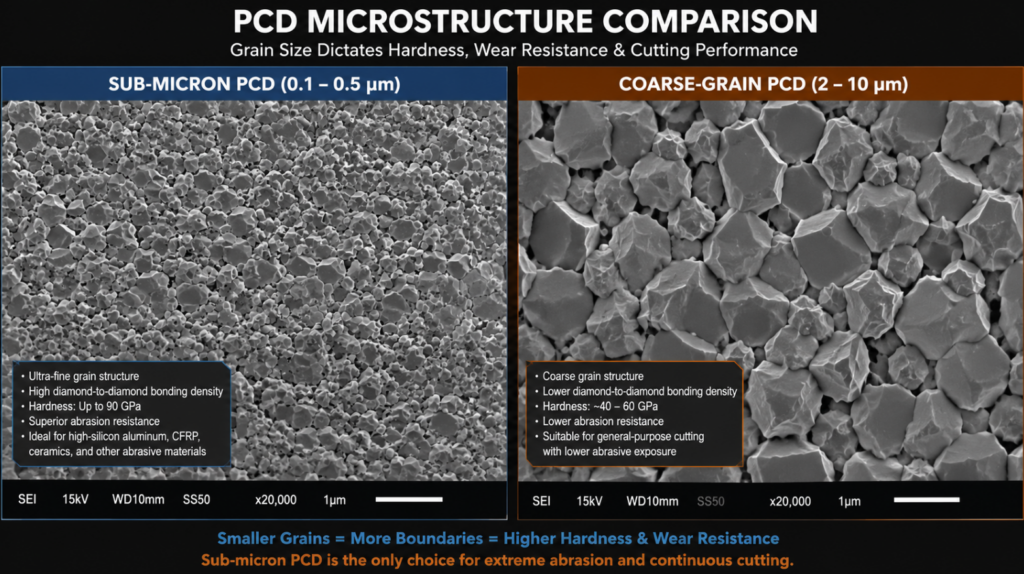
Hardness does not scale linearly with wear resistance in impact scenarios. Engineers frequently select the hardest available grade (2 μm) for interrupted cutting, only to experience rapid edge failure. The lack of binder volume in ultra-fine grades eliminates energy dissipation pathways. Macro-hardness tests (like standard Rockwell or Knoop) fail to reveal local soft spots caused by improper HPHT synthesis. You must request Vickers micro-hardness data (HV0.05) across multiple surface points to verify sintering uniformity before approving a batch for wire drawing dies or aerospace tooling.
| Industry Grade | Grain Size (μm) | Cobalt Content (%) | Vickers Hardness (GPa) | Relative Toughness | Typical Wear Resistance | Typical Applications |
|---|---|---|---|---|---|---|
| Ultra-Fine | 2.0 | 6–8 | 38–42 | Low | Excellent | High-speed finishing, precision cutting, wear parts |
| Fine | 5.0 | 8–10 | 32–36 | Medium | Very High | General machining, wire drawing dies, carbide tooling |
| Medium | 10.0 | 10–12 | 26–30 | High | High | Interrupted cutting, mining tools, heavy machining |
| Coarse | 20.0 | 12–15 | 20–25 | Very High | Moderate | Impact tooling, rock drilling, crushing equipment |
| Extra Coarse | 30.0–50.0 | 15–18 | 16–20 | Excellent | Moderate | Severe impact applications, excavation tools, heavy-duty wear components |
The metallic cobalt network acts as a severe bottleneck for polycrystalline diamond thermal conductivity. Pure monocrystalline diamond achieves thermal conductivity above 2,000 W/m·K through efficient phonon propagation. Standard PCD limits this metric to 400–800 W/m·K because the residual cobalt binder scatters phonons and disrupts heat transfer pathways.
Thermal degradation initiates rapidly when standard PCD exceeds 700°C at the cutting zone. Cobalt transforms from a binding agent into a catalyst, driving the reverse transformation of diamond back into graphite. This chemical breakdown collapses the tool’s structural integrity entirely. Thermally Stable Polycrystalline (TSP) diamond eliminates this specific failure mode. By leaching the cobalt out of the matrix using acid baths after the HPHT process, TSP raises the thermal operating limit to 1,150°C, albeit at a slight cost to impact resistance.
Fracture toughness pcd polycrystalline diamond mpa m1/2 values range narrowly between 7.0 and 11.0, representing the material’s resistance to crack propagation. Coarse-grain PCD (10 μm to 25 μm) commands the high end of this toughness spectrum. The larger grain boundaries force micro-cracks to navigate a longer, tortuous path around the diamond particles (intergranular fracture) or expend massive energy cutting through them (transgranular cleavage).
Interrupted cutting operations, such as milling engine blocks with complex geometries, demand a minimum fracture toughness of 9.5 MPa·m^1/2. Selecting a grade based entirely on hardness for these applications ignores the kinetic energy impacts that cause micro-chipping.
Bimodal grain distribution technology currently addresses the historical compromise between hardness and toughness. By mixing 2 μm and 15 μm grains during the sintering process, advanced manufacturers achieve a matrix where fine grains provide localized hardness while coarse grains arrest macro-crack formation. Tests in titanium aerospace component machining show bimodal grades outlasting traditional unimodal coarse grades by 42%.
Cobalt pooling remains the most destructive hidden defect in PCD tooling. Standard EDM wire cutting of PCD blanks often melts the metallic binder unevenly. This creates microscopic pools of concentrated cobalt near the cutting edge.
These pools register as invisible voids under standard optical inspection but act as initiation sites for severe thermal fatigue. During dry machining, localized thermal expansion of this pooled cobalt exerts internal stress exceeding 1,200 MPa against the surrounding diamond lattice. The edge detonates from the inside out. Specifying strict Electrical Discharge Grinding (EDG) parameters and mandating SEM surface validation eliminates this specific failure mechanism.
Material selection requires simultaneous evaluation of three opposing vectors. Apply the PCD Triad Optimization Matrix (P-TOM) to determine the exact grade needed:
What is the exact polycrystalline diamond hardness in GPa?
PCD hardness typically falls between 50 and 80 GPa on the Vickers scale. Fine-grain structures (1-2 μm) reach the upper limit of 80 GPa, while coarse-grain structures (25 μm) register closer to 50 GPa due to higher metallic binder content.
How does cobalt affect polycrystalline diamond thermal conductivity?
Cobalt reduces thermal conductivity by disrupting the diamond lattice and scattering phonons. While pure diamond conducts heat at 2,000 W/m·K, the cobalt network in standard PCD restricts conductivity to 400-800 W/m·K and causes graphitization above 700°C.
What is a good value for fracture toughness pcd polycrystalline diamond mpa m1/2?
A standard acceptable range is 7.0 to 11.0 MPa·m^1/2. Heavy interrupted cutting applications require a minimum fracture toughness of 9.5 MPa·m^1/2, typically achieved by specifying coarse grain sizes (10-25 μm) or bimodal microstructures.
Why does my PCD tool chip despite having high hardness?
High hardness strictly correlates with low fracture toughness. Selecting a highly abrasion-resistant, fine-grain PCD (80 GPa) for an interrupted cutting process leads to micro-chipping because the material cannot absorb the kinetic impact energy.
Can PCD thermal limits be extended?
Yes. Removing the cobalt binder through acid leaching creates Thermally Stable Polycrystalline (TSP) diamond. TSP extends the operational thermal limit from 700°C to approximately 1,150°C, making it suitable for high-friction drilling environments.
How is fracture toughness tested in PCD?
Engineers typically measure PCD fracture toughness using the Vickers indentation fracture (VIF) method. An indenter applies a specific load, and the length of the radial cracks extending from the corners of the indentation calculates the K1c value in MPa·m^1/2.
Pdc Bit Classification,Pdc Bit Nomenclature
View details
Step Shaped PDC Cutters Dealer Teaches You How To Choose The Right PDC Drill Bit Based On Scenarios And Work Conditions.
View details
Master PDC Bit Dull Grading For Peak Tool Life. Use Expert Wear Analysis To Cut Drilling Costs And Stop BHA Failures.
View details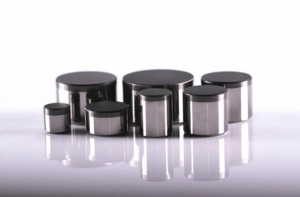
KingPDC High-Performance PDC Cutters – Bulk Supply Diamond Cutters for Demanding Drilling Applications
View details