 kingpdc


recherche de produits
recherche
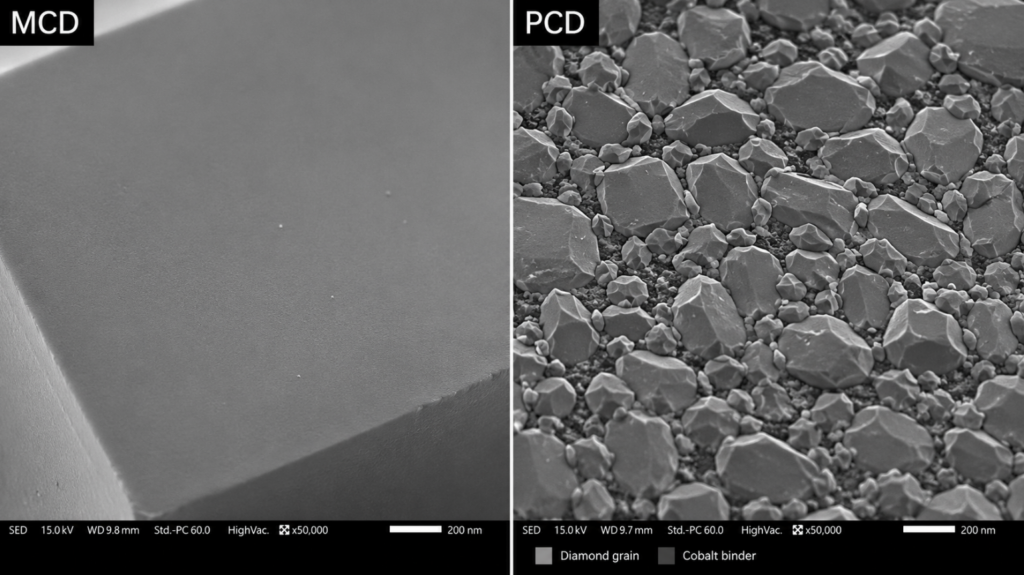
Buying single crystal (MCD) or polycrystalline (PCD) diamond directly determines the physical ceiling of your production line. The crystal lattice of single crystal diamond is continuous and perfect, which allows its cutting edge to be ground to below 50 nanometers, and it is all it does for mirror-level optical processing. In contrast to polycrystalline, it is composed of micron-sized diamond particles sintered together with cobalt as a binder. Although it is not so sharp, its toughness is uniform in all directions, making it extremely “resistant” when rough cutting aviation composite materials or drilling rocks .
To put it bluntly, if the microstructure is not selected according to the mechanical load, the tool you bought will either collapse on the spot and be scrapped, or the surface of the processed part will not pass the inspection at all. Today, let’s clarify the stress limits of these two materials to ensure that your procurement budget is spent on the cutting edge.
What a diamond’s internal lattice looks like determines what it can do. The peculiarity of MCD is the absence of grain boundaries -1 a whole block of pure carbon structure. This feature allows tool manufacturers to grind it to near-atomic sharpness, with negligible friction when cutting continuously.
PCD is going the other way. It is a complex of millions of synthetic diamond particles squeezed together under high temperature and high pressure (HPHT). The tiny gaps between the particles are filled with cobalt, which acts as a “shock absorber” in the microscopic world. Once the blade is impacted to produce micro-cracks, the adhesive can stop the cracks and not break the whole knife directly.
Many procurement engineers often make a mistake: in case of high wear conditions, close your eyes directly to MCD, thinking that the highest hardness is equal to the longest life. This completely ignores the most fatal weakness of MCD-crystal anisotropy.
In short, there is a “soft rib” inside MCD, which is called cleavage surface in the industry (especially <111> surface). As long as the direction of the external impact is exactly parallel to this surface, the stone will split instantly. Therefore, if you are processing a grooved shaft, or the machine tool vibrates during milling, MCD will definitely break into slag. Buy MCD, must be strictly limited to the kind of smooth, continuous turning, or the force direction is always perpendicular to the cleavage surface of the precision indentation environment.
As long as the working conditions have both extreme wear and physical impact, it is the world of PCD. Because its particles are out of order, no matter from which direction the force is applied, the strength is the same (isotropic). Intermittent Heavy Cutting and Automobile Castings
When machining high-silicon aluminum (ADC12) engine blocks, traditional carbide tools last only a few minutes. However, PCD inserts can not only cut through those extremely abrasive silicon particles but also withstand the “thudding” impacts caused by the intermittent cutting action required in engine cylinder bores. Typically, 2-micron fine-grain PCD is used for the final surface finishing, while 10–25-micron coarse-grain PCD handles the rough machining—the dirty, heavy-duty work.
PDC (polycrystalline diamond composite) drill bits are undoubtedly the leaders in the oil, gas, and geothermal drilling industries. Crushing granite and shale requires extremely intense shear forces; monocrystalline diamond would have been reduced to dust long ago under such conditions. But deep underground, when faced with the immense torque and vibrations transmitted through the drill string, the cobalt matrix in PCD perfectly absorbs this destructive force.
MCD is at the tip of the pyramid for ultra-precision manufacturing. Because it is not mixed with any binder, you don’t have to worry about the trouble of chemical affinity, and there will be no microscopic collapse at the nanoscale.
When manufacturing contact lenses, smartphone lens molds, and laser reflectors, the surface roughness (Ra) must be pressed below 5 nanometers. The PCD can’t do this job, because when sharpening the blade, the softer cobalt in the PCD will be worn off a little more, leaving a microscopic “jagged” edge. MCD can grind out a perfectly straight cutting edge with iron like mud, and will not tear the material structure when cutting acrylic, oxygen-free copper or electroless nickel plating.
When drawing ultrafine tungsten or molybdenum wires for medical devices, the friction force inside the die hole must approach zero. If the MCD drilled by laser ablation is used as the wire drawing die core, its friction coefficient is much lower than that of PCD. This ensures that when the wire is taken up at high speed, not only the diameter is not bad, but also the surface will not be scratched.
Stop picking materials on instinct. Before placing an order, put the item at hand into this D-CAP matrix 1 times:
| Specification | MCD — Monocrystalline Diamond | PCD — Polycrystalline Diamond | Practical Selection Impact |
|---|---|---|---|
| Material Structure | One continuous diamond crystal with defined cleavage directions | Randomly oriented diamond grains sintered together, usually with a cobalt binder | MCD provides extreme precision; PCD provides more stable performance under multidirectional loads |
| Vickers Hardness | Approximately 8,000–12,000 HV | Approximately 5,000–8,000 HV | MCD offers the highest intrinsic hardness, while PCD sacrifices some hardness for improved operational durability |
| Edge Sharpness Limit | Approximately 0.005–0.1 μm edge radius | Approximately 0.5–5 μm edge radius, depending on diamond grain size | Select MCD for optical surfaces, jewelry finishing and ultra-precision machining; select PCD when a microscopically perfect edge is unnecessary |
| Achievable Surface Finish | Mirror or optical finish; approximately Ra 0.005–0.025 μm under controlled conditions | Fine industrial finish; typically less suitable for true optical-grade surfaces | MCD is preferred when the finished surface must require little or no polishing |
| Fracture Toughness | Approximately 4–7 MPa·m¹ᐟ²; strongly affected by crystal orientation and cleavage direction | Approximately 6–10 MPa·m¹ᐟ², depending on grain size and binder content | PCD generally tolerates interrupted cuts, vibration and impact better than conventional MCD tools |
| Impact and Chipping Resistance | Low to moderate; vulnerable to sudden impact along cleavage planes | Moderate to high for a diamond cutting material; random grains help arrest crack propagation | Use PCD for castings, drilled workpieces, milling and unstable machine setups |
| Wear Direction | Anisotropic; wear resistance changes with crystal orientation | Nearly isotropic because the grains are randomly oriented | PCD provides more predictable wear in complex or multidirectional cutting operations |
| Cost per Carat | Very high; generally custom-priced according to crystal size, orientation, clarity and tool geometry | Moderate to high; normally less expensive than an equivalent MCD cutting volume | Cost per carat is not a standardized industrial quotation method; MCD is normally sold as finished tools or selected crystals, while PCD is sold as blanks, discs or inserts |
| Best Cutting Condition | Continuous, stable and vibration-free cutting | Interrupted cutting, heavy feed, milling, drilling and abrasive production machining | Machine stability is a decisive selection factor |
| Recommended Workpiece Materials | Gold, silver, copper, optical plastics, acrylic and non-ferrous materials requiring mirror finishes | Aluminum alloys, CFRP, GFRP, graphite, wood composites, ceramics and other abrasive non-ferrous materials | PCD is generally preferred for high-volume abrasive machining |
| Ferrous-Metal Compatibility | Not recommended | Not recommended | At elevated cutting temperatures, diamond reacts with iron and experiences rapid graphitization and chemical wear; use PCBN for hardened steel, cast iron and other ferrous materials |
In 2025, we did a controlled benchmark test when processing electroless nickel-plated optical molds, and the results perfectly confirmed the D-CAP model. Under the same continuous turning parameters, engineers compared a standard 2 micron particle PCD tool with an MCD tool synthesized by high temperature and high pressure method.
The result was cruel: PCD cutting tools worked hard, and the best surface finish was Ra 18 nm. Its own grain boundary printed the micro texture directly on the mold. On the other hand, after 40 hours of continuous cutting, Ra remained stable at 3.2 nm, and the subsequent polishing process was directly saved. Although the purchase of this MCD blade 1 started to cost 300 percent more, the total cost of a single piece dropped by 45% because of the cut-off of secondary polishing.
Where is polycrystalline diamond (PCD) usually used?
Best at gnawing non-ferrous materials that are particularly sharpening. For example, turning high-silicon aluminum automotive parts, milling aviation-grade carbon fiber composites (CFRP), and PDC cutting teeth for oil and gas drilling.
Is single crystal harder than polycrystalline?
That’s right. Single crystal diamond is a purely flawless carbon lattice that can achieve the highest theoretical hardness (about 100 GPa). The hardness of PCD is generally between 50-80 GPa, because it is mixed with a relatively soft metal binder (usually cobalt), which reduces the overall macro hardness.
Why is the surface finish of PCD not as good as MCD?
Because PCD is “assembled” with particles and binder. When sharpening the knife, the softer binder will be ground a little deeper, causing the blade to look serrated under the microscope. MCD is a 1 single crystal, the cutting edge can be ground to 50 nm below the extremely sharp degree.
How should these two choose?
Do the kind of optical lens that requires mirror effect (Ra < 5nm) and one-size-fits-all work, choose MCD. If the cutting is intermittent, there is vibration, or the cutting amount is very large, especially the impact resistance is required, PCD must be selected.
Can they be used to cut steel?
Absolutely not. Both are essentially carbon. When it comes to the high temperatures generated by the processing of steel, carbon will quickly diffuse into the iron, causing catastrophic chemical wear. Please look for PCBN when cutting black metal.
What is the “cleavage surface” of single crystal diamond?
Is a single crystal lattice in a particular direction of the “soft rib”. If the mechanical impact is just parallel to this plane, the MCD will crack or even shatter very simply. This is why MCD is extremely afraid of intermittent cutting.
Does PCD wear out faster than MCD?
If it is the kind of pure friction continuous conditions (such as precision wire drawing),PCD does wear faster, because the cobalt inside is relatively soft, will cause the diamond particles to fall off after being worn off. But in a high-impact environment, the MCD breaks instantly, and PCD is your only option.
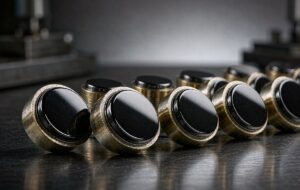
Polycrystalline diamond, commonly referred to as PCD in the industry, is an ultra‑hard material formed by sintering a large number of fine diamond grains under high temperature and high pressure. It retains diamond’s near‑ultimate hardness and wea...
Voir les détails
Fournir des mèches à pointe diamantée, y compris des mèches solides et des carottes, spécialement conçues pour la roche, le verre, etc.
Voir les détails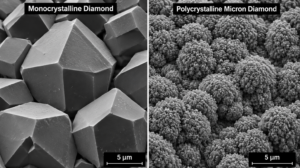
Découvrez nos solutions à base de diamant synthétique polycristallin micronique pour un polissage impeccable des plaquettes et des rendements CMP élevés.
Voir les détails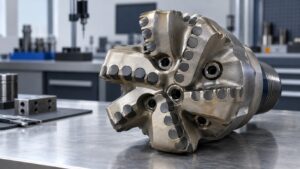
Learn what shapes pdc bit cost and compare quotes by design, cutter specification, quantity, quality, and delivery.
Voir les détails