 kingpdc


búsqueda de productos
busque en
Polycrystalline diamond is a superhard material formed by sintering micron-sized diamond powder and metal binder under ultra-high pressure and high temperature environment. As the “sharp teeth” of modern industry, PCD is the core consumable for efficient processing of carbon fiber composite materials and high silicon aluminum alloys in the aerospace field, extreme rock drilling in oil and gas exploration, and precision wire drawing. However, knowledge of these basic chemistries alone does not prevent premature obsolescence of tools on the production line. If you want to purchase the correct PCD, you must understand how particle size, bond loss and matrix adhesion directly determine tool wear resistance. Today, we’re going to take a direct look at how to select, source, and deploy PCD materials to reduce your machining and drilling costs.
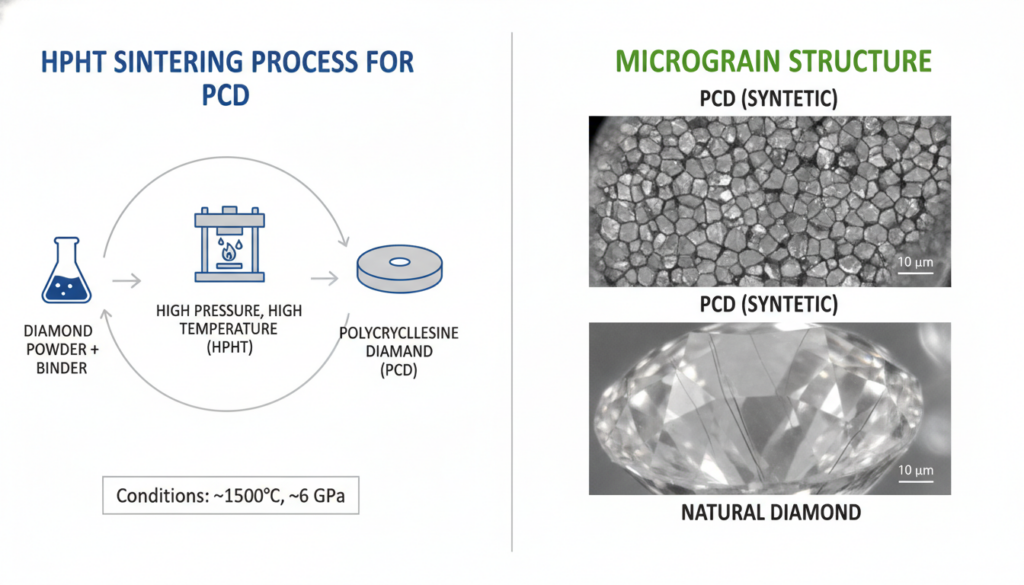
The isotropic structure prevents unpredictable chipping under heavy industrial impact. Natural diamond has a cleavage surface-this is 1 kind of structural weakness, if hit from a specific angle, the whole stone will split directly along the crack. But polycrystalline diamond is not the same, it evenly dispersed the impact force to millions of randomly arranged, tightly bonded grains. To put it bluntly, this structural randomness instead eliminates physical weaknesses. In those intermittent cutting conditions that require extremely high shock absorption and directly determine the survival of the tool, the person in charge of the project usually directly designates PCD to replace single crystal diamond.
| Feature | Polycrystalline Diamond (PCD) | Monocrystalline Diamond (MCD) |
| Hardness | Extremely hard, but slightly lower than MCD | Extremely hard, highest known hardness |
| Impact Resistance | Good, due to the random orientation of diamond grains | More brittle, can chip or fracture under high impact |
| Temperature Extremes | Up to 700°C (in inert atmosphere), lower than MCD in air due to binder | Up to 1200°C (in inert atmosphere), higher thermal stability |
| Major Applications | Cutting tools (drilling, milling), wear parts, wire drawing dies, mining tools | High-precision cutting tools, optical components, diamond anvils, medical instruments, jewelry |
The application of the industrial end mainly focuses on the extreme wear resistance of PCD when dealing with high wear removal rate and non-ferrous materials.
You take a standard carbide tool to cut carbon fiber reinforced plastic or high silicon aluminum alloy, and it will be scrapped in a few minutes. Under the same working conditions, the PCD tool can maintain the sharpness for several weeks. The aviation industry now relies heavily on 10 to 25 micron grade PCD to mill and drill wing structures so that they don’t have problems with fiber drawing or delamination. In the continuous production of large quantities, the coated carbide is replaced by PCD blades, and the reduction in tool cost is very considerable.
The current oil and gas drilling is basically dominated by PDC bits. The manufacturer brazes a layer of PCD on the carbide substrate to make PDC cutting teeth. This stuff uses the mechanical mechanism of scraping to shred rock formations, not by hard smashing. According to the first-line data, compared with the old-fashioned cone bit, a full switch to PDC bit can shorten the well construction time by up to 60%.
The tensile wire is extremely demanding on the consistency of the aperture, almost not at all. Drawing copper, aluminum, stainless steel wire will produce continuous great friction, PCD mold is used to resist this. The fine-grained PCD of 1 to 3 microns has almost zero wear characteristics, which ensures that the extruded wire will always maintain an absolutely precise tolerance range for continuous production up to several miles.
I usually do evaluation in the workshop found that the root cause of the vast majority of tool scrap is that the PCD grade does not match the actual application scenario. You can directly apply this exclusive “3-T matrix” to evaluate your next batch of purchase orders.
Target material Target Material: The workpiece material directly determines the chemical compatibility. You must strictly delineate the scope of use of PCD on non-ferrous metals and non-metals.
Temperature Limit Thermal Limit: Standard PCD degrades rapidly it passes 700°C. The cobalt binder inside will accelerate the thermal collapse, resulting in micro-collapse. Therefore, it is necessary to set the cutting fluid/coolant strategy and keep the temperature of the cutting zone below this red line.
Grain size Texture / Grain Size: Grain size is essentially a trade-off between tool life and surface finish. To create an ultra-smooth surface on aluminum, choose 2 microns of fine grain; if it is in the rough milling of CFRP priority to carry wear, directly on the 25 micron coarse grain.
If PCD is used to process ferrous metals, the tool will be 100% destroyed. Iron has an extremely high chemical affinity for carbon. When the temperature when cutting steel or cast iron, polycrystalline diamond will a chemical reaction called “graphitization. Simply put, diamond directly back into the graphite, into the iron filings. When it comes to iron materials, PCBN is always practical.
Another common pit is that the quality of parts is destroyed directly by using coarse-grained PCD in the list of mirror finishing. The coarse diamond particles will leave microscopic scratches on the surface of the workpiece that are invisible to the naked eye but can be measured. Many purchasing teams take it for granted that pile of common medium grain and expect to make high-end finishing effects. Listen to my sentence, be sure to completely separate the rough machining and finishing tool orders, and write the exact grain index clearly on the purchase order.
Thermally stable polycrystalline diamond completely breaks the 700°C failure limit just mentioned. After the initial high temperature and high pressure sintering, the manufacturer will use the acid leaching method to wash off the cobalt binder in the diamond matrix. Once the cobalt is removed, the structural integrity of the TSP cutter can be maintained all the way up to 1,200°C. Many drilling engineers are now aggressively rolling out the use of TSP in deep geothermal wells where standard PDC will melt.
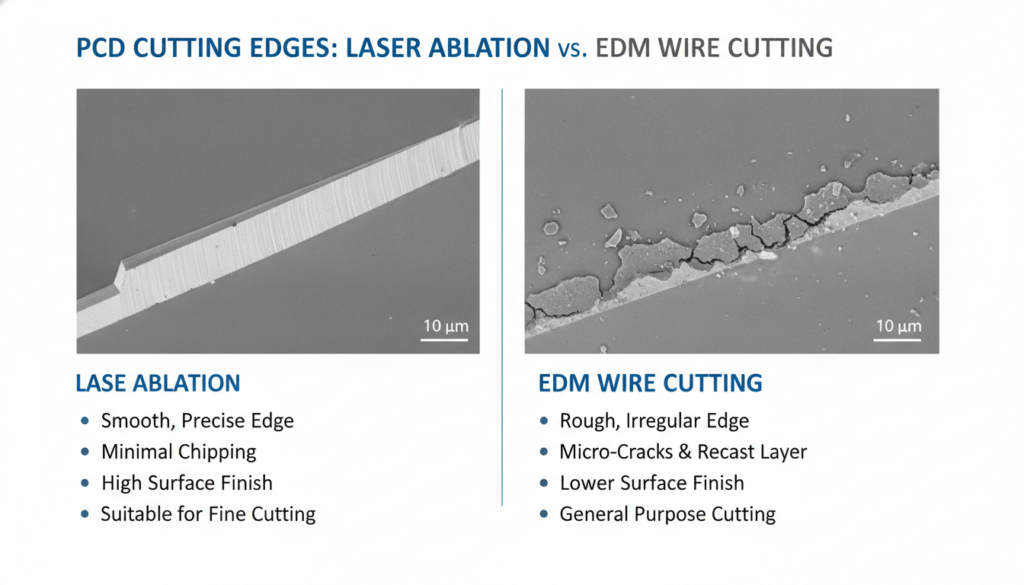
In addition, laser ablation is accelerating the replacement of traditional wire cutting to shape complex PCD tools. EDM in the local melting of cobalt binder, will damage the edge of the diamond layer. With ultrashort pulse laser can directly gasify diamond, there is no heat affected zone. The cutting edge produced by this modern manufacturing process is perfect. Compared with the line cutting, the tool life can be abruptly increased by 30%.
Polycrystalline diamond is a material synthesized in the laboratory. It is composed of thousands of micro-diamonds combined with metal solvents. The structure is very strong and isotropic. Natural diamond is a single crystal dug from the ground, although more hard, but along its natural cleavage surface is very easy to brittle.
Absolutely not. Polycrystalline diamond will react chemically with iron-based metals at high temperatures. The diamond will directly decompose into graphite and dissolve into the steel, instantly destroying the entire tool. Engineers usually cut steel with PCBN.
Standard PCD containing cobalt binders begins to structurally degrade around 700°C. However, if the cobalt is removed to make thermally stable polycrystalline diamond, it can continue to work at temperatures as high as 1,200°C.
Grain size refers to the physical diameter of the diamond particles sintered together. Fine grain can produce extremely sharp edges, suitable for mirror finishing. Coarse grains provide maximum impact and wear resistance, specifically for roughing materials with high wear rates.
Manufacturers typically use rotary discharge erosion, slow wire electrical discharge machining, or more advanced laser ablation techniques to shape PCD tools. Because PCD contains cobalt and can conduct electricity, EDM is still the most commonly used method for tool edge molding in the industry.
The tungsten carbide matrix provides the necessary impact support and brazeability. This layer of PCD is indeed extremely wear-resistant, but very thin. The diamond layer is directly sintered on the hard alloy back plate, and the composite blade can not only absorb the mechanical impact, but also facilitate the later direct brazing to the steel cutter body.
Discover Synthetic Polycrystalline Micron Diamond Solutions For Flawless Wafer Polishing And High CMP Yields.
Ver detalles
Discover What Is A PDC Bit, Its Top Functions For Deep Drilling, And Master Proper PDC Bit Selection To Maximize ROP.
Ver detalles
Choose Top-Tier PDC Polycrystalline Diamond Drill Bits To Boost ROP And Cut Hidden Drilling Costs.
Ver detalles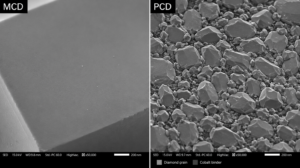
Evaluate Monocrystalline Vs Polycrystalline Diamond Applications For Extreme Precision And High-Impact PCD Tooling.
Ver detalles