 kingpdc


búsqueda de productos
busque en
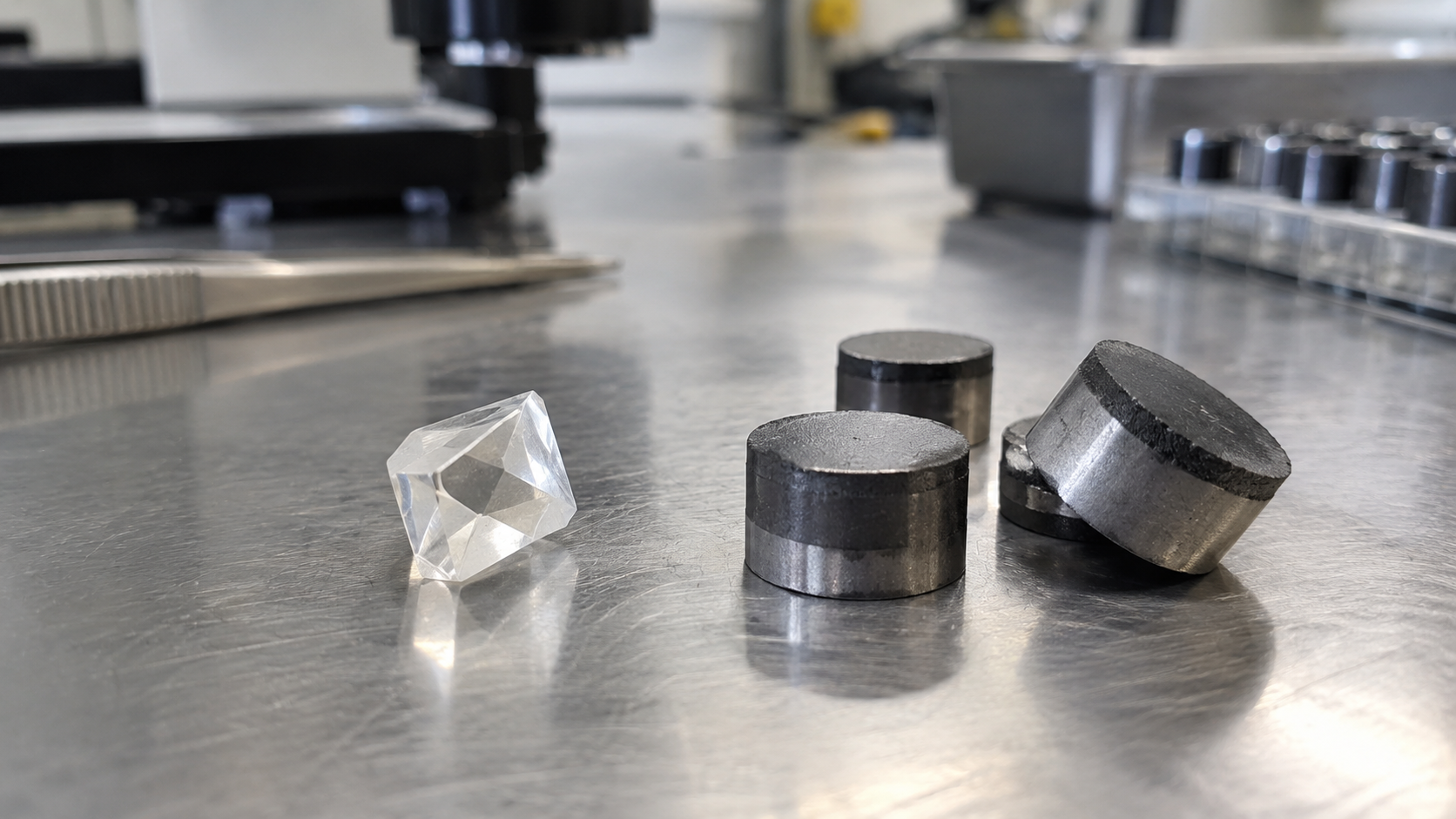
Single-crystal diamond and polycrystalline diamond are both made of carbon atoms, but the internal differences determine their completely different uses. Single crystal diamond is a crystal with a continuous lattice and no grain boundaries. Its properties vary with the crystal plane and crystal direction. The hardness and softness of the same crystal in different directions are not the same. Polycrystalline diamond is a material formed by the combination of a large number of micron-sized or even finer diamond grains, with a small amount of metallic phase and tiny pores remaining between the grains. Many sources write single crystals as monocrystalline diamonds, summarizing the comparison between the two as monocrystalline diamonds vs polycrystalline, which is essentially the same thing: the trade-off between continuous single crystals and polycrystalline aggregates.
The most obvious characteristic of single crystal diamond is its directionality. Its hardness, wear resistance and fracture behavior all change with the crystal plane. If the crystal orientation is not controlled during tool manufacturing, the cutting edge may fall precisely in a direction that is easily split. Single crystals also have well-defined cleavage planes. When the load direction and cleavage planes form an unfavorable combination, cracks can quickly penetrate the entire crystal in one direction, causing sudden brittle fracture. The grains of polycrystalline diamond are randomly oriented, and the directions of adjacent grains are different from each other. When cracks cross the grains, they will be forced to deflect and bifurcate, consuming more energy. This also shows that although polycrystals do not have a fixed path that can be split all the way to the bottom like single crystals, they may still break at grain boundary weakening or stress concentration.
Just looking at the hardness, single crystal diamond can be very prominent in the favorable crystal direction, while the hardness of polycrystalline will be slightly reduced due to the bonding phase and pores. What really widened the gap was the cutting edge. Single crystals have no grain boundaries or bonding phases inside, allowing for the machining of continuous, almost non-notched nanoscale cutting edges, making them ideal for ultra-precise cutting of non-ferrous metals, crystals, and optical molds. Polycrystalline cutting edges naturally have undulations at grain boundaries and tiny particle shedding, and their ultimate sharpness is usually not as good as that of high-quality single crystals. The strength of single crystals lies in their ultimate surface quality and contour accuracy, while the strength of polycrystals lies in the fact that the cutting edge remains stable even under wear.
If we shift our focus from hardness to toughness, the situation will be reversed. Conventional polycrystalline diamond typically has a higher fracture toughness than most single crystals, and randomly oriented grains can absorb some of the energy through crack deflection and bridging. Single crystals are prone to catastrophic fracture once defects expand in unfavorable directions due to the presence of long-range cleavage. For drilling cutting teeth subjected to random impacts, multi-axial loads, and extensive continuous wear, the risk of single-point failure is difficult to accept; controlling the crystal orientation piece by piece and then amplifying it into cutting elements on the drill bit will significantly increase costs and management difficulties.
In terms of wear resistance, some crystal orientations of single crystals are very wear-resistant, while others are easier to grind, and their performance is highly dependent on orientation. Polycrystals average the differences in different crystal directions through random orientation, making wear more predictable. In terms of thermal conductivity, both high-purity single crystal and high-purity vapor-deposited polycrystalline diamond can reach very high levels, while the thermal conductivity of sintered polycrystalline containing metal-bound phases will decrease significantly, and grain boundaries and residual metals will scatter heat flow. It should also be noted that high thermal conductivity and high heat resistance are two different things. The former describes the speed of heat transfer, while the latter describes whether the structure and performance can be maintained at high temperatures.
The available sizes, crystal faces, and defects of single-crystal diamond need to be selected piece by piece, and the complex large-size cutting edges are limited by crystal growth and processing. Polycrystalline diamond can be mass-produced into discs, slices, and composites through powder ratio and high-temperature, high-pressure sintering, making it more suitable for industrial production. This explains why single crystals are mainly found in precision machining tools, while PDC cutting teeth used in oil and gas drilling, geological exploration, mining and water well drilling almost all use polycrystalline diamond as the working layer.
The drilling cutting teeth do not make a simple choice between single crystal and polycrystalline; their structure is a composite structure of polycrystalline diamond working layer and cemented carbide matrix. The polycrystalline layer is responsible for resisting abrasive wear of the rock, while the carbide matrix is responsible for supporting, transmitting loads and providing a brazable mounting interface. Although single crystals are sharp, they lack the supporting capabilities to be installed, carried, and mass-produced. Returning to the comparison between single crystal diamond and polycrystalline diamond, who is more suitable depends on the workpiece you want to process, the load you are subjected to, and the goal you are pursuing. Ultimately, the conclusion is given by the specific working conditions.
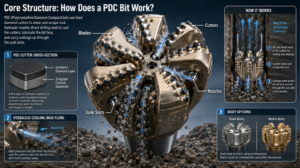
Descubre qué es una broca PDC, sus principales funciones para la perforación profunda y aprende a seleccionar correctamente la broca PDC adecuada para maximizar la velocidad de avance (ROP).
Ver detalles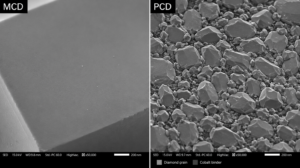
Evaluate Monocrystalline Vs Polycrystalline Diamond Applications For Extreme Precision And High-Impact PCD Tooling.
Ver detalles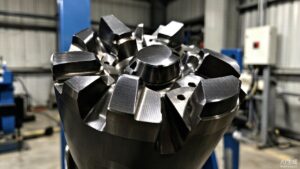
Descubre cómo se utiliza el diamante policristalino (PCD) en la perforación de pozos de petróleo y gas, la exploración geológica, el corte de piedra y el mecanizado de precisión.
Ver detalles
Fresas de PDC perfiladas KingPDC - Soluciones de suministro a granel para perforación de alto rendimiento en múltiples aplicaciones
Ver detalles