 kingpdc




product search
search
PDC bit grading evaluates cutter damage, gauge loss, and matrix erosion on a drill bit after pull-out to determine exact downhole failure mechanisms. Asset managers and rig supervisors rely on this forensic data to adjust Weight on Bit, redesign hydraulic layouts, and drastically cut the cost-per-foot on subsequent runs. Relying on legacy visual inspections introduces dangerous human bias that masks the root causes of premature bit failure. We replace subjective guesswork with forensic wear analysis, leveraging actual mechanical specific energy data to extend tool life and eliminate non-productive time.
Standard IADC codes fail to capture the dynamic forces acting on the Bottom Hole Assembly. Logging a “BT” in the dull characteristic column does nothing to explain whether high-frequency torsional oscillation or poor hole cleaning caused the fracture.
Rig operations lose hundreds of thousands of dollars annually by treating bit dull grading pdc as a simple administrative checkbox. Supervisors misinterpret complex wear patterns due to poor lighting on the rig floor and subjective experience levels. A dull grade of “4-4-WT-G-X-I-NO-PR” recorded by one driller might be recorded as “3-5-SP…” by another. This inconsistency destroys the integrity of your asset management database.
Laser optical scanning directly on the rig floor replaces the naked eye with millimeter-level precision. Handheld 3D scanners map the exact volume of diamond lost on each cutter, generating a digital twin of the worn bit.
Engineering teams map this volumetric loss against the formation logs to pinpoint the exact depth where thermal degradation began. You stop guessing which rock layer destroyed your outer cutting structure and start ordering bit modifications based on undeniable geometric data.
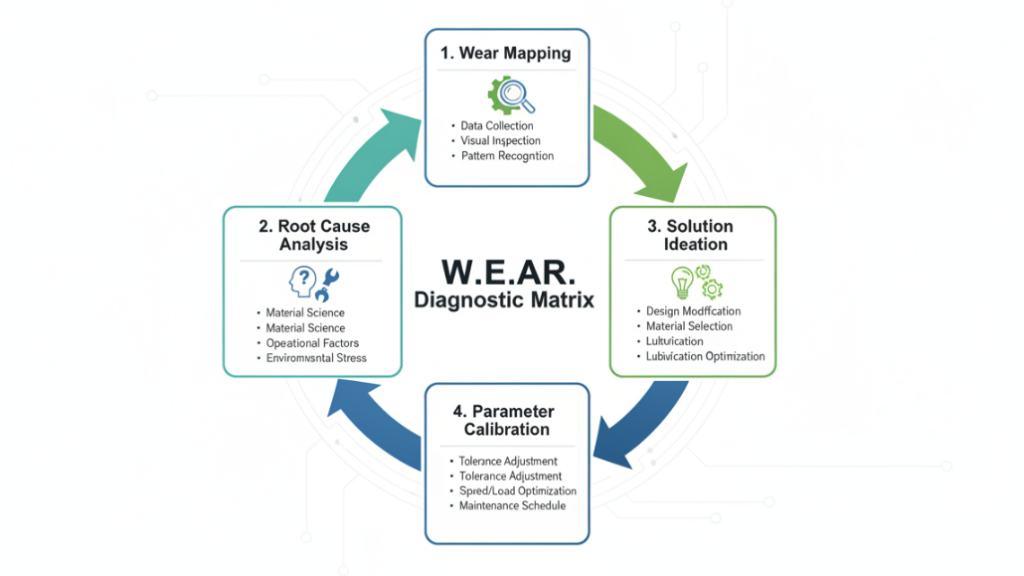
We engineered the W.E.A.R. Matrix to upgrade standard bit grading pdc into a predictive asset management tool. This framework forces drilling teams to connect surface damage with downhole energy inputs.
Pinpointing the exact physical location of the damage dictates the corrective engineering action. Shoulder wear typically indicates excessive RPM in interbedded formations, while severe inner-cone damage points directly to insufficient bit center cleaning. You map the localized wear to dictate exact back-rake angle adjustments for the next bit order.
Visible physical damage must match the Mechanical Specific Energy logs recorded during the run. A sudden spike in MSE correlating with heavy spalling on the gauge pad proves severe downhole vibrations occurred. You align the dull characteristics with surface logging data to isolate the exact moment of failure.
Physical grading data dictates the manufacturing adjustments for your next BHA. Identifying heavy matrix erosion around the nozzles forces a redesign of the hydraulic flow paths to prevent cuttings recirculation. You alter the cutter density and blade count directly based on the dominant wear patterns extracted from the dull bit.
The final grade dictates the operational limits for the Company Man on the next well. Discovering severe thermal checking on the outer row cutters mandates a strict reduction in RPM and an increase in flow rate through abrasive intervals. You dictate the driller’s operating window using the forensic evidence from the previous run.
Field supervisors frequently misdiagnose the root cause of cutter failure, leading to repetitive NPT on multi-well pads.
Drillers routinely confuse heat checking with mechanical impact spalling. Polycrystalline diamond loses its structural integrity at extreme temperatures, developing micro-cracks that eventually cause the cutter to shear off. Supervisors label this missing cutter as impact damage and respond by reducing WOB. This reduces the rate of penetration and keeps the bit in the hole longer, generating more heat and accelerating the exact thermal failure they tried to avoid. You verify thermal damage by inspecting the remaining intact cutters for spider-web-like micro-fractures before blaming rock hardness.
| Feature | Impact Spalling | Thermal Degradation |
| Visual Characteristics | Localized chipping, pitting, and material loss. Often has sharp edges. | Discoloration (yellowing, browning, charring), cracking, material softening, or embrittlement. |
| MSE Signatures | Elevated stress concentrations, localized strain, high frequency acoustic emissions during impact. | Changes in material stiffness, reduced yield strength, increased creep rates, altered thermal diffusivity. |
| Root Causes | Repetitive impact loads, insufficient material toughness, stress concentrations, improper material selection, foreign object impact. | Excessive operating temperatures, prolonged exposure to heat, insufficient cooling, high friction leading to localized heating, exothermic reactions. |
| Corrective Actions | Material upgrade (higher toughness), design modification to reduce impact, surface hardening, improved shock absorption, regular inspection for early detection. | Improved cooling systems, temperature control, material selection with higher thermal stability, reduction of friction, optimized operating parameters, heat-resistant coatings. |
Company men obsess over the primary cutting structure and ignore the gauge pads during standard evaluations. Severe under-gauge wear directly destroys the steerability of rotary steerable systems and creates micro-doglegs in the wellbore. You measure the gauge exactly to the 1/16th of an inch; anything less guarantees severe torque and drag issues during casing runs.
What is the IADC dull grading system for PDC bits?
The IADC dull grading system uses an 8-character code to record the physical condition of a pulled bit. It evaluates inner and outer cutting structures, primary dull characteristics, location of wear, bearings, gauge size, secondary wear, and the specific reason the bit was pulled out of the hole.
How do you differentiate spalling from chipping in pdc bit grading?
Chipping involves minor flaking of the diamond table edge, usually caused by poor handling or minor vibrations. Spalling is a severe structural failure where large chunks of the diamond layer break away from the tungsten carbide substrate, indicating extreme impact loads or aggressive interfacial severity.
Why is tracking the “Reason Pulled” critical for drilling optimization?
Recording the exact reason pulled provides context to the physical wear. A heavily worn bit pulled at TD is a success; the same wear pulled mid-run for low ROP indicates a drastic mismatch between bit design and formation.
What causes ‘Core Out’ on a PDC drill bit?
Core out occurs when the innermost cutters at the cone of the bit are completely destroyed, leaving a solid core of rock that prevents forward progression. This happens due to inadequate hydraulic cleaning at the bit center or dropping the bit too hard on the bottom of the hole.
How does thermal degradation affect PDC cutter life?
Thermal degradation destroys the cobalt bonding material within the polycrystalline diamond layer. Once the temperature exceeds critical limits, the cobalt expands faster than the diamond, creating internal micro-fractures that cause the entire cutter face to shatter under normal drilling loads.
Can accurate bit dull grading pdc reduce torque and drag?
Yes. Identifying specific gauge wear patterns allows engineers to select bits with enhanced active gauge protection. A stabilized gauge ensures a smoother, in-gauge wellbore, directly reducing friction during both drilling and casing installation phases.
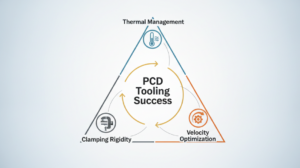
Master Polycrystalline Diamond PCD Tools. Learn Top Tooling Secrets And The T-C-V Framework To Stop Edge Failure.
View details
Find The Best PDC Cutter For Water Well. We Supply High-Impact 1308 & 1613 Inserts Balancing Cost And Durability.
View details
Boost ROP With Field Diamond’s High-Performance PDC Cutters. Advanced HPHT Sintering & Shapes For Lower Total Drilling Costs.
View details
Understand Ceramic Bond Polycrystalline Diamond, Its Sic-Bonded Tsp Example, And How It Differs From Standard Pdc.
View details