 kingpdc


product search
search

Polycrystalline diamond compact (PDC) drill bits are high-performance fixed tools that use synthetic diamond tools to shear rather than break rock. Significantly increase the rate of penetration (ROP) and extend the life of the drill bit for water well, oil, gas and mining applications. They are especially suitable for medium hard to soft formations and have superior durability compared to conventional drill bits.
To really understand the value of PDC bits in water well applications, we have to look back at the most basic engineering principles.
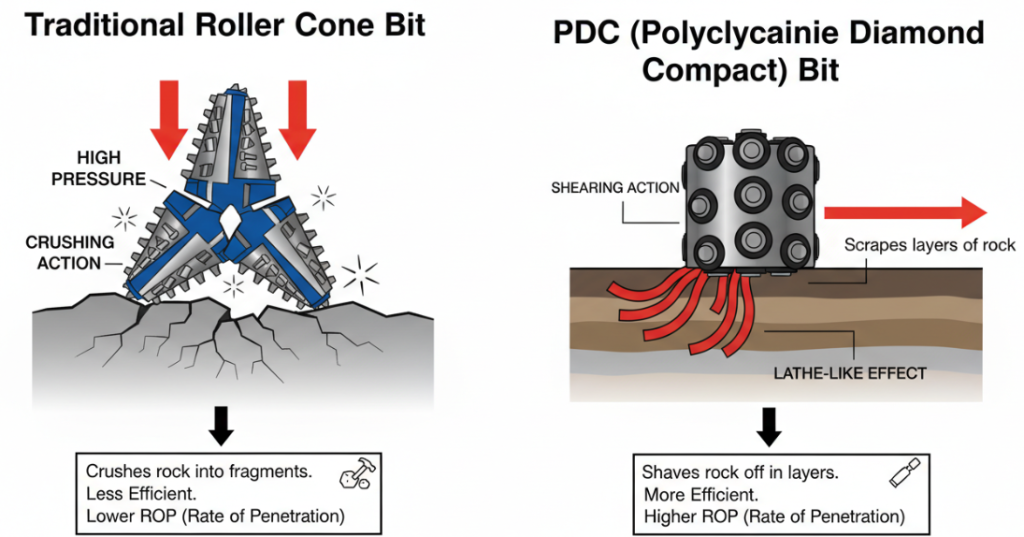
The biggest difference between PDC bits and traditional bits is the “Shearing Action”. The traditional roller cone bit relies on great pressure to crush the rock, while the PDC works more like a lathe in metal processing. Synthetic diamond cutting teeth are “scraping” down layers of rock. From the point of view of energy conversion, this shearing mechanism is much more efficient than crushing, which is why I mentioned earlier that it can lead to higher ROP.
Let’s look at the structure again. How long the drill can last depends on whether the “foundation” is played well. Usually we use tough steel body or carcass.
As for the cutting teeth themselves-the tungsten carbide substrate plus the synthetic diamond layer-provides extremely high hardness to keep the edge sharp. In some conventional applications, I ‘ve seen them last 100 times longer than conventional drills.
Flat PDC Cutter
Flat PDC Cutter features a flat structure for uniform force distribution, exceptional wear resistance for long service life, and a versatile, cost-effective design.
Dome PDC Cutter
Dome PDC cutter uses spherical geometry for superior impact resistance, ensures uniform heat dissipation to prevent thermal damage, and adapts to varied formations.
Ridge shaped
Ridge shaped PDC cutter features ridge-like projections to boost drilling efficiency, optimized chip removal channels, and an anti-rotary vibration design for stability.
Step PDC Cutter
Step PDC cutter features a step structure for staged rock breaking, reduced contact area to minimize frictional heat, and enhanced stability for reliable performance.
When talking about PDC bits for water wells, it is not enough to simply look at the material and must be classified according to hydraulic design. Different strata challenges need to match different hydraulic structures:
Even if you have the best PDC bit on hand, if the operating parameters are wrong, you will not be able to play the theoretical efficiency. As mentioned earlier, PDC performs well in shale, sandstone and limestone, but performance is highly dependent on two mechanical inputs:
In addition, hydraulic cleaning is non-negotiable.
I am most afraid to see the situation is the “mud bag”-formation material (such as mud-like shale) in the cutting teeth around the compaction, the drill paste into a smooth ball, completely lost cutting force. Maintaining high water horsepower on the drill surface, ensuring that the cutting teeth are always clean and exposing new attack surfaces, is the key to the success of the job.
Choosing the right PDC bit configuration is essentially the science of balancing cutter density and size.
In conclusion, only by carefully evaluating these factors-hardness, cloth tooth density and size-can field personnel really squeeze the performance limits of PDC technology and achieve the durability and high drilling speed we want.
Author: Robert Stone
Hi, I’m Robert Stone, a drilling efficiency specialist. My work focuses on optimizing downhole performance using Polycrystalline Diamond Compact (PDC) technology. I help drillers understand how features like shearing action and hydraulic ‘big flush’ designs can significantly increase Rates of Penetration (ROP). I am passionate about guiding you to select the right cutter density and bit size to master any formation, from soft clay to abrasive limestone.”
This will close in 0 seconds