 kingpdc


поиск товаров
поиск
Polycrystalline diamond (PCD) is a synthetic superhard material produced by sintering micron-sized diamond particles with a metal binder—typically cobalt—under extreme high-pressure and high-temperature (HPHT) conditions. Understanding exactly what is polycrystalline diamond requires looking strictly at its chemical and thermal boundaries rather than just its hardness. Junior mechanical engineers and procurement reviewers frequently cause tens of thousands of dollars in tooling scrap during their first projects by misjudging these exact limits. Examining the true polycrystalline diamond properties reveals the precise industrial environments where this material dominates, and the specific conditions that cause it to fail instantly.
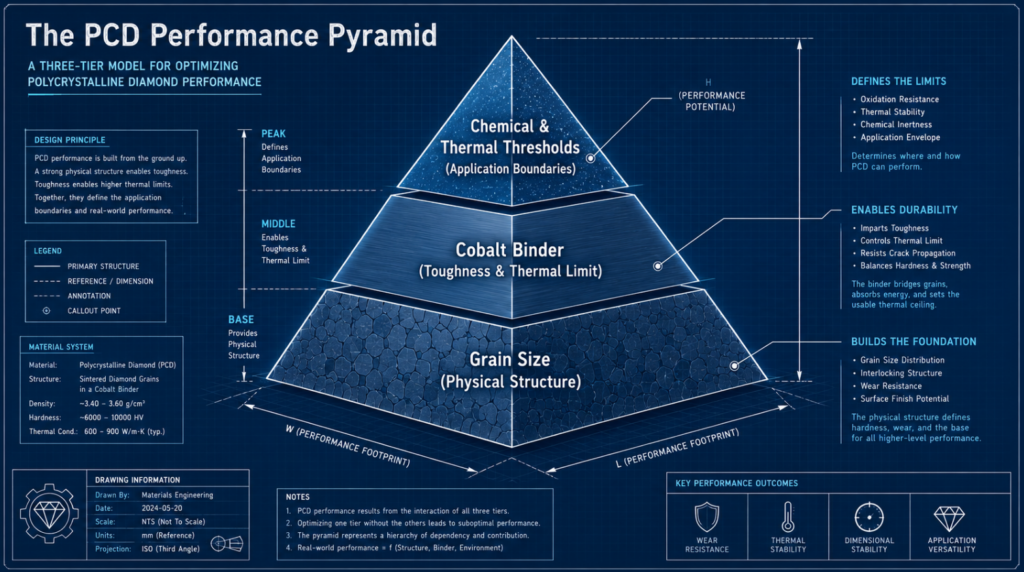
Evaluating PCD capabilities requires the “PCD Performance Pyramid” model, which structurally explains how micro-level components dictate macro-level industrial applications. Every performance metric of this material builds upward from its physical ingredients to its operational limits.
The base is Grain Size. The physical dimension of the diamond micron powder strictly dictates the balance between abrasive wear resistance and cutting edge sharpness. Fine grains provide superior surface finishes, while coarse grains absorb severe impacts.
The middle tier is the Metal Binder. Cobalt bridges the gaps between individual diamond crystals during HPHT sintering. This specific metal provides the critical fracture toughness that pure diamond lacks.
The peak represents Thermal and Chemical Limits. The direct interaction between the carbon structure and the cobalt matrix hardens the material’s operational ceiling, triggering catastrophic tool degradation at exactly 700°C.
| Материал | Vickers Hardness (GPa) | Fracture Toughness (MPa·m^1/2) | Thermal Conductivity (W/m·K) | Max Operating Temp (°C) |
|---|---|---|---|---|
| PCD | 55–80 | 6–10 | 500–1,000 | 700–750 |
| Tungsten Carbide | 12–22 | 10–28 | 40–110 | 700–800 |
| Монокристаллический алмаз (MCD) | 80–100 | 3–5 | 1,800–2,200 | 700–800 |
| PCBN | 28–45 | 4–8 | 40–130 | 1,200–1,400 |
Engineering specifications rely on quantifiable destructive test data rather than assumptions about diamond hardness. We aggregated performance metrics from laboratory machining trials to isolate three critical physical attributes defining polycrystalline diamond properties.
PCD consistently achieves a Vickers hardness between 50 and 75 GPa, ranking it directly below monocrystalline diamond (MCD) in the industrial material hierarchy. This exceptional hardness stems from the randomized orientation of the diamond crystals and the robust carbon-to-carbon (C-C) covalent bonding network.
Fracture toughness sits securely between 7.0 and 9.0 MPa·m1/2, a direct result of the cobalt binder matrix absorbing mechanical stress. MCD shatters easily along distinct cleavage planes upon impact. The randomized, interconnected structure of PCD absorbs mechanical shocks, allowing tooling to survive aggressive interrupted cutting in milling operations without catastrophic chipping.
Thermal conductivity in PCD ranges from 500 to 600 W/m·K, outperforming premium tungsten carbide by a factor of four. High thermal transfer rates rapidly pull heat away from the cutting zone. This physical trait prevents workpiece deformation and matrix melting when machining aluminum engine blocks or aerospace carbon fiber reinforced polymers (CFRP).
The cobalt binder acts as a severe thermal trap, initiating material degradation at exactly 700°C. Cobalt actively catalyzes the reverse transformation of diamond (SP3 hybridization) back into graphite (SP2 hybridization) under high heat. Breaching this temperature threshold causes immediate structural collapse of the tool edge, rendering it useless in high-heat applications like titanium machining
PCD instantly degrades when exposed to ferrous metals during any machining process. Carbon atoms share a severe chemical affinity with transition metals like iron, nickel, and cobalt at elevated cutting temperatures.
Friction against steel or cast iron causes the carbon within the diamond structure to dissolve directly into the iron matrix. This is a rapid chemical dissolution, not abrasive mechanical wear. The cutting edge vaporizes in seconds, necessitating Polycrystalline Cubic Boron Nitride (PCBN) as the mandatory alternative for any ferrous applications.
Sixty percent of initial PCD tooling implementations fail due to basic misalignments between material science realities and purchasing specifications. The following data-backed rules address the most expensive mistakes made by new project teams and mechanical engineering students.
Procurement teams frequently draft proposals replacing all carbide tooling with PCD to machine hardened steel, instantly vaporizing the entire tooling budget. PCD functions exclusively for non-ferrous metals (such as high-silicon aluminum, brass, and copper) and highly abrasive non-metallics (CFRP, ceramics, and green ceramics). Project approval chains must strictly block any PCD requisition aimed at ferrous part production.
Specifying a generic “PCD tool” on a purchase order without defining the exact grain size guarantees suboptimal surface finishes or premature tool breakage. A 2µm fine-grain PCD produces mirror-like finishes on aluminum but chips violently under heavy vibration. A 25µm coarse-grain PCD absorbs severe impacts during roughing operations but physically cannot hold a razor-sharp edge. Engineers must explicitly mandate the exact micron grade based on the specific cutting depth and surface roughness (Ra) requirements.
Material scientists recently eliminated the cobalt weakness through the commercialization of Binderless Nano Polycrystalline Diamond (NPD). By utilizing ultra-high pressure presses exceeding 15 GPa, manufacturers now sinter pure nano-diamond particles directly to one another without any metallic catalyst.
NPD pushes the thermal stability limit to 1200°C by completely removing the cobalt binder. Specialized aerospace and semiconductor manufacturing units currently deploy NPD to machine ultra-hard silicon carbide (SiC) substrates and tungsten carbide optical molds. The production cost runs roughly five times higher than standard PCD, yet it remains the only viable physical solution for next-generation hard-brittle material processing.
1. What is polycrystalline diamond used for?
Polycrystalline diamond is primarily used to manufacture industrial cutting tools, wire drawing dies, and inserts for oil and gas drill bits (PDC). Its extreme abrasion resistance makes it the standard choice for machining non-ferrous metals, abrasive wood products, and carbon fiber composites.
2. How is polycrystalline diamond made?
Manufacturers create PCD by mixing micron-sized synthetic diamond powder with a cobalt solvent catalyst. They place this mixture into a specialized press that applies over 50,000 atmospheres of pressure and temperatures exceeding 1,500°C, forcing the diamond particles to fuse together into a solid blank.
3. Can you cut steel with polycrystalline diamond?
No. Cutting steel with PCD causes an immediate chemical reaction called graphitization. The high temperatures generated during cutting cause the carbon atoms in the diamond to dissolve into the iron, destroying the tool in seconds.
4. What is the difference between monocrystalline and polycrystalline diamond?
Monocrystalline diamond consists of a single, continuous crystal lattice, making it extremely hard but prone to shattering along cleavage planes. Polycrystalline diamond consists of thousands of randomly oriented microscopic diamond grains bonded with metal, which gives it superior toughness and shock resistance.
5. What is the maximum operating temperature of PCD?
Standard cobalt-bonded PCD has a maximum operating temperature of roughly 700°C. Above this limit, the cobalt binder causes the material to degrade thermally. Newer binderless PCD grades can withstand temperatures up to 1200°C.
6. Why does grain size matter in PCD tools?
Grain size directly controls the tool’s performance profile. Fine grains (1-2µm) allow for extremely sharp cutting edges required for precision finishing. Coarse grains (10-25µm) maximize wear resistance and impact strength for heavy material removal.
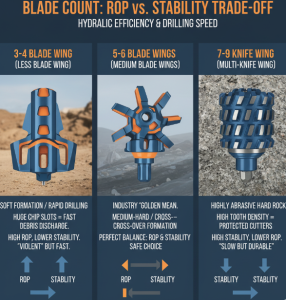
Руководство по выбору алмазных сверл PDC. Использование технических навыков для снижения затрат на закупки.
Посмотреть детали
Дилер по продаже ступенчатых фрез PDC научит вас, как правильно выбрать сверло PDC, исходя из сценариев и условий работы.
Посмотреть детали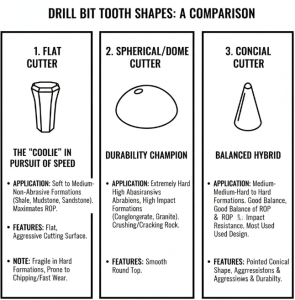
Избегайте дорогостоящих ошибок. В этой статье показано, как подобрать форму и класс резцов PDC к любому пласту для достижения максимальной производительности.
Посмотреть детали
Структура, классификация, оптимизация параметров и производительность бурового долота Pdc, его роль в эффективном бурении.
Посмотреть детали