 kingpdc


product search
search

In order to select the PDC bit for specific geological conditions, the core lies in how to find a balance between the uniaxial compressive strength (UCS) of the rock and the density of the teeth and the hydraulic design.
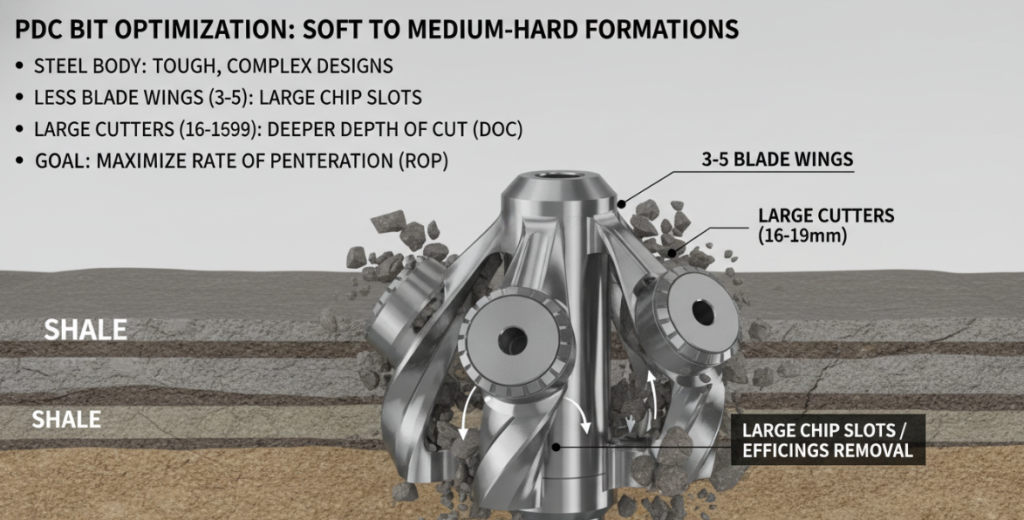
In short, for soft to medium hard formations (such as shale and sandstone), I usually recommend steel drill bits with 3 to 5 blades and large teeth with 16-19mm. This open profile design can maximize the rate of penetration (ROP) and prevent the bit from mud packing. Conversely, if it is a hard and abrasive formation (limestone, granite), you must replace the matrix drill bit, 6 to 9 blades, with 13mm small teeth, so as to disperse the impact load and extend the life of the drill bit.
The foundation of any successful drilling operation is a thorough understanding of the relationship between the PDC bit and the uniaxial compressive strength (UCS) of the formation. The UCS does provide a baseline of the force required for rock failure, but a one-size-fits-all approach will not work.
High UCS rocks require a mechanism that focuses on extrusion and grinding, while low UCS rocks respond better to shear. Therefore, the first step in the selection is not to stare at the drill catalog, but to analyze the geological data first. From this we need to determine the specific balance between the tooth density (the number of compacts contacting the bottom of the well) and the hydraulic layout.
When drilling soft to medium hard formations such as shale or sandstone, our primary goal is to achieve a full rate of penetration (ROP). In this type of geology, the rock is easily broken under shear, which allows us to adopt more aggressive bit designs.
Once you enter a hard and abrasive environment like limestone or granite, the strategy has to turn around completely. At this time, don’t just think about ROP, durability and stability are the father, and the longer the PDC bit stays downhole, the better.
Flat PDC Cutter
Flat PDC Cutter features a flat structure for uniform force distribution, exceptional wear resistance for long service life, and a versatile, cost-effective design.
Dome PDC Cutter
Dome PDC cutter uses spherical geometry for superior impact resistance, ensures uniform heat dissipation to prevent thermal damage, and adapts to varied formations.
Ridge shaped
Ridge shaped PDC cutter features ridge-like projections to boost drilling efficiency, optimized chip removal channels, and an anti-rotary vibration design for stability.
Step PDC Cutter
Step PDC cutter features a step structure for staged rock breaking, reduced contact area to minimize frictional heat, and enhanced stability for reliable performance.
The IADC code is not just a classification system, it is a blueprint for cost efficiency.
The last step in selection is to take your selection plan and cross-compare it with the abrasive IADC code of the formation. In hard rock with a soft formation bit, immediately will lead to composite wear and “ring-out “; and in soft rock with a hard formation bit, the drilling speed will be slow like a snail, but also mud bag.
Both of these conditions can lead to premature bit scrap. The end result is extremely high tripping costs. You have to know that because the failure of the drill bit brings up the drilling tool to change the drill bit, the production is not only stagnant, but the drilling time is burning at thousands of dollars per hour. Strictly following the design principles of body material, blade number and tooth size based on geological conditions, operators can avoid these wronged money.
Author: Michael Reed
With over 18 years of experience in downhole drilling operations, I specialize in PDC rock drill bit design and application. My passion lies in helping drilling teams analyze geological UCS data to select the precise blade configuration and cutter type needed to maximize ROP and extend bit life in challenging formations.