 kingpdc


product search
search

In the field of oil and gas drilling, choosing the most suitable PDC composite sheet (PDC rock cutter) is definitely the core factor to balance the two key indicators of penetration rate (ROP) and durability. For drilling engineers who often have to deal with abrasive hard rock or those troublesome interlayer formations, the so-called “best” cutting teeth are actually very clearly defined: they must have high impact toughness (to prevent catastrophic tooth chipping) and excellent thermal stability (to resist hot cracking).
In this link, the first task is to find a source factory that strictly follows API standards and has consistent and stable quality. This is not only to ensure performance, but also to actually control project costs by reducing non-productive time (NPT).
In this guide, I will disassemble how to optimize your drilling performance from the two dimensions of technical specifications and manufacturing standards.
In the process of oil and gas drilling, the high temperature generated by friction will cause the residual cobalt catalyst in the diamond polycrystalline layer to expand. This expansion creates internal stresses that lead to microcracks, which we call “thermal degradation” in the industry “.
Solution: We use advanced deep decobalation technology (Deep Leaching Technology). To put it bluntly, it is to remove the cobalt catalyst from the working surface of the diamond layer. This can significantly improve thermal stability.
Result: The cutting teeth retain a sharp cutting edge even at temperatures above 700°C. In my experience, this is essential to maintain an ideal ROP in deep, hot wells.
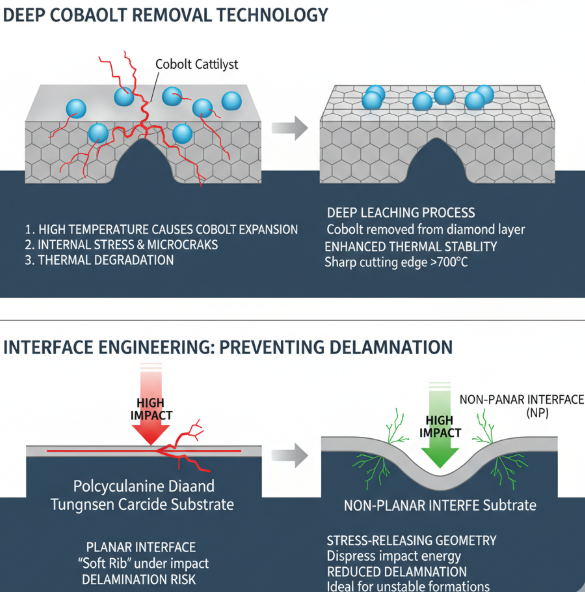
The bonding surface between the polycrystalline diamond layer and the tungsten carbide substrate is often a “soft rib” under high impact conditions “.
Non-Planar Interface (NPI): I personally strongly oppose the use of simple planar interfaces in complex conditions. Instead, we design complex, stress-releasing geometries in the bonding layer. This can disperse the impact energy more effectively. This design significantly reduces the risk of delamination (flaking) when drilling unstable formations such as conglomerate or crushed limestone.
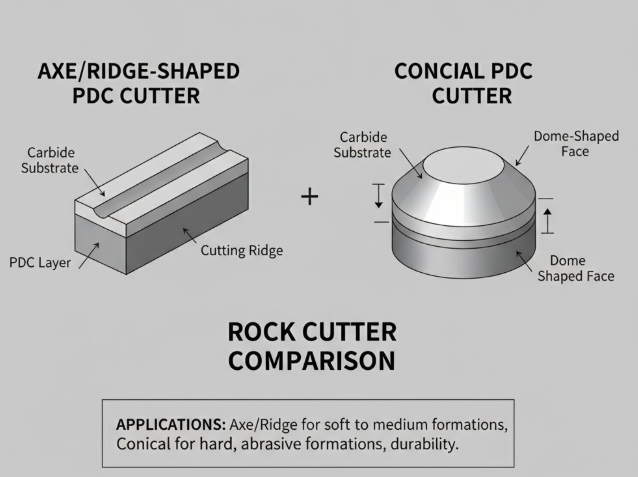
Take a general-purpose cutter to drill a specific formation, either ROP can’t go up, or you have to pull out ahead of time. According to the current drilling data on hand, I suggest that you clarify the requirements according to the following categories:
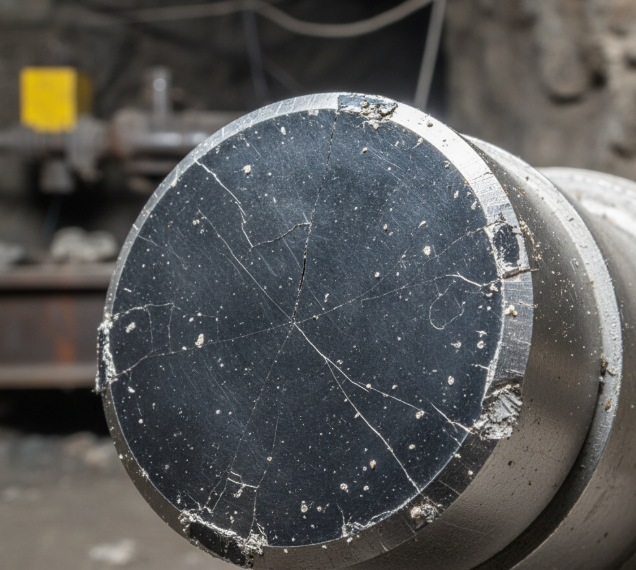
Looking at the wear of the cutting teeth, we can basically infer the working conditions of the underground:
Finally, when checking quality control (QC), these three test data are indispensable:
About the Author Michael Ross
I am Michael Ross ,the Senior PDC Material & Application Engineer . With over 11 years of experience in superhard materials and drilling dynamics, I specialize in failure analysis and cutter optimization for complex oil & gas formations. Holding a Master’s degree in Material Science, I focus on bridging the gap between manufacturing metallurgy and downhole application, dedicated to helping drilling teams eliminate premature bit failure and maximize ROP.