On the drilling platform, a damaged PDC bit means halted operations and burning money. Engineers and technicians on-site must make a critical call within minutes: is this tool salvageable or destined for the scrap heap? For the procurement department, the core mission is to secure a reliable repair solution that not only saves costs but also ensures the refurbished bit performs flawlessly downhole.
Today, I will not only share a set of rapid, field-tested decision-making rules but also show you what a truly high-quality PDC bit repair looks like.
The Rule for On-the-Spot Decisions
Immediate Repair (High Salvage Value)
Normal Cutter Wear: This is the most common scenario. The PDC cutters are worn flat or have become dull without catastrophic chipping. The bit body and gauge protection are both intact. This is a standard “retip” or “cutter replacement” job. A professional repair can restore the bit to over 90% of its original performance.
Minor Chipping/Damage to a Few Cutters: A small number of cutters (typically less than 15-20% of the total) are chipped or damaged, but the blades themselves are unharmed. For a skilled repair shop, replacing these specific cutters is a straightforward task.
Professional Assessment Required (Balancing Risk and Reward)
In the following situations, do not jump to conclusions. Immediately take clear photographs and send them to your superiors and a trusted repair vendor for a thorough evaluation.
Gauge Wear: The gauge pads of the bit are worn. If only the surface hard-facing material is worn away, the repair value is very high; the pads can be rebuilt through welding and redressing. However, if the wear is severe enough to cause the bit to become “under-gauge,” it may not be able to drill a to-spec borehole even after repair.
Erosion: You notice washout grooves near the nozzles or on the blades. Minor erosion can be repaired, but if it has cut deep into the steel bit body, the structural integrity can no longer be guaranteed. Attempting to repair such damage is, in my opinion, extremely risky.
Immediate Scrap (Avoid a Downhole Catastrophe)
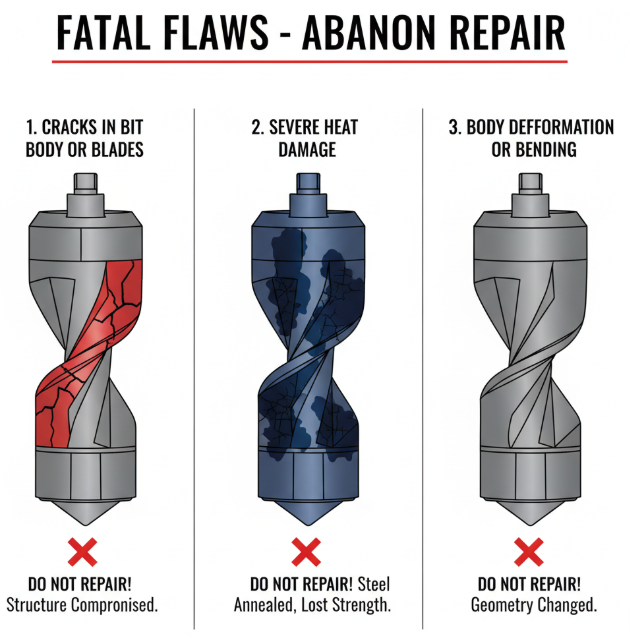
If you observe any of the following “fatal flaws,” abandon all thoughts of repair.
Cracks in the Bit Body or Blades: This is a death sentence—an absolute red line. The core structure of the bit has been compromised. No welding repair can guarantee its safety under extreme downhole stress. A failure would lead to a disastrous fishing operation.
Severe Heat Damage: Large areas of blue or black discoloration appear on the bit body or cutters. This is known as “heat checking,” a clear signal that the bit has been exposed to excessive temperatures. This means the steel has been annealed, losing its strength and hardness. The bit is fundamentally compromised.
Body Deformation or Bending: For any reason whatsoever, any significant change in the bit’s geometry should lead to its immediate decommissioning.
The 5 Core Steps of a Professional Repair
Now, let’s discuss how a reputable repair facility operates. The methods they use are what separate a valuable, refurbished asset from a piece of scrap.
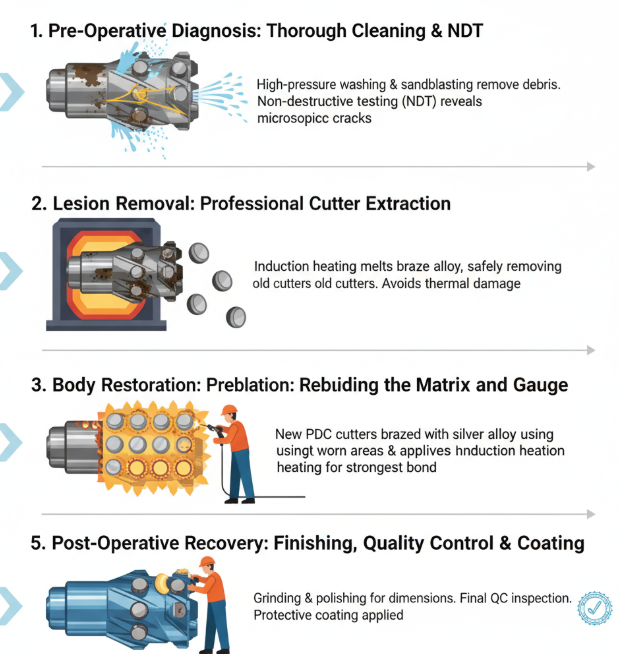
Pre-Operative Diagnosis: Thorough Cleaning & NDT
Upon arrival, the first step is to completely clean the bit of all drilling fluid and debris using a high-pressure washer and sandblasting. Technicians then use non-destructive testing (NDT) methods, such as magnetic particle or dye penetrant inspection, to identify microscopic cracks invisible to the naked eye.
Lesion Removal: Professional Cutter Extraction
A professional shop will use induction heating or a temperature-controlled furnace to heat the bit just enough to melt the braze alloy, allowing for the safe removal of the old cutters. I have seen many small workshops use direct flame torches or brute force, which can easily cause permanent thermal damage to the bit body.
Body Restoration: Rebuilding the Matrix and Gauge
If erosion or wear is present, technicians will first grind out the damaged area. They then use advanced methods like Plasma Transferred Arc (PTA) welding to rebuild the bit body and apply new hard-facing materials. The quality of this welding is directly linked to the post-repair lifespan of the bit.
Core Surgery: Precision Induction Brazing
This is the heart of the entire process. New PDC cutters are brazed into place in a tightly controlled environment using a high-quality, silver-based braze alloy. In my experience, induction heating is the superior method as it ensures the strongest possible bond with minimal thermal stress on the bit body.
Post-Operative Recovery: Finishing, Quality Control & Coating
In the final step, the brazed areas and gauge pads are carefully ground and polished to ensure correct dimensions and smooth nozzle flow. A final, comprehensive quality control inspection must be performed before the bit is painted with a protective coating.
Checklist for Selecting a Repair Vendor
When vetting suppliers, don’t just take their word for it. You need to scrutinize them like a project manager.
Do they provide detailed pre-repair inspection reports? A professional report must include clear photos, a damage assessment, and an itemized quotation.
How do they remove and install cutters? Ask them directly: Do you use induction heating or a direct flame torch? This is a key differentiator between a professional facility and a “roadside” level workshop.
Can they show you case studies of body and gauge repairs? Don’t trust the brochure. Ask them to provide “before and after” photos of repairs similar to what you require.
What is their average turnaround time (TAT)? What are the terms for delays? Get time commitments locked down in black and white in the service agreement.
Do they offer a warranty on their repair work? A company that is confident in its craftsmanship will always provide a warranty for its services.
About the Author Frank Peterson
With over 20 years in the oil and gas industry, I’ve worked my way up from a hands-on field engineer to a Senior Drilling Operations Director managing multi-million dollar projects. I’ve learned that the biggest profits come from the smartest operational decisions, not just the biggest budgets. My passion is sharing practical, field-tested knowledge that bridges the gap between the rig floor and the boardroom.
 kingpdc