 kingpdc


product search
search

The differences between PDC bits and Tricone bits lie in their structural design and rock-breaking mechanism.
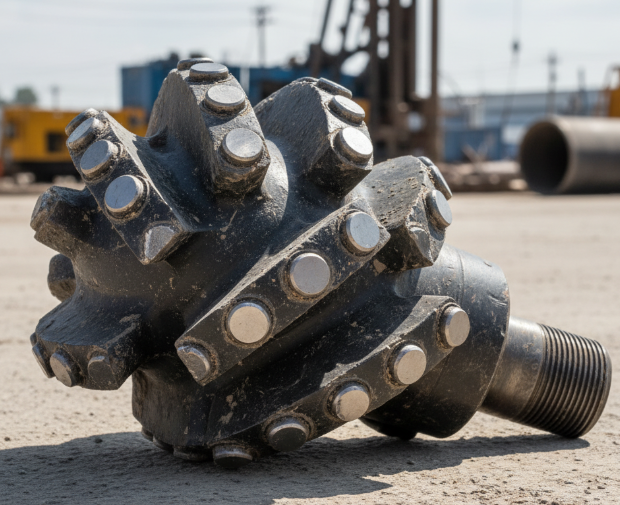
PDC drill bit, you can regard it as an integral “iron lump” with no moving parts on it. Its working mode is to rely on those PDC cutting teeth welded to the drill bit body to efficiently “scrape” away the rock by means of “shearing” or “plowing”.
In contrast, the tricone bit is an entirely different thing. It is a dynamic tool consisting of three independently rotating cones. Its rock-breaking mechanism relies on the teeth or inserts embedded in the cones to subject the rock to high-stress “impacting, crushing, and grinding”.
It is precisely this fundamental design difference that directly leads to their significant variations in application fields, performance, operational parameters, and failure modes. PDC pursues ultimate speed when drilling homogeneous strata, while the tricone offers better versatility and stability in hard, complex, and fractured strata.
| Characteristics | PDC Bit | Tricone Bit |
| Best Applicable To | Homogeneous strata ranging from soft to medium-hard, such as shale, limestone, sandstone, and salt layers. | Hard strata, highly abrasive strata, fractured strata, and complex strata with alternating hard and soft textures, such as granite, chert, and dolomite. |
| Rate of Penetration | In suitable formations, the ROP is extremely high, often several times that of a tricone bit. | Slower than PDC in soft to medium-hard formations, but can maintain a stable and reliable ROP in hard and complex formations. |
| Durability/Lifespan | Due to the absence of moving parts, it has a long lifespan in stable strata. Wear is mainly concentrated on the cutting teeth. | The lifespan is limited by that of the bearings and seals, especially at high speeds. |
| Stability | When encountering hard interlayers or gravel zones, stability is prone to vibration and impact damage, which may cause the cutting teeth to fall off or break. | The rolling rock-breaking action provides better stability and impact resistance, making it more adaptable to changing rock types. |
| Cost | The initial purchase cost is higher. However, in appropriate applications, due to the long footage and high ROP of a single drill bit, its unit footage cost may be lower. | The initial cost is relatively low. It may be more cost-effective when the durability of the drill bit is the primary consideration for short runs or in strata with high variability. |
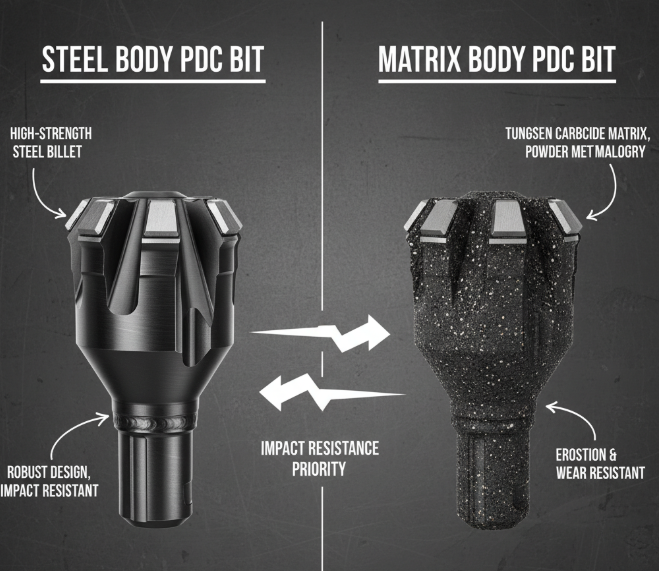
The core of the structure of PDC bits lies in their simplicity and strength. It consists of a sturdy drill bit body (either steel or matrix) and PDC cutting teeth brazed into pockets on the drill bit surface.
The absence of moving parts is a key advantage. One less moving part underground means one less risk. This greatly enhances its durability and reliability, and significantly reduces the probability of accidents caused by component wear.
The cutting element itself, namely the PDC cutter, is a composite material made by sintering a layer of polycrystalline diamond onto a tungsten carbide substrate. This combination takes advantage of the extremely high hardness and wear resistance of diamond, as well as the toughness and impact strength of cemented carbide.
The tricone bit is a complex mechanical assembly. Its main components are three cones, which are installed on bearings and rotate independently as the drill string rotates. Depending on the hardness of the stratum, the cones can be covered with milled steel teeth (for softer strata) or tungsten carbide inserts (TCI) (for medium-hard to extremely hard rocks).
The functionality of the tricone bit is entirely dependent on its complex internal components, including a bearing system (rollers, balls, and friction bearings) and a sealed lubrication system filled with grease, which protects the bearings from the harsh downhole environment. This complexity makes it a multi-functional tool, but it also introduces more potential failure points. The wear of bearings and seals is the primary factor limiting its lifespan.
PDC bits break rocks through a continuous shearing or plowing action. Under the action of weight on bit (WOB) and torque, the sharp PDC cutting teeth cut into the formation and move forward, causing the rock to fail under shear stress. This process generates large cuttings and has a very high efficiency, so a very high rate of penetration (ROP) can be achieved in a suitable homogeneous formation.
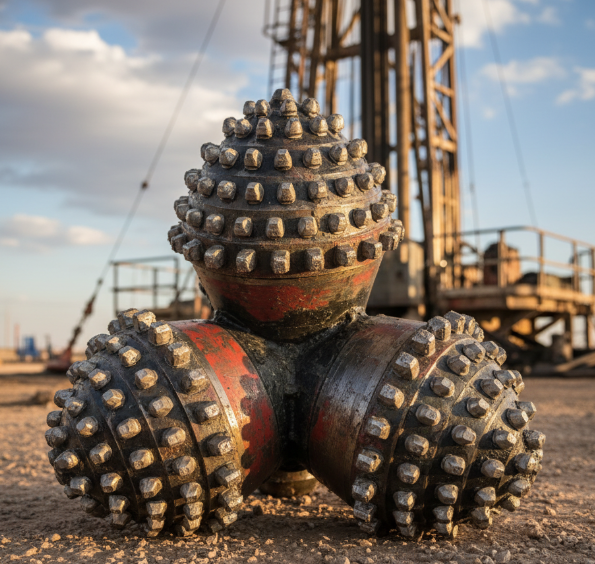
The tricone bit adopts a multi-action rock-breaking mechanism. When the drill bit rotates, the cones roll along the bottom of the well. The teeth or inserts apply extremely high point contact stress, impacting and crushing the rock beneath them. As the cones continue to rotate, a certain degree of scraping and grinding will occur between the teeth and the rock, which helps to remove the rock ridges left between the initial impact craters. This combination of “crushing + grinding” makes the tricone highly effective when drilling into hard, abrasive, and heterogeneous rock formations—in which pure shearing is very inefficient.
The techniques for operating these two types of drill bits are completely different.
Author:Leo
As a drilling engineer with over a decade of hands-on experience in the field, I’ve spent countless hours making the critical decision between running a PDC or a tricone bit. My passion lies in demystifying the complexities of drilling technology and sharing practical insights that can help fellow professionals optimize performance and reduce costs. Through articles like this, I hope to translate complex engineering principles into clear, actionable knowledge that empowers drillers and engineers to make the best choice for their unique downhole challenges.