 kingpdc


product search
search

PDC drill bit specifications are the critical technical parameters that define a bit’s physical dimensions and performance capabilities. To select the right bit for specific geological formations, engineers must evaluate six core specifications:
This video provides an overview of what drillers should know about PDC bits:
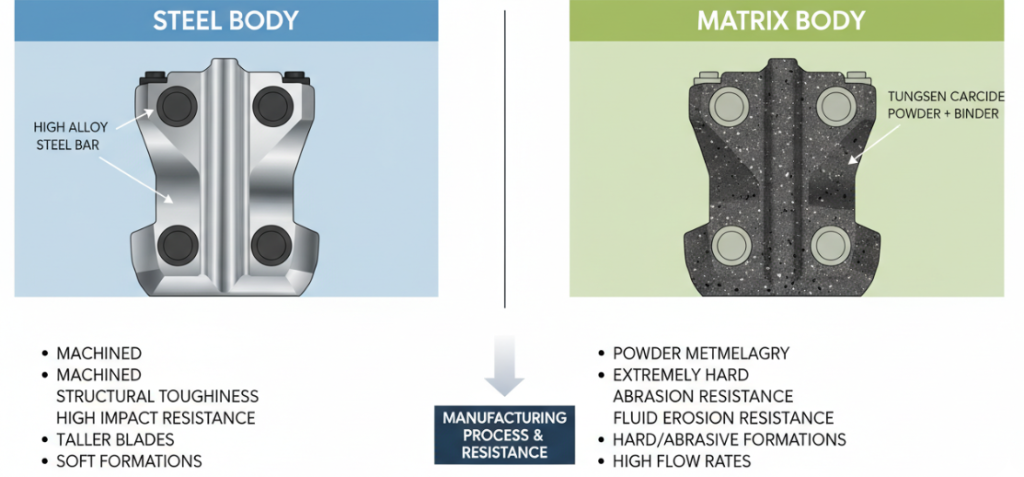
PDC bit specifications are based on the material of the bit body. This choice directly determines the manufacturing process and the resistance of the drill to wear and impact.
Steel Body: machined from high alloy steel bar. The biggest advantage of the steel body is the structural toughness and ductility. It can withstand extremely high impact loads and is not easy to crack. In addition, from a design point of view, the steel body allows us to make more complex blade designs, such as taller blades and deeper chip slots. In those soft formations that produce large amounts of debris, this is the cutting tool.
Matrix body: the use of powder metallurgy molding, the tungsten carbide powder and metal binder sintered together. The carcass is extremely hard and very resistant to fluid erosion and abrasion. If drilling in a highly abrasive formation or using a high flow rate of drilling fluid, the matrix is definitely the preferred specification because it is more resistant to Washing out than a steel body .
The number of blades is the primary specification that directly affects ROP and bit dynamic stability.
Fewer blades (3-5 blades): This type of drill is designed with huge chip grooves (open areas between the blades). This design allows the cuttings to be discharged quickly, preventing the drill bit from mud in sticky soft formations (such as mudstone or shale) . At the same time, the lower cutting tooth density allows for greater depth of cut per revolution and natural faster drilling.
Multiple blades (6-9 blades): As the formation hardens, the specification needs to be tilted towards multiple blades. The more blades, the more cutting teeth will contact the bottom of the well. This increases the total volume of the diamond, improving durability and wear resistance. Moreover, multiple blades can provide better support and reduce vibration in hard rock, which is especially important in directional drilling.
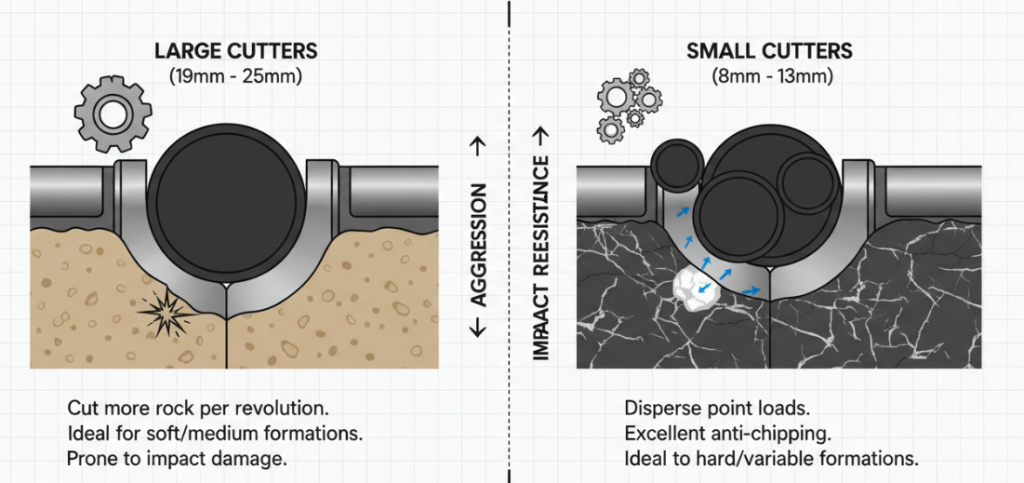
The diameter of the PDC compact (Cutters) is a determining factor in how the drill bit interacts with the rock.
Large teeth (19mm – 25mm): large size composite sheet is for aggressive and born. They can cut more rock volume per revolution and are ideal for soft to medium hard formations. However, their large size means that they are more likely to be damaged by impact when they hit a hard interlayer.
Small teeth (8mm – 13mm): In hard formations, we will specify small size composite sheets. Although less aggressive than large teeth, they disperse point loads more effectively and exhibit excellent impact resistance (anti-chipping) when drilling through formations with frequent lithological changes.
Hydraulic specifications are as important as mechanical cutting structures, and it can even be said that if you can’t drain the cuttings, it’s no use cutting them fast. The hydraulic design is responsible for managing the flow of drilling fluid to cool the PDC teeth and clean the wellbore.
Number and layout of nozzles: Engineers need to specify the number of nozzles and their orientation to ensure that the fluid hits exactly where it is needed-usually by skimming the surface of the cutting teeth to prevent overheating.
Total runner area (TFA): This is the sum of all nozzle areas. Adjusting the nozzle size is changing the TFA, which in turn controls the bit pressure drop and water horsepower (HSI). It is very important to calculate the correct TFA. We must ensure that the fluid velocity is sufficient to bring the cuttings up the annulus, but not too fast to cause erosion of the well wall.
To simplify the cost of communicating PDC bit specifications, the IADC (International Association of Drilling Contractors) classification system is commonly used in the industry. This is a 4-character code structure (for example: M232):
First place: represents the carcass material (M represents the carcass Matrix, S represents the steel steel).
Second: indicates the formation hardness (1 the softest, 4 the hardest).
The third bit: represents the size of the main cutting tooth.
Fourth: Describe the drill section (such as short, medium and long).
Understanding this code, engineers can quickly determine whether the specifications of this drill bit match the target formation, without having to go through the thick technical manual.
Finally, the geometric specifications ensure that the drill bit is physically adapted to the well bore configuration and drilling tool assembly.
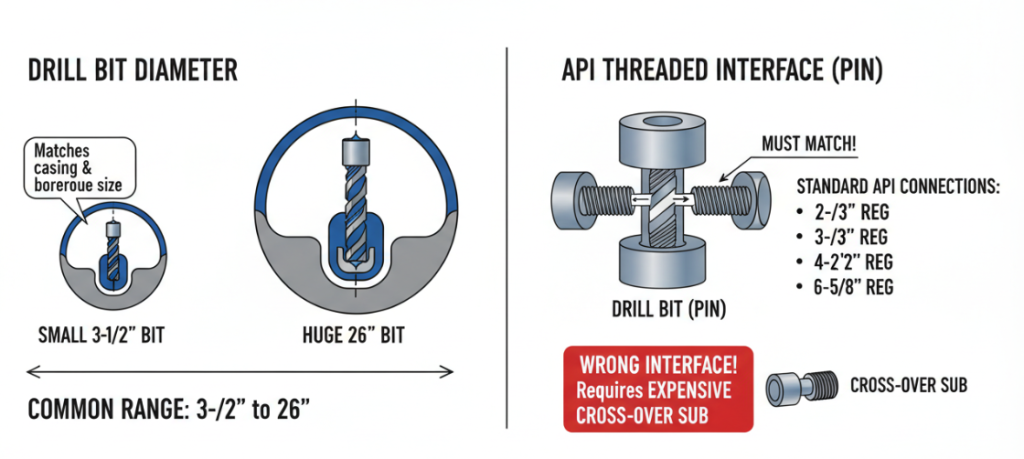
Bit diameter: must match the casing procedure and required borehole size. The common range is from a small 3-1/2 drill bit to a huge 26 drill bit.
API interface: The threaded connection (Pin) at the top of the bit must match the collar or the box of the screw. Standard specifications include API regular buckles (Reg), such as 2-3/8 , 3-1/2, 4-1/2 , 6-5/8. I have seen in the field that because of the wrong interface specifications, I have to look everywhere for expensive cross-over sub (Cross-over sub) and even cannot go down the well directly.
Author:Martin
I am a Senior Drilling Engineer with over a decade of field experience specializing in BHA optimization and bit selection. My career focuses on matching technical PDC drill bit specifications—from cutter topology to hydraulic layouts—with complex geological formations.