 kingpdc


product search
search

PDC drill bit repair is a technical remanufacturing service designed to restore a used bit’s hydraulic and mechanical performance to near-new condition. The process starts with rigorous cleaning and Non-Destructive Testing (NDT) to validate body integrity, followed by the precise removal of damaged cutting elements. Technicians then prep the cutter pockets and braze new Polycrystalline Diamond Compact (PDC) cutters onto the matrix or steel body using controlled thermal cycles. Finally, the bit undergoes gauge resurfacing and strict quality control, providing operators with a cost-effective solution that extends asset life without compromising drilling efficiency.
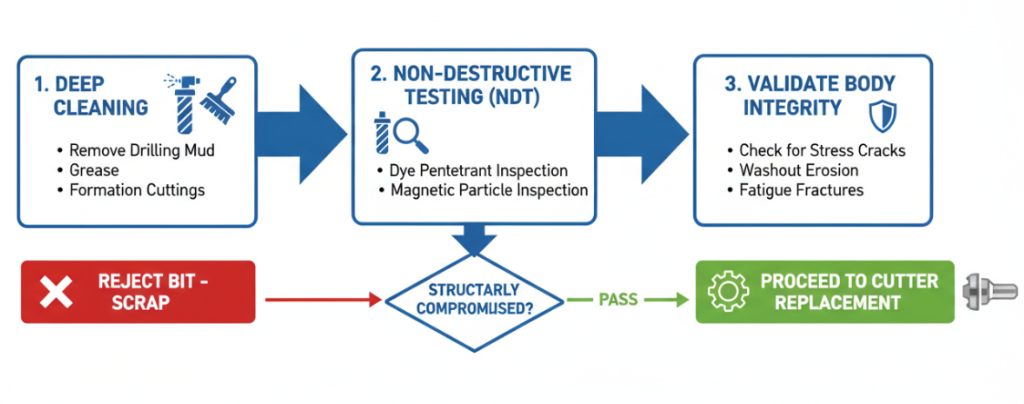
The foundation of a successful PDC drill bit repair lies in the initial evaluation. Before any repair work begins, the bit must undergo a deep cleaning process to remove drilling mud, grease, and formation cuttings. Once cleaned, the bit is subjected to rigorous Non-Destructive Testing (NDT).
Since the repair process is futile if the bit body is structurally compromised, NDT is critical. Technicians typically utilize dye penetrant inspection or magnetic particle inspection to detect stress cracks, washout erosion, or fatigue fractures in the blade or nozzle areas. This step validates the body integrity, ensuring that the matrix or steel body is robust enough to withstand another run. If the body passes this strict validation, it moves to the cutter replacement phase.
Restoring the mechanical performance requires addressing the primary cutting structure. The process involves the precise removal of damaged, worn, or broken cutting elements. This is a delicate operation; technicians must apply heat carefully to desolder the old cutters without overheating the surrounding bit body material, which could lead to metallurgical damage.
Once the damaged cutters are removed, the focus shifts to the cutter pockets. These pockets must be meticulously cleaned and prepped. Any residual braze alloy, debris, or oxidation is removed to create a pristine surface. This preparation is essential to ensure a high-strength bond when the new cutters are installed.
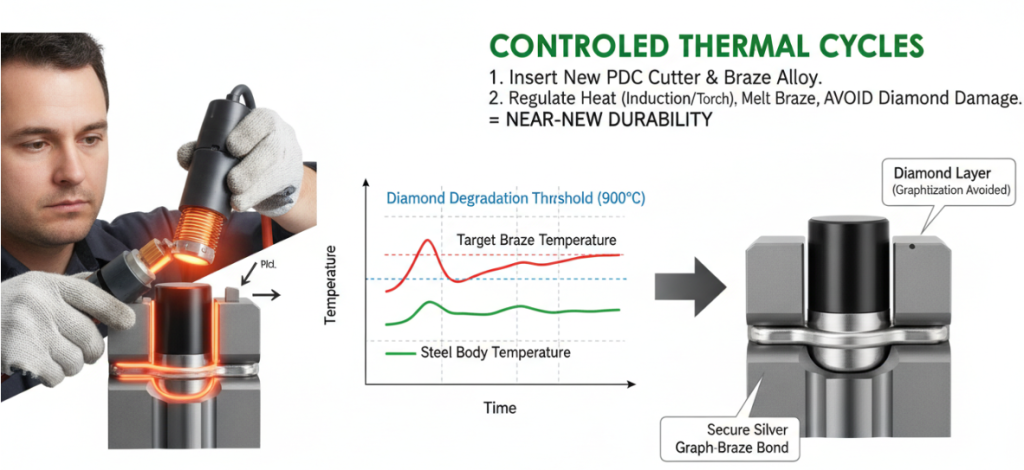
The core of the PDC drill bit repair is the installation of new Polycrystalline Diamond Compact (PDC) cutters. This stage requires a high level of expertise in metallurgy and thermal management. Technicians place new, high-grade cutters into the prepared pockets and secure them using silver-based braze alloys.
Critically, this is done using controlled thermal cycles. The heating process—whether via induction heating or precise torch work—must be carefully regulated. The goal is to melt the braze alloy for a secure bond while keeping the temperature below the threshold that would cause thermal degradation (graphitization) of the diamond layer. This balance ensures that the restored bit maintains the durability and impact resistance expected of a “near-new” tool.
A PDC bit’s ability to drill a strictly gauged hole is vital for wellbore quality. During the repair process, the bit undergoes gauge resurfacing. Wear on the gauge pads is repaired by rebuilding the hardfacing materials (such as tungsten carbide) and grinding them back to the original Outer Diameter (OD) specifications.
This step guarantees that the repaired bit will maintain the correct hole size, preventing issues like under-gauge hole sections which can lead to costly reaming runs or stuck pipe incidents.
The final stage of the workflow is strict quality control (QC). The repaired bit undergoes a final dimensional check, inspecting cutter orientation (back rake and side rake angles), nozzle standoff, and overall geometry.
By adhering to this rigorous remanufacturing standard, the service provides operators with a highly cost-effective solution. Instead of discarding a used bit, the repair extends the asset’s life significantly. This allows drilling companies to maximize their return on investment (ROI) while maintaining the drilling efficiency and Rate of Penetration (ROP) typically associated with new bits.
Author:Damon
“With over a decade of experience in downhole tool engineering, I specialize in the metallurgy and remanufacturing of PDC drill bits. My expertise focuses on thermal cycle management during brazing and rigorous NDT inspection standards, ensuring every repaired bit meets optimal hydraulic and mechanical performance requirements.”