 kingpdc


product search
search

To say how to make PDC cutting teeth perform at their best in geological exploration, in my opinion, the core essence is one: cleverly find that balance between impact resistance and wear resistance based on the actual lithology of the formation you encounter. Many people think about how to buy the cheapest tools when they talk about purchasing, but based on my years of experience, what can really help you reduce the cost of your project is by no means those “discounted products”, but those high-quality cutting teeth with consistent sintering quality (preferably verified by high temperature and high pressure). In this way, the drilling time is naturally shorter and the total cost per meter can really be reduced.
In engineering solutions, we usually consider customized chamfers (for example, I generally recommend 15°–25° for hard rock formations) and special diamond interface structures, which are all to prevent thermal degradation problems during high-speed coring operations. To put it bluntly, you need a knife that stays sharp in soft ground and won’t break easily in hard, abrasive rock.
Let’s put it this way, in my 13 years of traveling back and forth between factory lines and drilling sites, a large portion of the budget overruns I’ve seen have been caused by so-called “cheap” cutting teeth. When you purchase PDC cutting teeth for a geological exploration project, you are really not buying just a simple part, but a “insurance” for downtime.
For those in charge of the supply chain, the pressure to lower the purchase price of individual items is real. However, in the field of geological exploration, I personally believe that the only truly meaningful indicator is actually the total drilling cost (TDC).
There’s a “stealth trap” in here: A standard PDC cutting tooth, maybe upfront will save you 20%. But think about it, if it delaminated after just 50 meters (that is, the diamond layer peeled off the carbide matrix) because of poor sintering control, your team would have to stop and get off the drill pipe. That’s a big price.
The actual costs are as follows: the costs incurred by the drilling rig shutdown, manpower, and fuel during the process of lifting and lowering the drill pipe often far exceed the price of the drill bit itself.
My suggestion is: shift the focus of negotiations from “single-piece price” to “guaranteed advance”. Go find suppliers who can provide C-Scan (ultrasound scan) reports. This thing can help you confirm that the interface between diamond and tungsten carbide is intact and free of defects before it leaves the factory.
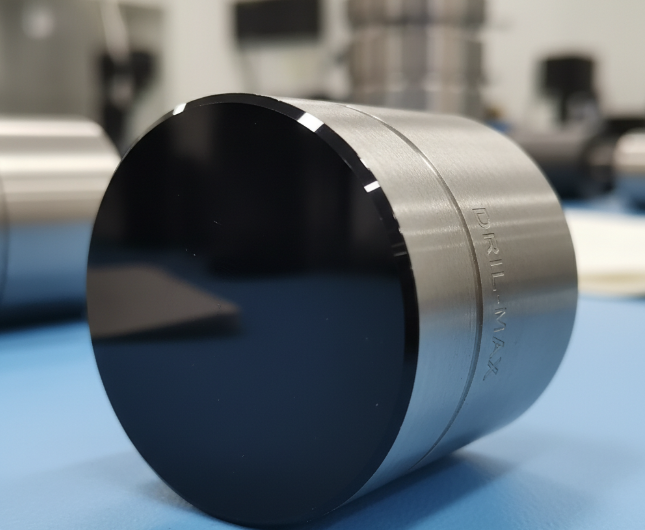
Check the consistency of the chamfer: I usually do this by casually grabbing five cutting teeth from the box. Take a closer look with a magnifying glass and if there is a noticeable difference in width or angle between their chamfered edges, then let me tell you, this manufacturer’s grinding accuracy is definitely not good. This difference will cause uneven forces on the drill bit surface, which will cause problems morning and night.
Request wear resistance data: A reliable factory should be able to provide VTL (vertical lathe) test data. For geological exploration, my experience is that you need a wear ratio that ensures both the durability of the tool and the sharpness of the cutting edge.
Delivery period for custom orders: Exploration projects often encounter unexpected rock formation changes. At this point, your supplier will have to be able to send you cutting teeth of special shapes (such as half-moon or spherical) within 15 days, not 45 days. This ability is directly related to the flexibility of our project.
Now, let’s talk about matching knife and rock types.
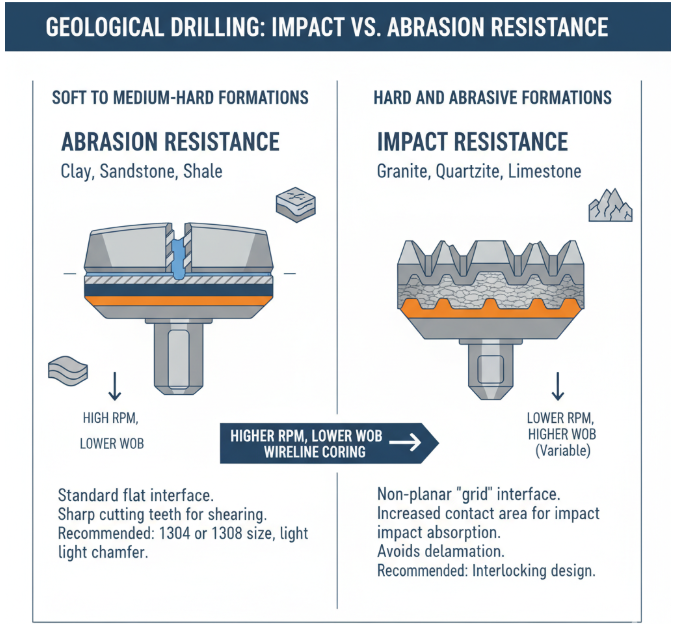
Geological drilling is a little different from oil and gas well drilling. I have found that we tend to use higher rotational speeds (RPM) and lower drill pressures (WOB), especially when coring wire rope.
For soft to medium-hard formations (clay, sandstone, shale): What you need is wear resistance. Just choose a standard flat interface. The cutting teeth must be kept sharp to shear the rock efficiently. Recommended specifications: 1304 or 1308 size, with a lighter chamfer.
For hard and abrasive formations (granite, quartzite, limestone): what you need is impact resistance. The brittle tool can easily break when the drill bit jumps or switches between different layers. My solution is: use a non-planar interface (often called a “grid” or “corrugated” interface). This design increases the contact area between diamond and carbide, significantly improving the cutting teeth’s ability to absorb impact and thus avoid delamination.
When you design or select geological exploration PDC cutting teeth for your current project, I often emphasize that these details must be clear:
This is the little beveled edge on the diamond layer.
Small chamfer (<0.3mm): Very “hard” at cutting into rock, performs well in soft formations, but is prone to chipping in hard rock.
Double chamfer: In my opinion, this is the “gold standard” for mixed formations. It provides both a durable primary cutting edge and a secondary cutting edge to limit the ruler depth and prevent overloading of the cutting teeth.
Geological exploration often involves small diameter holes, and coolant circulation can sometimes be a real hassle. If the cutting tooth temperature exceeds 700°C, common cobalt binders will induce graphitization (diamond turns back into graphite).
Tip (Pro Tip): When doing deep hole exploration, you should definitely ask if there are any deep leached (Deep Leached) cutting teeth. By removing the cobalt catalyst from the diamond surface, we can increase the upper limit of thermal stability to close to 1200°C, so that the cutting teeth can survive even if the bottom hole flushing is temporarily affected.
Ultimately, the right PDC cutting teeth directly determine the success or failure of a project. We all have the same goal: successful coring and efficient drilling. Finding the perfect geological exploration PDC cutting tooth is not a matter of luck. It requires you to analyze the formation, finalize the budget, select the cutting tooth specifications, and ultimately turn the drilling challenge into a profitable “tool”.
About the Author: David
I am a Senior Product Application Engineer with over 13 years of experience bridging the gap between the drill rig and the factory floor. Having started my career facing harsh geological formations firsthand, I now specialize in the manufacturing and sintering science of PDC cutters for geological exploration. My mission is simple: to help you select the exact specifications that maximize your ROP and minimize your project’s cost-per-meter.