 kingpdc


product search
search

The current PDC composite sheet (PDC Cutter) technology has long passed the stage of simple material hardness. The focus of the game now is how to balance the subtle relationship between thermal stability, impact toughness and wear resistance.
According to several projects I ‘ve been following recently, the latest technological breakthroughs-in particular, deep Leaching, non-planar (3D) geometries, and optimized interface engineering-are the key to solving premature failure of compacts. The underlying logic of these techniques is clear: either remove cobalt from the diamond layer as a thermal catalyst, or change the cutting mechanics from simply “shearing” the rock to “crushing” the rock.
This combination has had an immediate effect: the non-productive time (NPT) has been significantly reduced, the life of the drill bit in the transition zone (Transition Zones) has been extended, and the rate of penetration (ROP) in hard and abrasive formations has also been improved.
The core challenge of PDC composite technology, or the most troublesome problem when we make products, has always been the classic Trade-off (trade-off): teeth with high hardness are prone to brittle collapse (Chipping), while teeth with good toughness are not wear-resistant. How does modern technology break this deadlock and solve practical problems in the field?
The following is the dismantling of the 3 dimension:
When you drill abrasive sandstone or hard limestone, the heat generated by friction is phenomenal (often over 700°C). In the older generation of compacts, the cobalt catalyst used in the manufacturing process expands faster than the diamond, with the result that the diamond layer is “propped” from the inside. This is a typical ” thermal degradation “.
Solution: Deep cobalt removal technology (Deep Leaching).
Value to you: Today’s manufacturers remove the cobalt catalyst from the working surface of the composite sheet (often to a depth of several hundred microns). This creates a thermally stable layer on the surface that can withstand higher temperatures without microcracking.
Field results: Even in highly abrasive formations, you can push the speed (RPM) higher without worrying about the Gauge Cutters burning out, thus ensuring ROP throughout the footage.
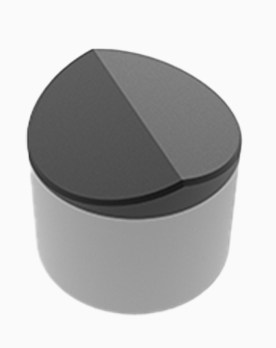
Drilling through the “hard Stringers” or stratigraphic transition zone is often the “ghost gate” of PDC bit “. Sudden impact loads can cause ” Spalling ” or large chipping of the composite sheet surface.
Solution: Non-planar (profiled) geometry.
Value to you: Don’t just stare at traditional flat-headed scalloped teeth anymore, the current technological trend is ridge, axe or tapered teeth. These shapes do two main things:
Point load (Point Loading): Concentrating the force in a smaller area is actually “plowing” or even “shattering” the rock, not just scraping.
Stress distribution: The unique shape can lead the impact force away from the most vulnerable parts of the cutting edge.
Field results: In hard carbonate formations, the instantaneous ROP can be improved by 20-30%, while reducing stick-slip vibration (Stick-slip), which indirectly protects your BHA (bottom hole assembly).
I have also encountered this kind of situation: the composite sheet looks good after pulling out of the drill, but it is inexplicably broken the next time it enters the well. This is often attributed to poor residual stress management in the manufacturing process.
Modern high-end composite sheets are equipped with engineered” chamfers (Chamfers) ” for specific lithologies. Whether it is a double chamfer or a variable chamfer design, it can significantly enhance the ability of the composite sheet to resist the initial impact when it just touches the bottom (Tagging bottom).
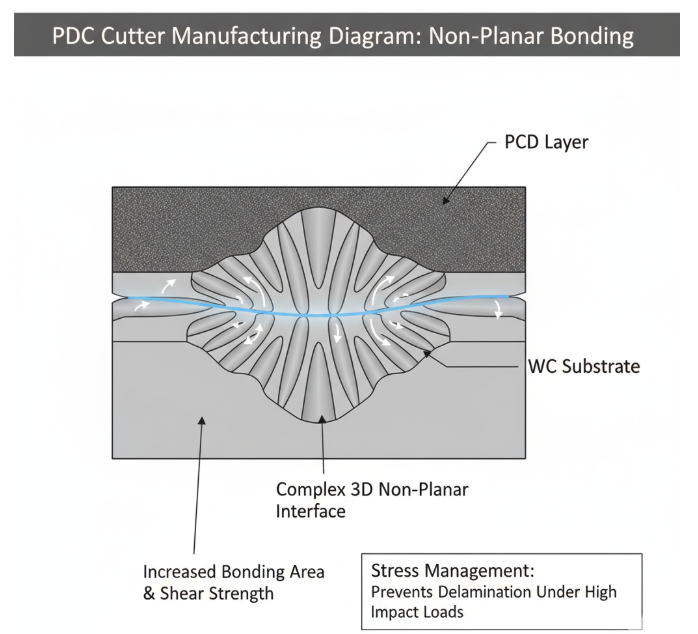
The Achilles heel of many PDC compacts is actually the interface between the polycrystalline diamond (PCD) layer and the tungsten carbide (WC) substrate.
Non-planar interfaces: We are no longer satisfied with planar bonding layers, and complex 3D interface designs (such as circular, wavy or spoke-like) are now popular.
Technical advantages: This design increases the bonding area and improves the shear strength of the connection. More importantly, they can redistribute the transient tensile stress generated during cooling after sintering. By managing these residual stresses, delamination (Delamination) accidents can be prevented under high impact loads.
The latest generation of compacts uses a multi-modal grain size distributions. Simply put, it is to mix the fine, medium and coarse diamond particles together to maximize the bulk density (Diamond Volume).
Fine particles: Provides extremely sharp cutting edges and high wear resistance.
Coarse particles: acts as a “crack Arrestors” to prevent microcracks from spreading in the diamond layer.
Results: This composite material not only achieved extremely high hardness (HV > 1601), but also retained sufficient fracture toughness (KIC) to deal with various abuses downhole.
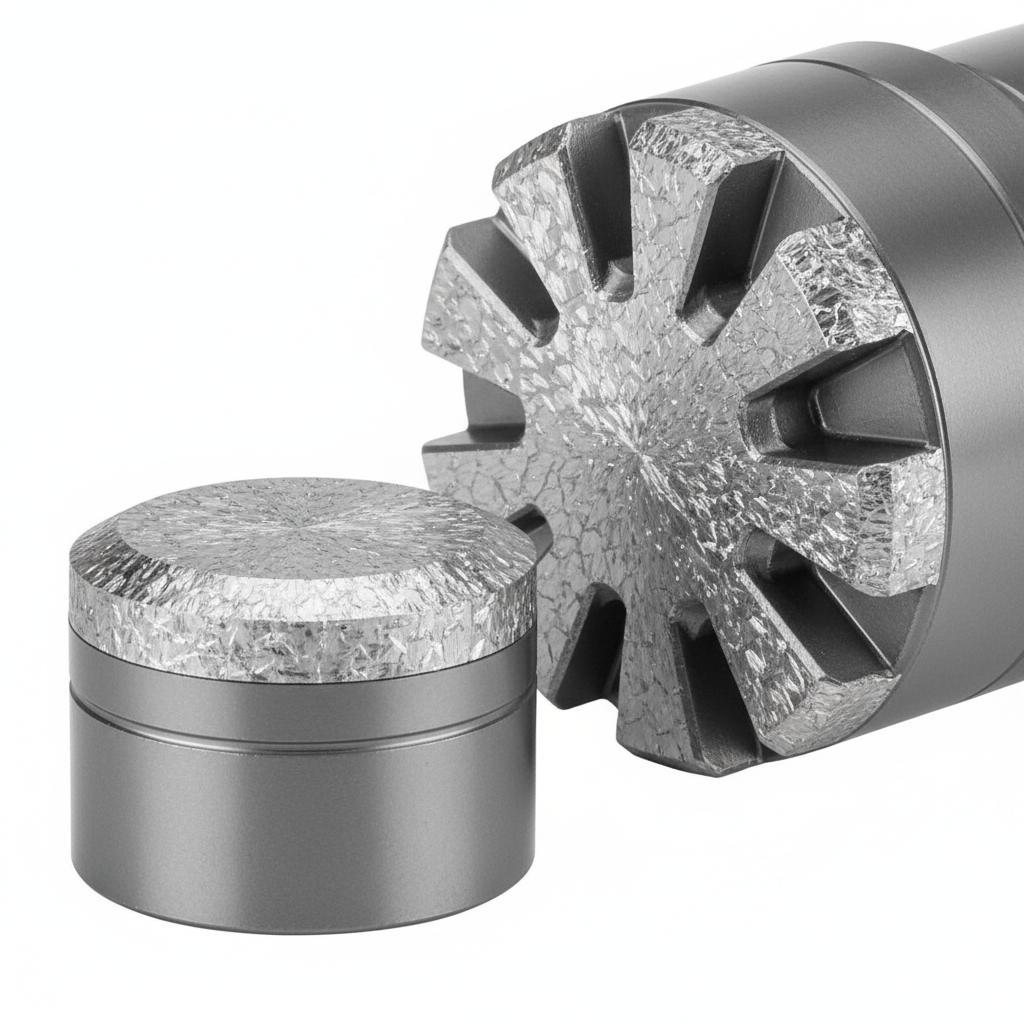
The key to bringing the cost-per-foot down is” the right medicine “.
For long, abrasive formations: preference is given to wear-resistant compacts that have undergone deep decobalification and polished surface treatment to reduce frictional heat.
For interbedding and hard formation: preference is given to impact-resistant special-shaped teeth (axe/cone), and the solid double chamfer design is matched.
About the Author: Alex
Senior Field Application Engineer & Technical Product Manager
With over 9 years in the oil & gas drilling sector, I bridge the gap between material science and rig-site reality. Starting my career on the rig floor as a Drilling Supervisor, I later transitioned to R&D for a top-tier global bit manufacturer.
I specialize in PDC cutter failure analysis, bit selection optimization, and application-specific technology matching. I have helped operators worldwide reduce drilling costs by implementing advanced cutter technologies like deep leaching and non-planar geometries. My writing aims to translate complex engineering concepts into actionable strategies for drilling faster and longer.