 kingpdc


recherche de produits
recherche
PDC bit classification utilizes the standardized 4-character IADC code to categorize fixed-cutter bits based on body material, cutter density, cutter size, and bit profile. Conversely, PDC bit nomenclature refers to manufacturer-specific naming conventions—combining body type, blade count, cutter size, and proprietary feature suffixes—used by engineers to pinpoint exact structural specifications.
Rig floor realities constantly contradict standard textbook procurement strategies. Field engineers rarely use the official IADC code to select a drill bit for complex lateral sections, relying heavily on proprietary manufacturer nomenclature to verify hydraulic layouts and directional steerability. Procuring drill bits based strictly on generalized classification charts guarantees suboptimal rate of penetration (ROP) and triggers costly unnecessary pipe trips. This technical analysis dismantles outdated bit naming rules, exposes critical procurement traps, and introduces a practical framework for decoding any fixed-cutter bit currently deployed on the rig floor.
The official IADC code provides a universal baseline for initial procurement filtering and dull grading reporting. Established in 1987 and updated in 1992, this exact character sequence remains the global industry standard for generic inventory categorization.
| Digit 1 (Body Material) | Digit 2 (Cutter Density) | Digit 3 (Cutter Size) | Digit 4 (Bit Profile) |
| M (Matrix Body) | 1 (30 or fewer cutters) | 1 (> 24 mm) | 1 (Fishtail Profile) |
| S (Steel Body) | 2 (30 to 40 cutters) | 2 (14 mm to 24 mm) | 2 (Short Profile) |
| D (Natural Diamond) | 3 (40 to 50 cutters) | 3 (8 mm to 14 mm) | 3 (Medium Profile) |
| T (TSP) / N/A | 4 (50 or more cutters) | 4 (< 8 mm) | 4 (Long Profile) |
The 1992 IADC fixed-cutter classification system creates dangerous blind spots in modern directional drilling programs. The 4-digit code (e.g., M232) fundamentally ignores junk slot volume, nozzle distribution, and gauge pad geometry. Drilling engineers require exact structural data to calculate hydraulic horsepower per square inch (HSI) and cuttings evacuation rates. The generalized IADC “cutter density” digit fails to provide the exact blade count required for these fluid dynamics calculations.
Modern Finite Element Analysis (FEA) and directional drilling platforms demand hyper-specific tool configurations. Rotary Steerable Systems (RSS) fail prematurely due to high-frequency torsional oscillations (HFTO) if the bit’s gauge pad length and depth-of-cut control elements are incompatible. Manufacturer-specific nomenclature clearly indicates these critical directional features, rendering the generic IADC code insufficient for final well planning.
Mastering any manufacturer’s naming convention requires abandoning flat specification lists and adopting the “PDC Nomenclature Pyramid.” This original 3-tier mental model categorizes bit data by operational impact, filtering out marketing noise and highlighting core engineering metrics.
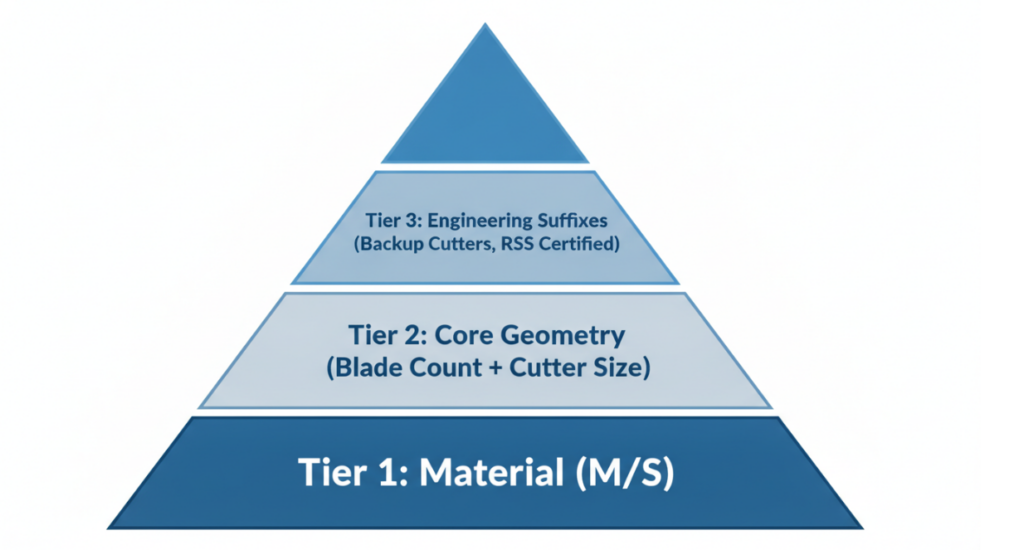
Body material dictates the manufacturing process, repairability, and ultimate erosion resistance. Nomenclature always begins with this foundation, universally utilizing ‘M’ for Matrix or ‘S’ for Steel. Matrix body bits outlast steel equivalents in high-abrasion environments like hard sandstones due to their tungsten carbide composite construction. Steel body bits provide superior impact toughness, allowing manufacturers to design taller blade standoffs for aggressive ROP in soft, reactive shales.
The geometric structure of the bit determines its sheer cutting efficiency and dynamic stability. Following the material letter, proprietary nomenclature systems list a sequence of numbers representing blade count and cutter diameter (e.g., “616” translates to 6 blades and 16mm cutters). Low blade counts with large cutters (e.g., 419) maximize depth of cut in homogenous, soft formations. High blade counts with smaller cutters (e.g., 813) deliver maximum durability when drilling through hard, interbedded rock stringers.
Suffixes transform a standard drill bit into a highly specialized downhole tool. Letters appended to the core numerical sequence designate specific engineering upgrades built into the bit face or gauge. “B” frequently indicates backup cutters designed to limit primary cutter wear. “D” or “R” specifies RSS compatibility and IDEAS platform directional certification. “PX” indicates thermally stable polycrystalline (TSP) gauge protection against severe under-gauging.
The first character establishes the structural chassis of the cutting tool. ‘M’ denotes a Matrix body construction, and ‘S’ denotes a Steel body construction. ‘D’ categorizes natural diamond bits, which operate via plowing and grinding mechanisms entirely outside standard PDC shearing parameters.
The second digit estimates the concentration of primary cutting elements on the bit face. Values strictly range from 1 to 4 for PDC bits. Digit 1 represents light density (typically fewer than 30 cutters), while digit 4 indicates extreme heavy density (50+ cutters). This metric attempts to correlate roughly with blade count but lacks precise geometric plotting.
The third character categorizes the diameter of the primary polycrystalline diamond compacts. Digit 1 indicates large cutters exceeding 24mm. Digit 2 covers the mid-to-large range of 14mm to 24mm (capturing the popular 16mm and 19mm sizes). Digit 3 represents 8mm to 14mm elements (capturing the 13mm size). Digit 4 applies to specialized micro-cutters under 8mm.
The final digit describes the overall geometric shape of the bit face. Digit 1 defines a flat profile, engineered for aggressive drilling but poor directional control. Digit 2 identifies a short profile, digit 3 indicates a medium profile, and digit 4 represents a long, parabolic profile. Long profiles distribute formation wear evenly across a massive surface area but inherently resist steering commands in tight curve sections.
Major drill bit manufacturers embed proprietary design features directly into their product nomenclature to bypass the strict limitations of standardized IADC codes. Decoding these brand-specific dialects prevents critical misapplications during tool deployment.
Smith Bits prioritizes directional certification and specific hydraulic software platforms in their product names. A designation like “MDSi616” breaks down immediately into Matrix body (M), Directional certified (D), IDEAS software platform engineered (Si), 6 blades, and 16mm cutters. The strict inclusion of the “D” suffix guarantees the tool’s gauge geometry will integrate flawlessly with push-the-bit RSS tools.
Baker Hughes heavily utilizes structural suffixes to communicate depth-of-cut control mechanisms and advanced gauge protection. A nomenclature string such as “HCC65D” indicates a Hughes Christensen (HC) Genesis series bit, featuring 6 blades, 5/8-inch (approximately 16mm) cutters, and an extended directional gauge (D). Relying strictly on an IADC code for this tool obscures the extended gauge feature, which dictates curve-building and holding capabilities.
Procurement departments waste thousands of dollars annually by treating general IADC codes as exact cross-referencing tools. The 4-character system completely ignores junk slot volume and hydraulic design layouts. Purchasing an IADC M333 bit from Manufacturer A to replace an IADC M333 bit from Manufacturer B creates a false assumption of identical performance.
Manufacturer A’s bit might feature a tall-bladed, deep junk slot design optimized for high-flow cuttings evacuation in water-based mud. Manufacturer B’s version might utilize a shallow cone with restricted junk slots meant for sliding operations in oil-based mud. Running the restricted variant in a reactive clay formation causes instantaneous bit balling, dropping ROP to zero. Engineers must cross-reference manufacturer nomenclature—specifically blade count and secondary features—rather than trusting the generalized IADC classification.
Accurately decoding proprietary bit nomenclature dictates the financial outcome of complex drilling programs. During a 2024 drilling campaign in the Delaware Basin (Wolfcamp shale), an operator experienced severe stick-slip vibrations in the curve section while utilizing a generic steel-body tool. The baseline bit was designated as S616 (Steel body, 6 blades, 16mm cutters).
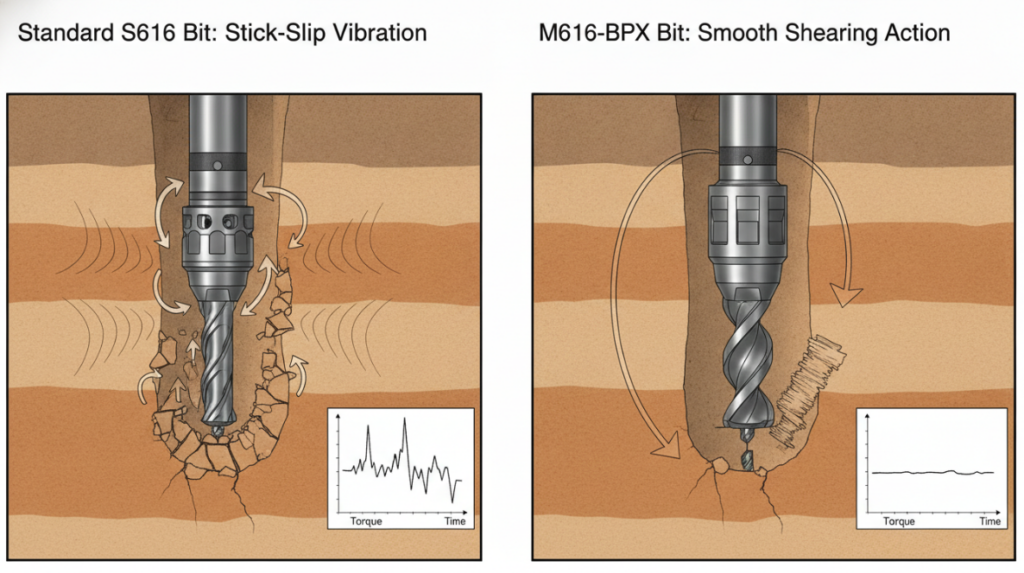
The drilling engineering team swapped the S616 for an M616-BPX (Matrix body, 6 blades, 16mm cutters, with Backup cutters and Polycrystalline diamond gauge protection) from a premium supplier. The generalized IADC codes for both bits were nearly identical (M232 vs S232), entirely masking the vast structural difference. The proprietary “-BPX” suffix indicated built-in depth-of-cut control features that successfully absorbed the torsional shocks. This exact nomenclature interpretation allowed the rig to drill the entire curve and lateral in a single run, saving approximately $50,000 in tripping costs.
1. What is the precise difference between PDC bit classification and nomenclature?
Classification utilizes the 4-digit IADC code to provide a broad, generic category based on density and material. Nomenclature represents the manufacturer’s specific naming convention (like M616-D), which defines the exact blade count, cutter size, and proprietary engineering features.
2. How do you read an IADC fixed cutter bit code?
You read the 4 characters sequentially to identify specific baseline traits: the first letter indicates body material (M/S), the second digit defines cutter density (1-4), the third digit identifies cutter size (1-4), and the final digit dictates the overall bit profile (1-4).
3. Why do drilling engineers prefer blade count nomenclature over IADC density codes?
Blade count provides the exact geometric data necessary for calculating hydraulic horsepower, nozzle placement, and cuttings evacuation area. The IADC density digit merely gives an arbitrary range of total cutters, which is practically useless for hydraulic optimization.
4. What does the suffix “X” typically mean in PDC bit nomenclature?
The “X” suffix generally denotes backup cutters or enhanced gauge pad protection, depending on the manufacturer. These elements limit depth of cut to prevent impact damage in hard rock stringers.
5. How does the bit profile digit affect directional drilling performance?
Flat (Digit 1) and short (Digit 2) profiles respond aggressively to steering commands from mud motors. Long profiles (Digit 4) inherently resist directional changes and are utilized primarily to maintain verticality or maximize durability in straight hole sections.
6. Can two PDC bits share the same IADC code but have completely different blade counts?
Yes. The IADC code groups bits by general cutter density. A bit with 5 blades and a bit with 6 blades can both possess 45 total cutters, placing them in the exact same IADC “Cutter Density 3” category despite functioning differently downhole.
7. Does the standard IADC classification system account for Rotary Steerable Systems (RSS)?
No. The 1992 IADC fixed cutter system predates modern RSS proliferation. Engineers must look at manufacturer nomenclature (like “D” or “R” suffixes) to verify if a bit’s gauge length and active cutting structure are certified for rotary steerable deployment.
KingPDC PDC Drilling Technology - Bulk Supply Cutting Solutions for Oil, Gas, and Mining Industries
Voir les détails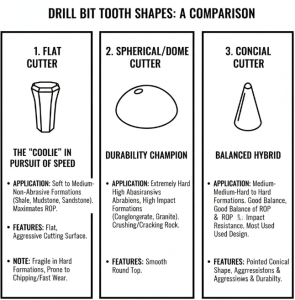
Évitez les erreurs coûteuses. Cet article vous montre comment adapter la forme et la qualité des fraises PDC à n'importe quelle formation pour obtenir un rendement maximal.
Voir les détails
Master Polycrystalline Diamond Hardness, Thermal Conductivity And Fracture Toughness For Tool Selection.
Voir les détails
Découvrez les principales différences entre les trépans PDC et les tricônes. Apprenez quel trépan convient le mieux à votre formation.
Voir les détails