Facing soft to medium hard formations (such as shale or sandstone), you usually need a 3 to 5-blade steel drill bit with 19mm large teeth to pull the rate of penetration (ROP) full. However, if you are drilling hard strata with strong abrasive properties such as granite or limestone, you must replace them with matrix drills with 6 to 8 blades and 13mm small teeth to save your life-that is, to ensure durability.
I have been running both in the workshop and the drilling team for so many years, and I have seen too many tragedies caused by the wrong bit selection: the drilling cost per foot (CPF) can directly soar by more than 300 percent simply because of the wrong configuration.
How to Select a Diamond PDC Drill Bit
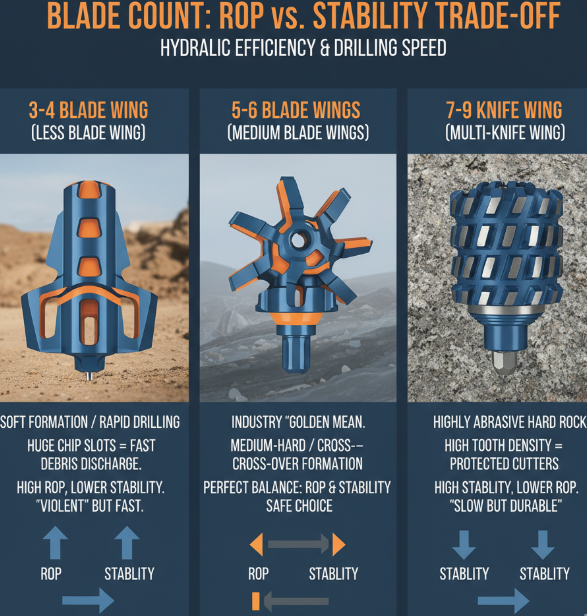
Blade Count: The ROP vs. Stability Trade-off
The number of blades directly determines your hydraulic efficiency and drilling speed.
3-4 blade wing (less blade wing):
Applicable scene: soft formation, or surface rapid drilling.
Reason: the huge chip slot (Junk slots) can ensure the fastest discharge of debris. This kind of drill bit is extremely strong and “violent”, but it also means that the downhole stability is slightly worse.
5-6 Blade Wings (Medium Blade Wings):
Positioning: the industry’s “golden oil” main force.
Applicable scene: medium-hard formation or soft-hard cross-over layer.
Why: It’s the perfect balance between ROP and stability. If you are not sure about the geological conditions underground, this is usually the safest choice and will not cause major trouble.
7-9 knife wing (multi-knife wing):
Positioning: Heavy armor.
Applicable scene: high abrasive hard rock.
Reason: The extremely high density of cloth teeth can disperse the drilling pressure and protect the composite sheet from being worn bald, but the price is that the drilling speed will slow down.
Cutter Size
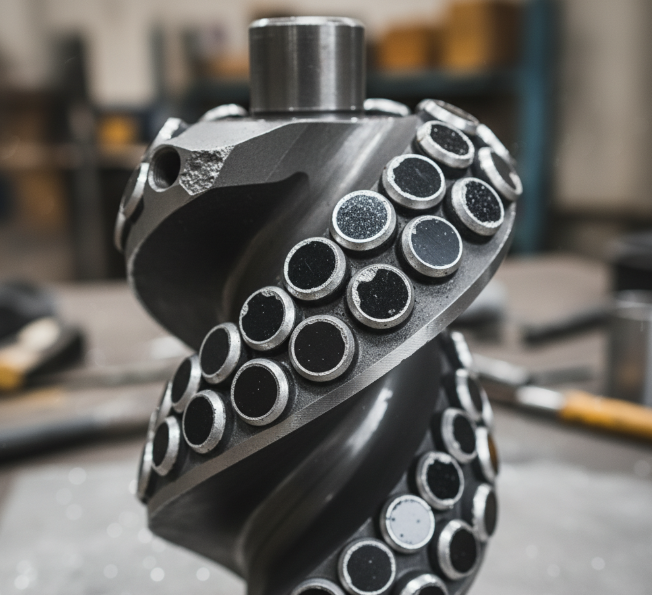
PDC composite is the heart of the drill.
19mm (3/4 ″): Think of this as a big shovel. It digs deep and quickly, but it easily collapses if it shovels into a hard rock. This is a sharp tool for drilling soft mudstone.
16mm (5/8 “): standard size, the most versatile.
13mm (1/2 ″): Think of this as a file. It does not “gnaw” much every time, but it is extremely tough. In hard rock drilling, this is the standard to prevent impact damage.
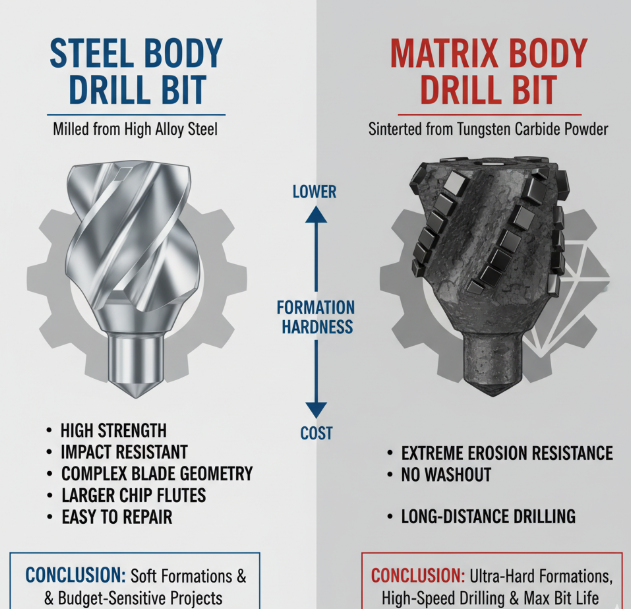
Matrix Body vs. Steel Body
Steel body drill bit:
Milled from high alloy steel by a five-axis machining center.
Advantages: high structural strength and impact resistance. We can design very complex blade geometries and larger chip flutes on steel bodies. Moreover, the steel body drill bit is relatively easy to repair.
Conclusion: soft formation and budget-sensitive projects preferred.
Matrix drill bit:
sintered from tungsten carbide powder.
Advantage: Extremely resistant to erosion. Even under high-velocity mud scouring and long-distance drilling, it will not be “washed” out of the groove like a steel body.
Conclusion: This is a mandatory option for ultra-hard formations, high-speed turbine drilling, or when “bit life” is your only KPI.
How to purchase reliable PDC drill bits
1. Verify API Spec 7-1 Certification
Before placing an order, be sure to check the certificate number of that drill factory on API website.
Why this is important: API certification proves that the factory strictly follows the quality management system (QMS) for steel heat treatment and thread gauge testing. In our factory, the annual API audit is actually a stress test. Although troublesome, it can prove that our quality control is consistent.
2. Ask for Engineering Drawings, Not Just Photos
Real manufacturers can generate customized blueprints for you.
A small test: you ask the supplier: “this order can help me adjust the back angle of the gauge teeth (Back Rake Angle)?” The trade chamber said, “I’ll have to ask.” And a factory technical director like me will send the modified CAD drawings to your email within 24 hours.
3. Focus on “Cost Per Foot,” Not “Price Per Bit”
The “cheap” option: you buy a 500drill,drill300feetandscrapit.Yourcostis:500drill,drill300feetandscrapit.Yourcostis:1.67/ft.
The “expensive” option: You pay 900foragooddrillanddry1200feetinonego.Yourcostis:900foragooddrillanddry1200feetinonego.Yourcostis:0.75/ft.
Conclusion: That seemingly “expensive” drill bit actually saves you more than 50% of the direct cost-and that’s not counting the valuable rig time you save by tripping out less.
Possible problems and solutions
Problem A: Bit Balling
Symptoms: Weight on Bit (WOB) is added, but the footage does not move. The pump pressure suddenly spiked.
Reason: Use bits with too many blades or unreasonable nozzle layout to drill viscous clay/shale.
Solution: You don’t need a harder drill bit at this time; what you need is a steel drill bit with fewer blades, and its hydraulic flow field (CFD design) is optimized to clean the cutting teeth.
Problem B: Impact Damage (Chipping)
Symptoms: The composite is chipped or sheared, not ground flat.
Cause: severe vibration, or drilling over gravel layer/soft and hard cross layer.
Solution: Change to a drill bit with “shock absorbing teeth” (Impact Arrestors) or a more shock-resistant blade profile. In this case, simply changing to a harder composite sheet is useless; what you need is a more resistant engineering design.
About the Author: David Chen
I am the Technical Director and Senior Drilling Engineer . My career didn’t start in a factory—it started on the rig floors of Texas and the Middle East, where I spent 8 years dealing with the harsh realities of drilling operations.
I’ve personally experienced the frustration of premature bit failure and the pressure of keeping a project on budget. That experience drove me to transition into manufacturing R&D. Today, I combine my field background with advanced engineering to design high-performance Diamond PDC Drill Bits that meet strict API standards. I don’t just sell tools; I help drilling contractors and procurement managers analyze their formation data to select the perfect bit configuration, ensuring maximum ROP and durability for every project.
 kingpdc