 kingpdc


product search
search

Standard PDC drill bit sizes range widely from 3-1/2 (88.9mm) to 26 (660.4mm), depending on the wellbore profile. The most common industry workhorse sizes are 6, 8-1/2 (or 8-3/4), 12-1/4, and 17-1/2, which are specifically engineered to pass through standard API casing strings (7, 9-5/8, 13-3/8, and 20, respectively). Beyond these primary standards, intermediate sizes such as 6-3/4, 7-7/8, and 9-7/8 are also frequently used for specific formation requirements. Ultimately, selecting the correct PDC bit size is strictly dictated by the drift diameter of the previous casing string and the required API Pin connection size.
Although the current manufacturing process allows us to make PDC bits any size from 3-1/2 to 26, the entire drilling industry is still highly dependent on specific standard sizes. This is not a random habit, but to ensure the commonality of drilling projects and the availability of equipment worldwide. Just imagine, if you are in urgent need of drill bits in a remote drilling team, the standard size can usually be transferred immediately, while the non-standard size may have to wait several weeks for the manufacturing cycle.
For well structure design, it is important to understand the application scenarios of these “main force” dimensions:
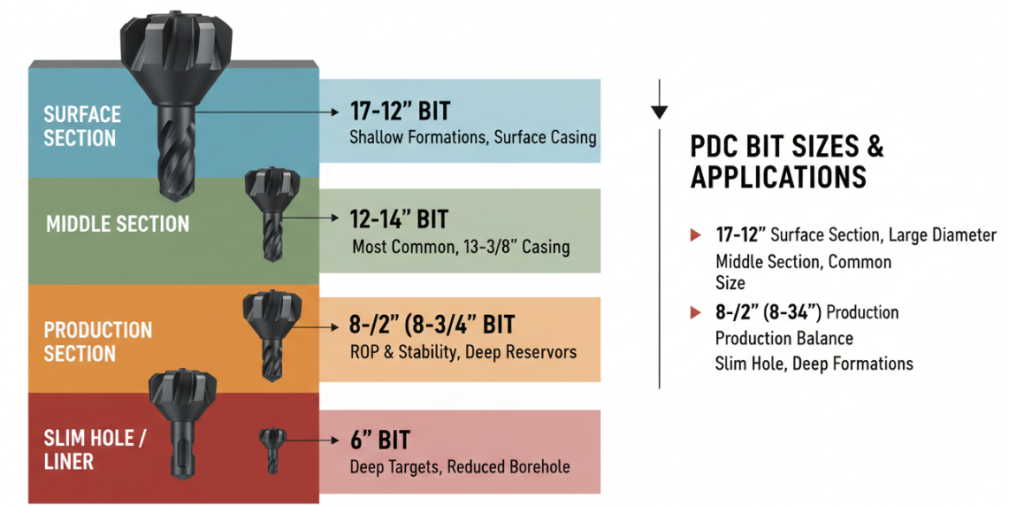
The choice of PDC bit is inseparable from the API casing installed last time. The logic is simple: the bit must be able to pass through the existing casing in order to drill into the next section of the formation.
Here is the standard correlation between the “workhorse” bit sizes and their corresponding API casing sizes:
| PDC Drill Bit Size | Corresponding API Casing Size | Application Context |
| 17-1/2” (444.5mm) | 20” (508mm) | Surface Hole Sections |
| 12-1/4” (311.2mm) | 13-3/8” (339.7mm) | Intermediate Sections |
| 8-1/2” (215.9mm) | 9-5/8” (244.5mm) | Production Sections |
| 6” (152.4mm) | 7” (177.8mm) | Liner / Deep Sections |
Note: While 8-3/4 is an alternative to 8-1/2, it requires careful calculation of the casing drift to ensure clearance.
Although the standard size occupies the vast majority of the market share, the underground situation is complex and changeable, and sometimes we need those “non-standard” intermediate sizes. Sizes such as 6-3/4 “, 7-7/8” and 9-7/8 “come in handy when standard bits do not provide the best annulus return speed, or when non-standard casing/tailpipe is used.
Choosing the correct PDC bit size must be technically verified with Drift Diameter and API thread connections.
The absolute upper limit of PDC bit size is determined by the drift diameter of the previous layer of casing, not just its nominal inner diameter (ID). The drift diameter represents the minimum diameter guarantee that the standard gauge can pass smoothly.
Field rule: The outer diameter (OD) of the PDC bit must always be less than the drift diameter of the casing. Otherwise, the drill bit will be stuck halfway 100% when drilling down (RIH), which will be very troublesome to deal.
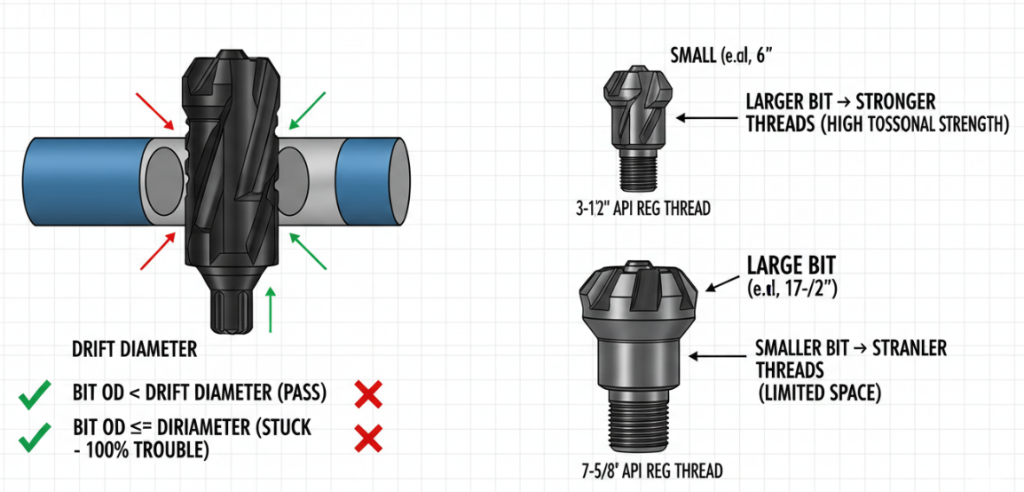
This is often overlooked-the physical size of the drill bit determines how much API thread (the threaded part that connects the drill bit to the drill string) it can connect.
Making sure the thread size matches your collar or bottom hole assembly (BHA) is no less important than choosing the right bit diameter.
Author:Perry
With over a decade of experience in drilling engineering and BHA design, I specialize in optimizing downhole tool selection. My focus is on matching high-performance PDC bits with specific wellbore profiles and casing programs to ensure maximum drilling efficiency and operational safety.