 kingpdc



product search
search

PDC drill bit is a high-performance, fixed-head tool with no moving parts for the oil, gas, geothermal, and mining industries. Its cutting mechanism relies on shearing, or scraping away rock, rather than the crushing action of traditional roller cone bits. This is achieved using specialized cutters made of a synthetic diamond layer bonded to a tungsten carbide substrate. This unique construction makes PDC bits exceptionally hard, durable, and wear-resistant, allowing them to drill faster, last longer, and create smoother boreholes in the right conditions. Structurally, a PDC bit consists of a solid body (made of either steel or a tungsten carbide matrix material) that holds the PDC cutters, blades that define fluid channels, and nozzles that direct drilling fluid to cool the cutters and clean the hole. Their fixed-cutter design enhances stability and reliability, making them a go-to choice for drilling through consistent soft to medium-hard rock formations like shale, limestone, and sandstone.
PDC bit breaks rock by shearing. Based on the monolithic design we mentioned above, the drill feels a bit like a turning tool on a lathe or a chisel for woodworking. As the drill bit rotates, the cutting teeth cut into the formation and “planed” the rock. This way of shearing rock is far more efficient than crushing. My understanding is that to remove the same volume of rock, much less energy is required for shearing. Therefore, this is the fundamental reason why PDC bits can achieve higher penetration rate (ROP), which can help operators drill faster and the project efficiency will naturally go up.
The reason why PDC bits are so hard and durable is all at the core of its material science. The word “PDC”, the full name is “Polycrystalline Diamond Compact”, that is, polycrystalline diamond compact. Its cutting teeth are manufactured by pressing a layer of synthetic diamond and a tungsten carbide substrate together under high temperature and high pressure.
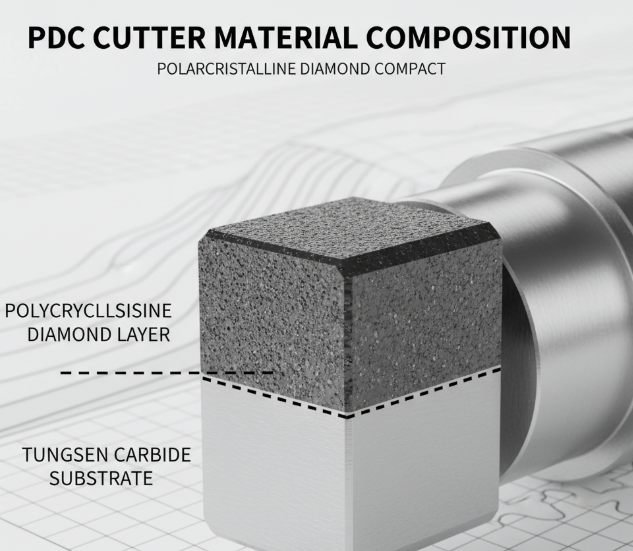
Diamond layer: This layer provides extremely high wear resistance, ensuring that the cutting edge of the drill remains sharp after drilling for several kilometers.
Tungsten Carbide Matrix: This layer mainly provides impact resistance and structural support, preventing the brittle diamond layer above from chipping under huge drilling loads.
It makes the cutting teeth both thermally stable and strong, ensuring that the life of the entire tool far exceeds that of traditional drill bits, directly reducing the number and cost of frequent tripping due to changing drill bits.
Meet the Demands of High lmpact, High-Wear Oil-Drilling Operations. Delivering Longer Lifespan and Less Downtime De signed for. Efficient and Durable Oil Drilling Applications with PDC Cutters.
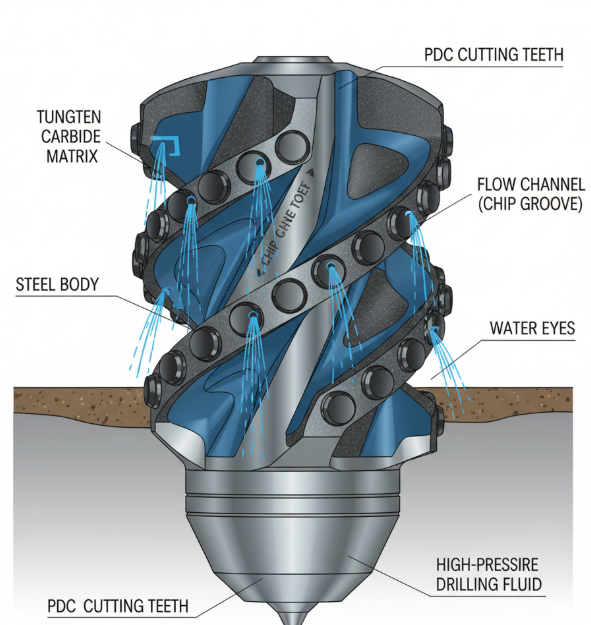
In order to support those high-performance cutting teeth, the overall structure of the PDC bit is designed with emphasis on stability and hydraulic efficiency.
Strong body structure: The drill bit body is usually made of two materials. The one is a steel body (better toughness and easier to manufacture), and the other one is a tungsten carbide matrix (much stronger erosion resistance). This one-piece design eliminates the risk of moving parts such as cones or bearings falling into the well, as a roller cone bit.
Blades and runners: The cutting teeth are mounted on blades that extend from the bit body. The space between the blades forms a flow channel (we often call it a chip groove), and the drilled cuttings are taken away from these grooves to ensure that the bottom of the well is clean.
Water eyes: These precisely calculated and positioned water eyes can accurately spray high-pressure drilling fluid onto the surface of each cutting tooth. This has two key functions: the first is to cool the diamond cutting teeth that produce high heat by friction; the second is to wash the cuttings away from the bottom of the well and return to the ground along the annulus to prevent the drill from being stuck by the cuttings, which is what we often call “mud bag”.
Although the performance of PDC bit is powerful, it is not a panacea, and the efficiency depends largely on the geological conditions. Its integral design and shearing mechanism determine that it is an absolute ideal choice when dealing with soft to medium hard formations with uniform composition. Common rock types where PDC bits perform well include:
Shale
Limestone
Sandstone
In these well-consolidated formations, the borehole wall punched by a PDC bit will be much smoother than the percussive crushing method of a cone bit. However, because it relies on shear, it is most efficient in formations with uniform geological composition.
All in all, by matching the proper PDC bit design to the specific rock type, the stability, reliability and penetration rate of the entire drilling operation can be greatly improved.
Author:Floyd
I am a drilling technology specialist with a focus on downhole tool mechanics and material science. With extensive experience in analyzing rock-cutter interactions, I specialize in explaining how synthetic diamond technologies and tungsten carbide structures optimize drilling performance.I hope to help industry professionals understand the engineering behind high-efficiency PDC bits.
Improve ROP With The Latest PDC Cutter Technology. Expert Analysis On Deep Leaching, 3d Shapes, And Solving Bit Failure.
View details
View The PDC Cutting Gear Dimension Drawing. Learn The Standard Specifications And Tolerances And Make Selections.
View details
Master PDC Cutter Technology: Deep Leaching, Non-Planar Designs, And Grade Selection For Maximum ROP And Low CPF
View details
PDC (Polycrystalline Diamond Compact) cutters are integral components in drilling operations across a variety of industries, including oil and gas, mining, and construction. These advanced cutting tools are specifically engineered for hig...
View details