 kingpdc


product search
search

The core of choosing the right PDC cutting teeth is “precise matching”. To put it bluntly, it is to accurately number the geometric shape of the cutting tooth (for example, for the pursuit of high drilling speed flat-top type or for the durable semi-spherical type) with the hardness of the formation, and then to pick the grade of diamond to find a balance between cost and performance.
Next, I’m going to talk about the boring parameters in the specifications, especially the hidden trade-offs (Trade-offs) that manufacturers usually don’t take the initiative to emphasize-this is the key to expert selection.
According to the on-site accidents I have dealt with, choosing the wrong tooth shape is often the first major incentive for the premature failure of the drill bit or the failure of ROP (rate of penetration). Let’s simplify the matter and get to the point.
Best application scenario: In soft to medium-hard, non-abrasive formations such as shale, mudstone and sandstone, if you want to soar ROP to the highest, you must be right to choose it.
What it is: The features are very obvious, with a flat and very aggressive cutting surface.
Note: This sharp cutting edge is very fragile in hard formation or interlayer formation, easy to collapse (Chipping), wear fast.
Best application scenario: used for harsh conditions with extremely hard, high abrasiveness or high impact, such as conglomerate and granite. It works more like crushing and cracking rock than shearing.
What it is: The top is smooth and round, with no sharp edges.
Note: Its ROP is significantly lower than that of flat teeth. If the primary goal of the shift is to speed up, don’t use this.
Best application scenario: The pangold option for medium-hard to hard formations has a good balance between ROP and impact resistance. This is one of the most used designs on the market today.
What it is: The pointed conical shape combines the aggressiveness of flat teeth and the durability of spherical teeth.
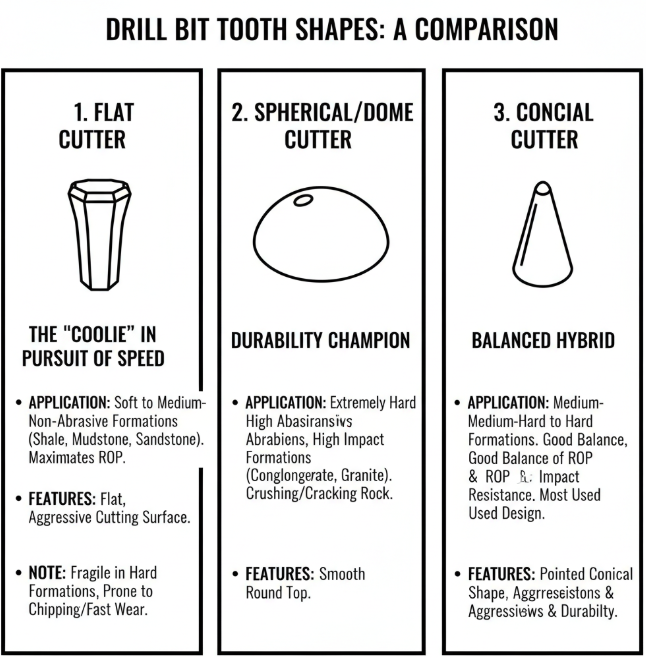
Chamfer (Chamfer): The small bevel on the cutting edge. Don’t underestimate this small detail. The larger the chamfer, the stronger the strength and impact resistance of the cutting edge, but at the cost of a little sacrifice of aggressiveness.
Rake Angle: The relative angle of the cutting surface to the rock. Positive inclination (Positive) is more aggressive (eating soft rock fragrance), while negative inclination (Negative) is stronger in structure and suitable for hard bones.
My rule of thumb: first look at the geological report to determine the general direction (flat, spherical or conical), and then fine-tune it through chamfering and inclination. This is like cooking, the main material is selected, and the temperature has to be controlled by these two parameters.
In order to facilitate comparison, I have compiled the following table:
| Cutting Teeth Type | Role and Shape Features | Best Scenario | Performance and Remarks |
| Flat tooth (Flat) | speed acts as <br> flat, aggressive cutting surface. | Soft to medium hard <br> non-abrasive formations (shale, sandstone, etc.). | Pros: Very high ROP. <br> Disadvantages: easy to collapse in hard formation or interlayer, fast wear. |
| Dome | Durable King <br> Smooth, rounded, with no edges. | Extremely hard/highly abrasive <br> high impact conditions (conglomerate, granite). | Advantages: High impact resistance by crushing/cracking rocks. <br> Disadvantages: ROP is significantly lower and is not suitable for catching up time. |
| Tapered teeth (Conical) | balance hybrid <br> sharp conical shape. | Medium hard to hard <br> The current versatile all-rater. | Advantages: both the aggressiveness of flat teeth and the durability of spherical teeth. <br> Balance: Excellent compromise between ROP and impact resistance. |
| Parameter | Definition | Adjustment & Effect | |
| Chamfer | A small bevel on the cutting edge. | Larger Chamfer: Significantly increases edge strength (impact resistance) but slightly sacrifices aggressiveness. | |
| Rake Angle | The angle of the cutting face relative to the rock. | Positive: More aggressive (best for soft rock).Negative: Stronger structure (best for hard rock). |
If the shape determines the applicable scene, then the grade of the cutting tooth determines how well it can do in this scene.
Diamond particle size and grade: coarse particles of diamond cut fast, but the wear resistance is slightly worse; fine particles of the opposite. High-end suppliers often offer a variety of grades, allowing you to choose between cost and performance under extreme operating conditions.
Thermal stability (Thermal Stability): This is the “heart” of the PDC cutter “. In high-temperature deep wells, ordinary PDC (which can usually only withstand about 750°C) can easily fail because the catalyst metal will cause graphitization (graphitize) of the diamond. Be sure to specify high-end cutters that have undergone a decobalation process (leaching process), which removes the catalyst and can increase the thermal stability to 1200°C.
Quality Control (QC): A reliable manufacturer must have strict QC procedures, such as vertical lathe (VTL) testing to measure wear resistance and impact strength. Remember to request QC documents as a standard action in the procurement process.

Don’t rush to sign, first throw these questions to them and see if the other party is professional:
Briefly, micron-sized synthetic diamond powder is sintered onto a tungsten carbide substrate at a pressure in excess of 5.5 GPa and a high temperature of 1400°C. The metal catalyst in the substrate (usually cobalt) will melt and penetrate into the diamond layer, promoting the formation of strong bonds between the diamonds, and finally forming a dense polycrystalline diamond layer (Polycrystalline Diamond layer).
Current research and development focuses on catalyst-free synthesis, optimization of bonding interfaces (such as non-planar interfaces) to deal with residual stresses caused by thermal expansion mismatch, and introduction of nanomaterials to enhance toughness. These may sound academic, but the future breakthroughs in drilling efficiency are in these details.
About the Author
My name is Billy, and I’m an independent drilling technology consultant with over 19 years in the energy sector. My career began on the front lines as a field engineer, giving me a practical, hands-on understanding of how equipment really performs downhole, not just how it looks on a spec sheet.
I’ve since advised major oil & gas operators on multi-million dollar procurement decisions, and my mission now is to share that knowledge. I bridge the gap between manufacturer claims and real-world performance to help engineers and procurement managers make decisions that boost efficiency and protect the bottom line.