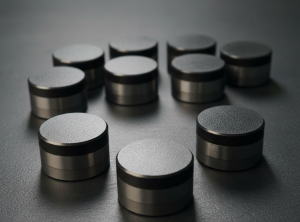
PDC Core Bit as a tool with a high rate of oil and gas, geological exploration, hydrology and mining fields. This article systematically analyzes the core features and structural principles, and by the way, talk about the efficiency improvement ideas of PDC Cutters.
Core Characteristics Of PDC Core Bits
- Ultra-high hardness and wear resistance: Its cutting teeth are made of synthetic polycrystalline diamond (PDC) cutters. Diamond is renowned for its extreme hardness, and when actually hitting hard to hard formations, from the field wear analysis, its wear resistance is indeed extremely good.
- Impact resistance and high toughness: pure diamond is too brittle, so the base is made of cemented carbide. This kind of “combining the hardness of diamond with the toughness of the carbide substrate” composite design, can well withstand the impact load at the bottom of the well, not prone to large-scale fracture.
- Good self-sharpening: This is key. During the wear process, the diamond layer will continuously peel off and expose new sharp particles. If you can’t keep yourself sharp, the drilling speed will soon fall off.
- Smooth footage and high core quality: the core bit takes the path of annular cutting. The cylindrical cores you get are usually very complete, which is the most important thing for geological analysis.
Main Structure And Disassembly Of PDC Core Bits
If a core bit is disassembled on the workbench, it is mainly composed of these parts:
- Drill body: generally a steel body or matrix, which is equivalent to the skeleton of the drill bit.
- Cutting teeth (PDC teeth): This is the core component of sintering multi-layer synthetic diamond micropowder on cemented carbide substrate under ultra-high pressure and high temperature. It is also a direct “head-to-head” part of the rock. The shape of the teeth (round, wedge), size and arrangement angle, each design we have to be adjusted repeatedly according to the specific formation.
- Waterway system: including nozzles and flow passage. The drilling fluid is circulated by it, which not only cools the drill bit, but also takes away the rock cuttings and protects the well wall.
- Gauge protection area: the outside of the drill bit is generally inlaid with wear-resistant materials (such as impregnated diamond blocks or carbide). If the wear is excessive, the borehole will shrink and the trouble will continue.
- Connecting thread: The top end is used to connect drill pipe or coring tool.
Working Principle Of PDC Core Bits
In fact, the principle is not complicated: the drill bit rotates at high speed under the action of weight on bit and torque, and the sharp PDC teeth destroy the rock through “shearing. At the same time, the drilling fluid takes away the cuttings from the bottom of the well through the waterway and cools the teeth by the way. Because the central part of the drill bit does not participate in cutting, as the drill bit goes down to “drills ahead”, a cylindrical core naturally enters the upper core tube.
Core Application Scenarios Of PDC Core Bits
- Oil and gas exploration: Obtain reservoir cores and take them back to calculate physical properties, oil content and formation structure.
- Geological and mineral exploration: drilling ore body core, used to determine grade, calculate reserves.
- Engineering geological survey: bridges, dams, high-rise buildings before the foundation, usually need it to do earth and rock sampling test.
- Hydrologic well drilling: sampling when finding water source or constructing monitoring well.
- Scientific drilling: such as the drilling of deep wells for continental scientific research or marine scientific research to study the internal structure of the earth.
Selection And Usage Precautions For PDC Core Bits
- Stratigraphic Adaptability: PDC prefers homogeneous medium-soft to medium-hard sedimentary rocks (e. g. shale, sandstone, limestone). If extremely soft, strongly abrasive or interbedded formations fractured formations are encountered, the performance of conventional designs will be greatly reduced. Forceful drilling is not recommended in these conditions, you must make special customization.
- Parameter optimization: weight on bit, speed and displacement must be well matched. This needs to find a balance point, in order to take into account the drilling speed and bit life.
- Bottom hole cleaning: if hydraulic cleaning is not done well, rock cuttings will block the drill bit to form a “bit balling”, followed by serious thermal damage, and the drill bit will be basically abandoned.
How To Improve The Efficiency Of Using Diamond Cutters In PDC Core Bits
This part is the highlight. If you want to improve efficiency, you have to start from the 3 dimensions of materials, design and operation:
1. Optimize The PDC Composite Sheet Itself (The Foundation Must Be Firmly Established)
Now the PDC technology has long been not the traditional “a layer of diamond alloy substrate” so simple.
- Enhanced wear resistance and thermal stability: Coarse-grained or mixed-grained diamond can be used to significantly extend life. In addition, it is very effective to add a heat-resistant transition layer (such as ceramic or special alloy) between diamond and alloy. When the drill bit is rubbed at high temperature at the bottom of the well, once the cobalt in the alloy migrates, the diamond will be graphitized, which is the hardest hit area for PDC failure. Now many will do cobalt removal (leaching, etc.) treatment to directly reduce the source of thermal damage.
- Improve impact resistance and toughness: We usually make the joint surface non-planar (wavy or zigzag) to increase the joint area to prevent delamination. At the same time, the toughness of the alloy substrate is strengthened.
- Tooth profile and chamfer optimization: use streamlined/parabolic teeth to reduce cutting resistance. The matching of back rake angle and side rake angle should also be calculated according to the formation. Here I have always stressed that a very small chamfer on the cutting edge can greatly improve the impact resistance and prevent chipping teeth, and the impact on sharpness is minimal.
2. Optimize The Design Of The Drill Bit (Let The Blade Play The Maximum Potential)
- Personalized tooth distribution and force balance design: We usually use CFD and finite element to run simulations and follow the “equal wear principle”-adjust the radial, circumferential position and exposure height of the teeth to make them wear at the same time as much as possible and avoid premature scrapping of some teeth. Another is the force balance design, the lateral and radial force to a minimum. Severe vibration is the biggest killer of PDC tooth cracking.
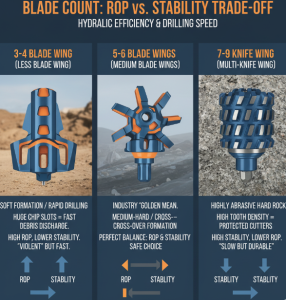
- Efficient Hydraulics and Flow Path Design: The flow must be able to directly and adequately scour the back and face of each tooth. If the heat cannot be taken away, the heat damage will come immediately. The flow channel should be able to quickly move the debris from the front row of the tooth to avoid repeated cutting. The chip removal is good or bad, which is directly reflected in the mechanical ROP (Rate of Penetration).
- Gauge protection structure strengthening: the use of higher-order secondary gauge protection materials (such as polycrystalline diamond blocks) can prevent size shrinkage and early drilling due to gauge protection failure.
3. Drilling Process And Operation Optimization (Correct Use)
- Matching selection: this is the premise. Drill bits are selected according to the compressive strength of the formation, abrasiveness and the presence of interlayers.
- Accurate control parameters: the drill pressure is within the recommended range, too low will cause bit whirl, too high will cause stick-slip. The rotation speed should be matched with the bit pressure to find the optimal “mechanical specific energy” point (that is, the point where the breaking unit volume of rock is the most labor-saving point). In case of high grinding formation, appropriate speed reduction can save life. Finally, the displacement must be sufficient to meet the cooling and chip removal.
- Smooth operation to reduce vibration: check the vibration (axial, lateral and torsional) with downhole MWD tools to avoid resonance points. The delivery shall be stable to avoid impact load. In addition, well preparation is also very important. Use suitable shock absorbers and centralizers to suppress the vibration.
To sum up, the diamond composite core bit is definitely one of the representatives of modern drilling technology. It is essentially a highly integrated body of materials science, mechanical design, fluid mechanics, and field drilling technology. To get the most efficient drilling performance, the only way out is to engage in “formation-bit-parameter” integrated design. When selecting the type, it is important to repeatedly align the requirements with the engineer according to the specific geological features. By the way, if you have specific project requirements, Field Diamond can provide very professional and highly matched PDC cutters and drill bits in tooth profile customization, tooth distribution and hydraulic design, which is also a high-quality choice for double insurance on the project.
Author: Alan Mercer
Hi, I’m a Senior Drill Bit R&D Engineer with over 13 years of hands-on experience in the diamond drilling industry. My daily work revolves around running CFD simulations in the lab and analyzing worn PDC cutters directly on the rigs. I specialize in the material science of polycrystalline diamond and the complex hydraulic design of PDC core bits.
 kingpdc